| What: 1–2–3 As One: A Japanese-South African Butoh Experience Featuring: jackï job, Mitsuyo Uesugi and Yukio Suzuki When – performances: December 5 and 6, 2025 When – masterclasses: Masterclasses: December 8–9, 2025 Where: The Little Theatre, Hiddingh Campus, Cape Town Tickets: R350 Bookings at Quicket |
Butoh’s darkness is “a potential state from which light can emerge”, muses jackï job who is presenting 1–2–3 As One: A Japanese-South African Butoh Experience in December 2025. There are performances and masterclasses, featuring job and Japanese Butoh artists, Mitsuyo Uesugi and Yukio Suzuki. “It is is not just a performance; it’s a celebration of individuality, collaboration, and the creative dialogue between cultures”. This groundbreaking event is the first Japanese-South African Butoh experience. “The performances and series of masterclasses is a new beginning to promoting Butoh’s spirit for trans-disciplinary research and cross-cultural dialogue in Africa”:
TheCapeRobyn: Can you tell us about your Butoh journey? You lived in Japan from 2003-2011 – for eight years? https://www.on-curating.org/issue-49-reader/butoh-and-the-third-space-inhabiting-difference-and-difficulty-in-academia-and-the-performing-arts-in-south-africa.html What were you doing in Japan? Teaching and performing?
jackï job: Prior to relocating to Japan, I spent ten years in South Africa working as an independent choreographer and performer. In Japan, I continued to advance my independent practice by creating new choreographic works and producing performance projects. Additionally, I adapted my creative methodologies into structured coursework and workshops, which I delivered at several universities and community-oriented educational institutions.
TCR: From the above – “Butoh and the third space” – I gather that when you returned that you felt outside of the national narrative of “national-identity propaganda, namely, ‘Simunye, We Are One’” Butoh provided you with tools to navigate difference, within a liminal and fluid framework? Has Butoh ignited t “a new dance language created from the notion of rebellion against the established order”?
jj: Before living in Japan, I had already established a practice with a well-developed signature in solo performance. Experiencing Butoh allowed me to further expand and refine the expression of my dance vocabulary and concepts. Conceptually, the notion of Simunye challenges me, as I am drawn toward more layered and nuanced configurations of identity, resisting fixed definitions or singular descriptions. I prefer to focus on subtleties, contradictions, and differences to cultivate richer understandings of personhood and transformation.
TCR: How did this Japanese-South African Butoh Experience come about – your collaboration with celebrated Butoh artists Mitsuyo Uesugi, Yukio Suzuki?
jj: Our paths crossed on various occasions over the years, but we never had the opportunity to work together. 1-2-3 as One marks our first collaboration.
TCR: In addition to masterclasses, there will be a performance on Dec 5 and 6. Can you tell us about the performance? The three of you will be performing? And can you talk about the title about the experience- 1–2–3 As One: A Japanese-South African Butoh Experience.
jj: When I first returned from Japan in 2011, I co-produced a Japanese-South African dance collaboration, Two As One, with Japanese artists – contemporary dancer Kenshi Nomi and taiko player Hidano Shuichi – with South African artists, soundscapist Garth Erasmus and myself. The title 1-2-3 As One nods to this production. The title also mirrors the structure of the production. In the first half of the show, three solo performers each take the stage, before coming together in a shared, collaborative piece in the second half. Similarly, the masterclasses follow this structure: each performer leads a session, giving participants a chance to explore their individual approaches, and then all three join forces in a final class, co-taught by Mitsuyo Uesugi, Yukio Suzuki, and myself. 1-2-3 As One is not just a performance; it’s a celebration of individuality, collaboration, and the creative dialogue between cultures.
TCR: Butoh conjures up darkness and stillness for me, repose. I don’t know much about it so have done my best to do some research. I see that he two Kanji characters that form Butoh (舞踏) translate to dance and step, although it was originally called ankoku butoh (暗黒舞踏), ‘dance of darkness’. Can you give insights please? It goes back to what drew you personally to Butoh – as different from other dance forms – and how you have drawn from it as an artist working in Africa- working in the context of Eurocentric dance forms like classical ballet?
jj: Butoh frees the body from hegemonic Western forms, and in so doing reveals and renders alternative narratives and movement expressions with value. In my understanding of Butoh, the concept of light is not in binary opposition to darkness. Rather, light constitutes part of the dark, and both worlds seep into the other to create a wide palette of shades. With delving into Butoh, binaries such as seen in race and gender have multiple possibilities which include convergence, divergence, as well as dissolution. Butoh thus becomes a strategy to actively confront precepts of the body and systems of identification. The darkness is a philosophical state of being that potentially provokes and awakens alternative ways of seeing or understanding oneself, others and the surrounding world. For me, Butoh’s darkness is thus a potential state from which light can emerge.
TCR: Anything else to add about this exciting experience – the masterclasses and the performances.
jj: This performance is the first Japanese-South African Butoh experience, seeding a new research initiative that is backed by the Faculty of Humanities and the Japanese Embassy in South Africa. The performance will be officially being opened by the Japanese Ambassador, His Excellency, Fumio Shimizu. The performances and series of masterclasses is a new beginning to promoting Butoh’s spirit for trans-disciplinary research and cross-cultural dialogue in Africa.
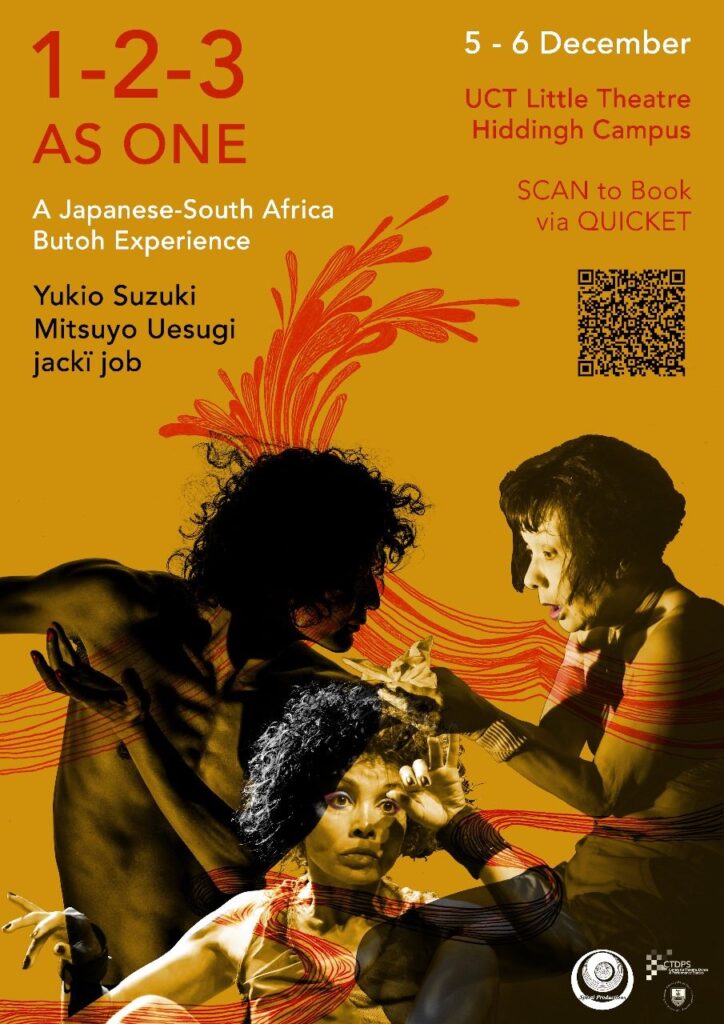
❇ jackï job is presenting 1–2–3 As One: A Japanese-South African Butoh Experience in Cape Town, featuring job, and Japanese Butoh artists Mitsuyo Uesugi and Yukio Suzuki. Performances are from December 5 and 6, 2025 and masterclasses are from December 8–9, 2025.