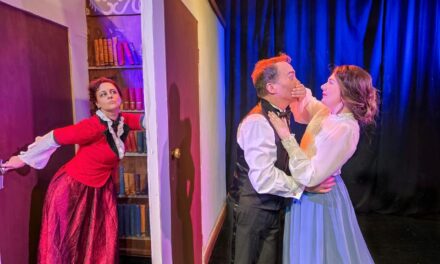
| What: The Glass Menagerie / Speelgoed van glas When: The Glass Menagerie is on July 31 to August 7, 2025. Speelgoed van glas is on August 8 to 16, 2025 Where: Baxter Flipside, Cape Town Directed, translated and designed by: Nico Scheepers Cast: Anna-Mart van der Merwe, Carla Smith, Ben Albertyn and Mark Elderkin Tickets: R160 to R210 at Webtickets Age restriction: 13 with parental guidance Duration: 110 minutes |
𝐓𝐡𝐞 𝐆𝐥𝐚𝐬𝐬 𝐌𝐞𝐧𝐚𝐠𝐞𝐫𝐢𝐞 on in the Baxter Flipside – July 31 to August 7 and then also in the Flipside – will be 𝐒𝐩𝐞𝐞𝐥𝐠𝐨𝐨𝐝 𝐯𝐚𝐧 𝐠𝐥𝐚𝐬 – August 8- 16. Both productions have been directed, designed and translated by Nico Scheepers, from the play by Tennessee Williams. Masterful and exhilarating theatre.
I saw, The Glass Menagerie last night, August 8. I missed the opening and media night, so this is a shout-out to go and see this masterful reimagining of the classic play with outstanding performances by Anna-Mart Van der Merwe, Carla Smith, Ben Albertyn and Mark Elderkin. Scheepers has set the play in South Africa in the 90s when the “country was holding its breath.” [See interview: https://thecaperobyn.co.za/interview-unique-dialogue-between-language-memory-and-performance-with-glass-menagerie-and-speelgoed-van-glas/] The location is an inner city suburb in Cape Town with a family tethered together in mutual disappointment, a co-dependency of sort of love, simmering with loathing and resentment. The exhilarating production is two hours (no interval) and yet it feels much shorter. Wow – do not miss.
The genesis of this season goes back to the Afrikaans adaption that Scheepers presented at Woordfees in 2024. The acclaimed production won awards. For this season at the Baxter, Scheepers translated his Afrikaans version, into English, retaining aspects of Afrikaans language and Saffa-isms and the central concept of an Afrikaans family, visited by an English visitor. The English and Afrikaans versions are being presented in repertory at the Baxter. The Baxter commissioned the English version. The same actors perform in both versions. See interview for more on the two language versions.
The references are period – 90s in South Africa- VHS videos, a telephone on a long extension cord, stacking/nesting tables, a cigarette table with ash tray but it feels like it is right now – with a delusional mother kibitzing her adult children, terrified of what is to come, with memories of the past and her absent husband; their dad, triggering them all to somehow avert a further decline for the future.
I am trying to imagine where this white Afrikaans family might have lived in the 90s- Salt River, Woodstock, perhaps Wynberg. Cape Town’s South is pinging for me. One of those suburbs would make sense as there is the Paradise Club across the road – with a disco ball. It was a dance hall in the Williams play. It “works” brilliantly and makes sense with the text and the staging.
The adaptation is extraordinary. The brilliant Anna-Mart van der Merwe plays the mother of the family, the disappointed and desperate Amanda Wingate (pronounced Amunda as in Afrikaans) who was once courted in the by wine farmers in Wellington. She married for love –a postman (a phone man in the Tennessee Williams original) who skipped out and went long distance. The last that the family heard from him was that he was in Mozambique.
The husband/father has ghosted them. His image dangles in the home, peering at them. He escaped. They didn’t. They are trapped in the coffin of their existence. That is all in the Williams text and so is the ghostly presence of Tom (Ben Albertyn) who is narrator and a character – of the past as he remembers it in its fallibility – and in the present as he looks back and the events that led him to escape from his job as a mechanic in a garage and follow in his father’s footsteps. He is watching long distance as his mom and sister, Laura (Carla Smith) cling to each other in increasing penury and desperation in a narrative that he has set in motion which doesn’t end well.
Laura has a physical disability which she and Tom acknowledge – her status as a “cripple” but Amanda does not. Clearly they are crippled by life. The last hope of being saved is dashed by the visitor – the gentleman caller – Jim. He is English speaking (Mark Elderkin) and works as a manager where Jim works as a mechanic. Jim is the a blast from their past. He was once a star but has fallen on bad times but as he says he may be disappointed but he is not discouraged. Jim and Laura knew him when he was a star and I think that makes them feel less bad as they see how the mighty have fallen but the visitation is transitory. Jim steps into the ambit of the bickering family but is able to leave, armed with a souvenir, broken unicorn from Laura’s, collection of glass animals which she fiddles with when she is not reclining on the carpet, immersed in watching Disney animated films, lured by the illusion of happiness.
It is all illusionary – life – and this comes across vividly in this production as we gaze through the fugue of Tom’s chain smoking. The production is cloaked in sfumato – a haze of smoke. Tom tells us at the start: “I have tricks in my pocket – I have things up my sleeve – but I am the opposite of the stage magician. He gives you illusion that has the appearance of truth. I give you truth in the pleasant disguise of illusion.”
What I found extraordinary about this re-imagining of the Williams play is how it stands alone as a text in its own right, evoking a potent portrait of an unhappy white Afrikaans family, perching on the cusp of change in South Africa which “was matriculating from a school for the blind. Their eyes had failed them, or they had failed their eyes, and so they were having their fingers pressed forcibly down on the fiery Braille alphabet of a dissolving economy.” They have been flattened by life and the choices made.
Scheepers’ design echoes that – flattening the design – by doing away with the height and fire escapes that Williams put in for his stage directions. It works as the protagonists step on and off the rostum – with Laura falling at one point. Brilliant performance by Carla Smith, with a lagging gait which conjures up disability through physical theatre, without a brace or mobility aid.
Scheepers presents a stripped back Glass Menagerie, with some snips to the text. The symbolism that Williams loves is not foregrounded. Blue for example is a leitmotif in Williams work and symbolic. Yes, Amanda wears a blue dress in the scene when Laura’s caller arrives but it looks like the dress was bought on hire purchase at Truworths or Edgars when it was around. The story is foregrounded in this production. The frippery and artifice of Amanda as the fallen matriarch who was once glam and fab has given way for the disheveled helicopter parent trying to keep a tight leash on her adult children, auditing their eating and sitting habits, never letting up. She drives them crazy and embarrasses them, although she means well. This production is achingly relatable in its contemporaneity of the not so distant past of this country – our memories of what was – what is and what will be and within that how we navigate our relationships. It is also very funny. I loved the way the humour is teased out.
✳ The Glass Menagerie / Speelgoed van glas at Baxter Flipside, Cape Town, 2025.