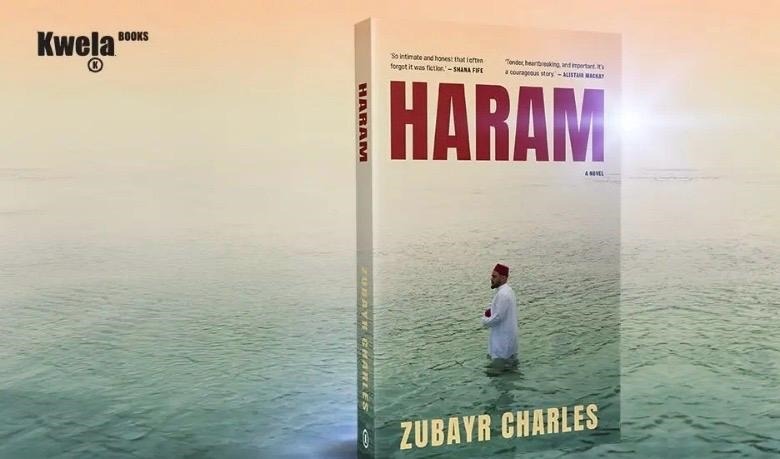
| What: Haram – novel by Zubayr Charles Release date: January 2026 Publisher: Kwela Books (Jonathan Ball) Instagram: https://www.instagram.com/zubayrcharles/ |
Haram – the novel by Zubayr Charles is a wistful and elegiac coming-of-age novel set in a Muslim community in Cape Town. It is a community, where everyone knows each other. They watch over each other; watch each other and watch each other being watched, judged. The scrutiny is intense, unwavering, claustrophobic, unbearable at times.
The protagonist, Muhammad is the dutiful son, following rules and regulations, following daily rituals. His mother, abandoned by his father, works long hours as a nurse and is largely absent. She is clearly trying to hold things together financially. Emotionally, that leaves her son Muhammad to his own devices. For the most part, he hangs out with Kaashief, his “only cousin” from his “unknown father’s side”. Kaashief is he admits, basically his only friend. And he needs a friend at this time.
The novel opens in 2012, with the peregrinations of Muhammad as he explores sexuality and identity. This is framed against the scrutiny and judgement of his community, family and friends. The narrative comes to a head, four years later, in 2016, with the marriage of Muhammad. I won’t plot spoil as to who he marries and how he gets to that point as he navigates his “coming-of-age” against the pervading ostracism in his landscape. Muhammad wants to love, be loved and feel safe. The ostracism by his community leads him to self-destruct in terms of substance abuse and addiction, by finding solace and anonymity in clubbing in Cape Town. In the dark, in the thrall of the thump of noise and booze and vomit, boundaries fall away to hangovers and remorse.
The moral censure of Muhammed is evidenced throughout as he grapples with being the good son, pushing back at the ties that bind him but at the same time, acknowledging the rituals which he enjoys and which have shaped his life. Even when he has apparently turned his back on incantations, he finds himself chanting and evoking rituals, almost subconsciously. I love the way Charles brings that into his writing – that our identities – religious – cultural – social – remain ingrained and imbedded – even when we disavow aspects. Muhammad admits: “Allah was still a part of me despite my wanting to ignore his presence.” Muhammad “goes to mosque for penance” and falls asleep. Insert “synagogue”, “church” for “mosque” in that line and I think many people can relate. A great image – which reverberates with tenderness and comfort – transcending censure. Love that.
In addition to the heart-breaking coming-of-age story, Haram is also a vivid evocation of a time, with beautifully nuanced and crafted prose by Charles. The setting of 2012 was just prior to the explosion of social media and smart phones in South Africa. It was the time of when Blackberry mobile phones were hugely popular in South Africa. I had forgotten the thrall of that Blackberry keyboard and BBM friend requests. For context, I looked up and see that in “2012, Blackberry was the dominant smartphone brand in South Africa, holding roughly 4.8 million out of 10 million smartphones, largely driven by the popularity of BBM (BlackBerry Messenger) and affordable BIS (BlackBerry Internet Service). It was voted the ‘Coolest Brand Overall’ in the 2012 Sunday Times Generation Next Survey, with the Curve 8520 as a top-seller.” Source https://businesstech.co.za/news/mobile/5343/why-blackberry-dominates-sa-smartphone-market/ The Blackberry was the primary medium of communication. It was WhatsApp before WhatsApp and we are taken along with Muhammed as he strokes and caresses his Blackberry, finding solace and hope, through the device.
In Muhammed’s life of 2012, there are numerous references to ordering “a cab”, limited references to Facebook but no references to Instagram. When the narrative reaches its climax in 2016, Instagram is in the frame of Muhammed’s life and so is Uber. (Instagram was introduced in SA between 2012 and 2016. Uber was officially introduced in South Africa in August 2013). The bookending of 2012 and 2016 is fascinating.
Circling beyond the time frame in the narrative, the destructive behaviour of getting wasted in Cape Town’s party land is not just pushback against communal prohibition. Muhammad hangs out with a bunch of toxic individuals. They are not nice people. The hook-ups become a web that bind him in another way. He seeks belonging, sexual gratification, community, but this world ultimately doesn’t give him comfort or safety – just a sense of self-loathing. In terms of mental health, it is not a happy state at all. I would have liked this to have been fleshed out more in the novel – the toxic masculinity and toxicity of relationships, deception, ghosting in the clubbing landscape.
In his quest to live a life true to himself, an authentic life, Muhammad gets locked in to another world, with its rituals. And to rise above that? What’s his way out? Read the novel. Haram surprised and intrigued me – in a good way. Muhammad’s story is a cautionary tale, a call out to live “a peaceful life without the struggles of living a double life”. But there is a reality check and the acknowledgment that some choices are made because of a whole bunch of complex reasons. Ultimately we don’t know about Muhammad’s “happily ever after” and how his life will pan out. As Zubayr Charles reflects in his acknowledgment in the book: “May we all continue to heal and have compassion towards others. We don’t have to agree with each other, but we must never spew hate”. Amen to that.
I thoroughly enjoyed reading Haram – twice – once for “what happens” and again to get the thrust of the yummy, full bodied writing (example “lips tasted like strawberry Zambak and cheap Sambuca”) and the intersection of 2016 as it impacts against events of 2012, the desire to love, belong and feel safe. Haram reverberates against the city of Cape Town; achingly beautiful and complicated, like its protagonist Muhammad who yearns for much more than a “rehearsed cover story”. Zubayr is brave and courageous in his gaze. He is also wise and writes beautifully.