| What: Far Gone Where and when: Baxter Theatre, Cape Town, November 11–15, 2025 Joburg Theatre, Johannesburg, November 19–22, 2025 Writer/performer: John Rwothomack Director: Mojisola Kareem Producer: Roots Mbili Theatre Bookings: www.webtickets.co.za |
When he was eight, John Rwothomack was “nearly kidnapped” in Uganda by the LRA (Lord’s Resistance Army). His play, Far Gone inspired by his experience, is touring South Africa. It is the first time that the play is being staged in South Africa and he it feels like he is bringing the story home – to Africa. “The story was always rooted on the continent, so in a way it feels like it finally has the audience it was meant for.” Far Gone is on at the Baxter Theatre, Cape Town, November 11–15, 2025 and the Joburg Theatre, Johannesburg, November 19–22, 2025:
TheCapeRobyn: Is this the first time the play will be performed in South Africa?
John Rwothomack: Yes, this is the first time Far Gone will be performed in South Africa, which is incredibly meaningful for me. The first version of the show was staged in 2018 in the UK, then again in 2019. We had plans to tour more widely, but the pandemic stopped everything in its tracks. We picked things up again in 2022 with another UK tour. The only time the show has been performed on the African continent was a short festival appearance in Uganda in late 2019. So yes — this is the first proper international tour and the first time audiences across Southern Africa will see the full production. It feels like bringing the story home in a way.
TCR: Can you tell us a bit about your story and background?
JR: The near-kidnap happened when I was eight, in Uganda, not far from where my family lived. That moment stayed with me my whole life, and eventually became the spark for Far Gone. I moved to the UK as a young adult to study, and I’ve been based in Sheffield ever since. Being a Black African artist in the UK is a mixed experience — you’re grateful for the opportunities, but you’re also constantly aware of how easily your story gets misunderstood or flattened. That’s partly why I started writing and performing my own work. Sheffield has been kind to me though; it’s become a second home, and a place where I’ve been able to grow as an artist without losing connection to where I come from.
TCR: Have you shifted anything in the text for South African audiences?
JR: I haven’t rewritten the piece, but I’ve definitely adjusted the way I deliver certain moments. South African audiences sit much closer to the realities the play deals with — politically, historically, emotionally. You don’t have to translate certain things here; people understand the undercurrents instinctively. In the UK, I often had to hold the audience’s hand through some of the context because they’re viewing it from the outside. Here, I can lean into the truth of it more confidently. The story was always rooted on the continent, so in a way it feels like it finally has the audience it was meant for.
TCR: Does performing the horror of the story allow you to transcend the pain? And how does Roots Mbili fit into this?
JR: Telling this story every night is emotionally hard, but there’s a strange healing that happens when something painful is witnessed properly. Theatre gives shape to things we usually avoid looking at — especially the idea of children being forced into war. People think because Africa is “closer,” we’re more used to these stories, but often it’s the opposite: we distance ourselves because it hurts too much. With Roots Mbili, our aim is to create a space where these truths can be held honestly, without sensationalism and without judgement. My play doesn’t offer easy hope — it’s not a romance or a coming-of-age story — but it does offer humanity. And for children whose stories were cut short, sometimes humanity is the only form of justice we can still give them.
TCR: Can you talk about how susceptible children are as soldiers?
JR: Yes, yes, of course. And scary is like the perfect word to use for this. Children, humans, become the result of the adults and the examples around them. There is nature and nurture. Yes, nature is there, there are personalities and all that. But really, it’s the nurture, it’s who is around you, the things you see, the culture you grow up in, the things you see that are acceptable. You start learning those things, and they inform what kind of person, what kind of character you become.
These children are being taken at a very crucial point, knowingly, by these grown men, at a point where they’re still too young to fully understand what their moral compass is. That’s not fully formed yet. They’re young enough to not quite know that, but old enough to be strong enough to be trained. So physically they have some strength, but mentally their capacity can still be controlled. And that’s when these abductions normally happen. Because if the teenagers are 16, 17, 18, that’s much harder. But at 10, 11, 8, you’re still forming…
“It’s very, very scary. Extremely scary. And organizations like these [like the LRA], only operate because children are not yet fully formed in terms of their psychological and moral identity. That’s not yet fully formed, but physically they are strong enough to be trained. This is where they come in, at that very crucial point in a child’s life, and they completely derail it and change it…
“And I hope this is where art can come in and reflect what’s happening and how ridiculous and stupid it actually is. I hope we’ve done that. I really hope we’ve created something that can reflect a mirror to the world, which I believe right now is quite an ugly place to be.”
TCR: Insights into the design — set, costume, lighting, sound?
JR: The design is intentionally stripped back. The set gives me space to shift between characters and memories quickly, almost like stepping into different rooms of the same past. The costume is simple but functional — it allows the movement work to breathe. Lighting is a huge storyteller in this show; it shapes mood, time, and tension with very minimal elements. And the sound design carries the heartbeat of the piece — the environment, the fear, the humour, the silences. Everything is designed to support the story without getting in the way of it.
TCR: Anything else to add?
JR: Only that I’m incredibly grateful to be bringing this work to Southern Africa. It’s not an easy story, but it’s an important one, and I hope audiences will meet it with openness. If the play starts conversations — the uncomfortable kind, the necessary kind — then that’s all I can ask for.
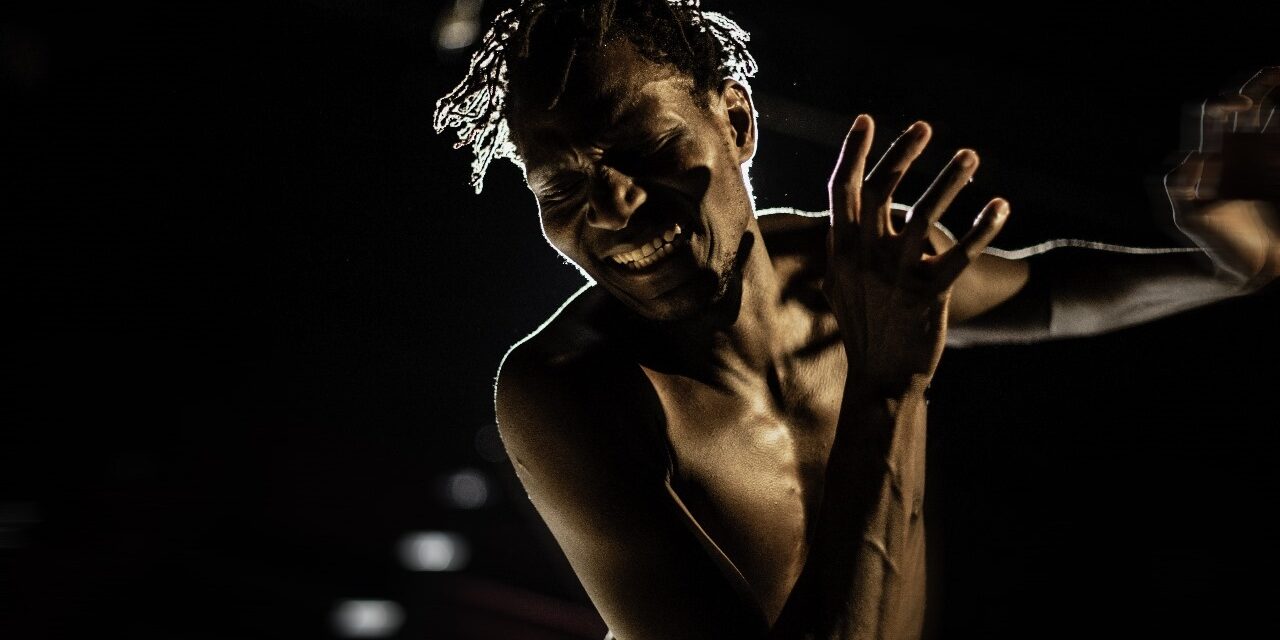
✳ John Rwothomack who has written and performs in Far Gone, which is on its first international tour in South Africa, November 2025, Cape Town and Johannesburg. This interview has been marginally edited for length. Pic: Supplied.