
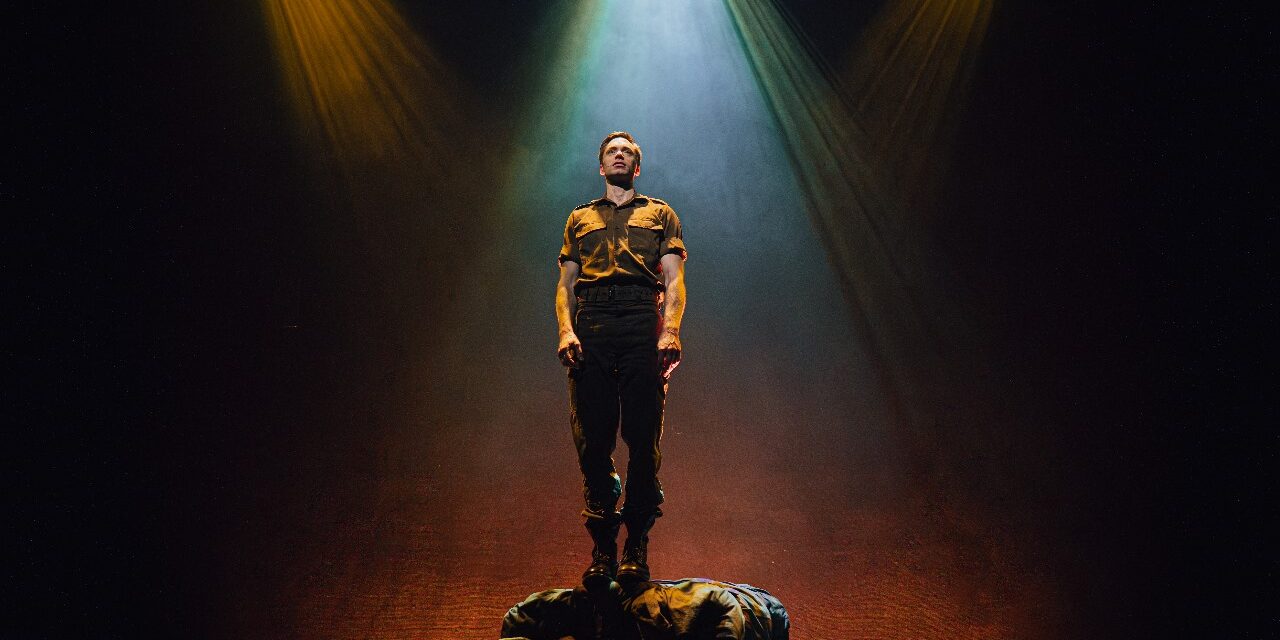
𝐌𝐨𝐧𝐮𝐦𝐞𝐧𝐭𝐚𝐥 𝐭𝐡𝐞𝐚𝐭𝐫𝐞 – 𝐚𝐜𝐡𝐢𝐧𝐠𝐥𝐲 𝐞𝐱𝐪𝐮𝐢𝐬𝐢𝐭𝐞 – 𝐌𝐨𝐟𝐟𝐢𝐞 – 𝐬𝐭𝐚𝐫𝐫𝐢𝐧𝐠 𝐃𝐚𝐯𝐢𝐝 𝐕𝐢𝐯𝐢𝐞𝐫𝐬 – 𝐝𝐢𝐫𝐞𝐜𝐭𝐞𝐝 𝐛𝐲 𝐆𝐫𝐞𝐠 𝐊𝐚𝐫𝐯𝐞𝐥𝐥𝐚𝐬
The Moffie stage – the set (Niall Griffin ) – is a slab of granite – shiny and reminiscent of a tomb stone. On this plinth, sits the protagonist Nicholas van der Swart (David Viviers), who immerses us in his story, getting through his two years of compulsory service as a conscript in the South African Defence Force, from 1981. As a gay man, every step he takes, he has to watch his back that he won’t be found out. He prowls around bags – army kits – dumped in a pile on the slab. It is a mound of stuff – the bags that were carried by Nicholas and his cohort – the baggage that we all carry – from the past. The mound, the pile, reminded me of the Jewish tradition when visiting graves. Stones are left on gravestones – to show that you were there – that you visited – physically – and remember the deceased. It is about memory and commemoration, acknowledgment. For me, Moffie on stage feels sacred. We as the audience in a theatre, are visitors, visiting the site of wounds and horror. But is a consecration, not a burial. Transcending the horror of the story, of war, conscription, toxic masculinity, homophobia, is a story about love, friendship and hope.
Moffie is the stage adaption of the autobiographical novel by André Carl van der Merwe, which was published in 2006 and was developed from notes and reflections he kept in a diary while he was doing his military service, over two years in Apartheid South Africa. As a gay man, a “moffie”, there was the fear of being “outed which would have had led to aversion therapy and other draconian measures by the South African Defence Force. Moffie on stage has been brilliantly adapted by Philip Rademeyer from the novel and not from the 2019 film of the same name, starring Kai Luke Brümmer. Brümmer also starred in the London production.
David Viviers does not just perform Nicholas van der Swart, he inhabits him with a grace, tenderness and a simmering sensuality; fighting a war that he didn’t believe in but was forced to sign up and do his time. It isn’t just a war of being in the army physically and emotionally, Nicholas grapples with the legacy of abuse in his family, by his father and others, the taunts and the loss of his beloved brother. Viviers flawlessly shifts between characters- from perpetrator to the recipient of abuse – I don’t want to say victim – because Nicholas is a warrior – a beacon – a survivor. Therein lies the power of Moffie on stage. It transfigures Apartheid war Border memoir, gay love story. It is visceral and beautiful mediation and visitation in the safe space of theatre.
What I find extraordinary from Viviers’ performance is how he conjures up the lyricism of the book – which transcends horror story – of “anticipated retribution”. Nicholas was always present, in the landscape which defies belief: “Homosexuals are from Satan. No Christian can be homosexual. Evil spirits possess them. I shudder and start praying again. It becomes a mournful plea.” But, within that he can appreciate the sunsets, the beauty of the landscape, the beauty of male bodies; the hope of a better future, love and friendship.
After watching the play, I read the book again and I have been mulling over the stage production as it intersects with the book. I would like to suggest that the two- stage production and book – be viewed as companion pieces. Rademyer’s “adaption” nails the essence of the novel and works fiercely and yet with delicacy, in tandem with the set, costumes and lighting. Seeing the stage production, feels like an extension of the novel.
The set – the slab of granite – tombstone – nest – is a character in the play and so is the soundscape (Charl-Johan Lingenfelder) – helicopter blades, ammunition, birds chirping, needles of records playing, the voice of the mom of Nicholas. His mother “supports” him on “this knife-edge of survival” and “helps” him “balance whenever she can.”
Direction by Greg Karvellas is perfection; holding space for performance and design. Niall Griffin’s design (set, costume, lighting) summons the “smudge of brown army rabble” that is evoked so vividly in the book: “Early on, I realise that the only way to survive is not to stand out – not in front, not at the back but to merge into the middle smudge of brown army rabble.” I was away for most of the run of Moffie at the Baxter in Cape Town and saw it on the last weekend, September 25, 2025. The production was scheduled for a season at Woordfees but was cancelled because of technical issues. I hope that this brilliant piece of theatre will return.
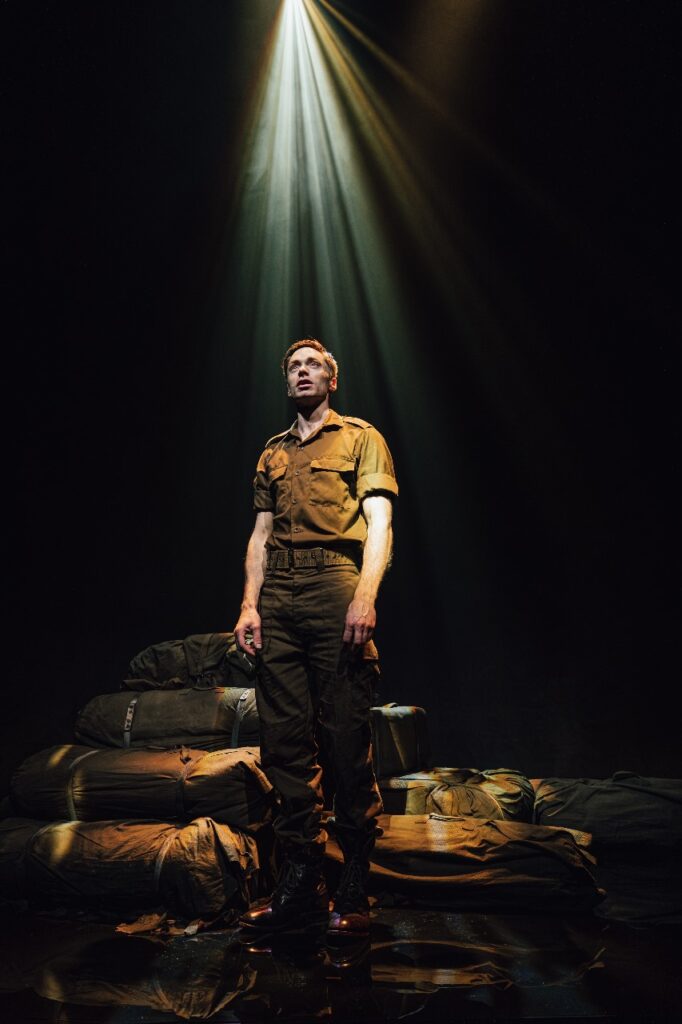
✳ David Viviers performing in Moffie, adapted for the stage by Philip Rademeyer, based on the novel by André Carl van der Merwe. Photo: Daniel Rutland Manners


