
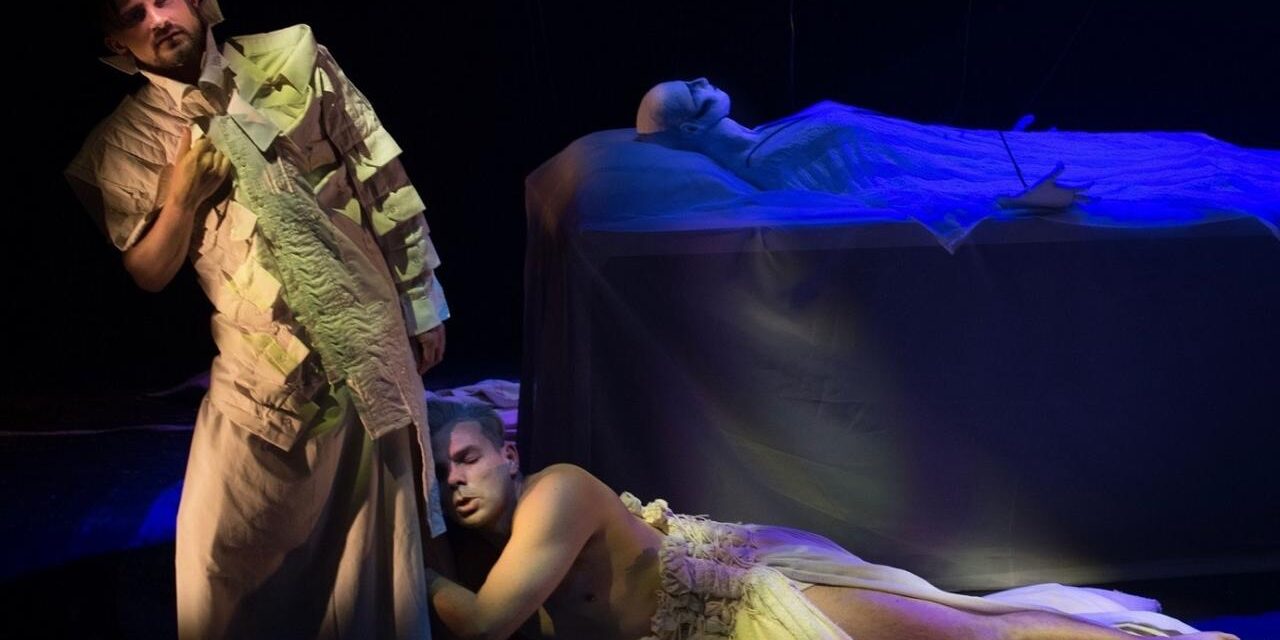
| The Lady Aoi by Yukio Mishima – staged by Abrahamse & Meyer Productions When: Feb 14, 18, 19, 20, 21 2026 Booking: Webtickets Starring: Marcel Meyer and Matthew Baldwin Director: Fred Abrahamse Original score: Charl-Johan Lingenfelder Lighting design: Faheem Bardien Set, costume, puppetry design and construction: Fred Abrahamse and Marcel Meyer |
Yukio Mishima’s The Lady Aoi is on in Cape Town in the Artscape Arena, February 2026, staged by Cape Town’s staged by Abrahamse & Meyer Productions. This award winning production is breathtaking; dark, twisted psychotic and yet beautiful and lyrical. It invites us into another realm, where out of body experiences make total sense as a theatrical experience. Please, do not miss.
The stagecraft (puppetry, minimalist set, cocooned in a Japanese Oshun circle) is exquisite. Marcel Meyer plays the nurse/Rekujo. Mathew Baldwin plays the philandering Hilkaru. Lady Aoi is manifested on stage, through a puppet. The set, costume, puppetry design and construction is by Meyer and Fred Abrahamse. Direction is by Abrahamse and soundscape is by Charl-Johan Lingenfelder
I saw this production in 2021 in Cape Town. It was still during the Covid pandemic, still in lockdown, albeit with slightly relaxed Covid regulations (the season ran November 17 to December 4, 2021). We were masked as we watched which heightened the eeriness and creepiness of the narrative.
It is a mad trip through ghosting, obsession and possession, desire, psychosis. It is “about” unrequited love, regret, toxicity of relationships, unbridled revenge, subjugation of women by men; economically, sexually. It is about mental health and intuitions, the vulnerability of those who are ill and their reliance on society, care givers, the medical profession and that is just the tip of it. In brief: A comatose woman, Lady Aoi (Aoi means blue or azure) lies in a psychiatric hospital. Her husband Hikaru, a businessman/salary man, has been summoned from his business trip to attend to her. (Hikaru means – The Shining one, the one who shines, as in shining warrior). A nurse in the ward toys and flirts with him, while railing on about how nurses are used by the doctors for sexual favours. That is a whole story in itself, embedded in this drama. Then Lady Rekujo – the spurned lover of Hikaru – manifests as a “living ghost” – intent on vanquishing, annihilating. Hikaru had discarded Rekujo for the younger Aoi who had higher social status. His job is more important than his wife (Aoi) as we see when he arrives at the hospital, soaked by rain (early summer rains in Japan). He is clearly irritated that he has had to cut short his business trip.
Mishima wrote the play in 1954. It is part of his Five Modern Noh Plays, in which he gave contemporary resonance to the genre of Noh drama. His contemporary rendition (well, contemporary for 1954), was an adaptation of the Japanese Noh play Aoi no Ue, which was adapted from 11th-century novel by Murasaki Shikibu, The Tale of Genjii. Shikibu was of Japanese nobility. But she was a working woman. While serving as lady-in-waiting in the imperial court and administering to Empress Shoshi, she wrote the Tale of Genjii, which is widely considered as the first novel, globally. Fast forward to 1954, Mishima, the superstar male artist, was writing with Japan taking stock of itself, post-World War II, considering where it ended up as a nation – defeated and disappointed. Mishima was utterly disappointed with Japan – the way she submitted to the new order. He wanted things to be as before the war, with the emperor restored to his position as the leader of the country and as a “living god”.
Mishima was a philanderer, with conflicting identities, sexually and gender wise; a narcissist. He fed off scandal and drama. Multiple threads of his identity were transmuted into his 1954 adaption of Aoi, in that post war period in Japan – Japan after … everything. In 1970, Mishima suicided by seppuku, the suicide ritual of the Samurai. His suicide was part of a failed military coup event. His death, like his work, was heightened, symbolic and dramatic.
Then we have Marcel Meyer and Fred Abrahamse, from Cape Town, South Africa, staging Mishima’s text. The journey began when they were commissioned to present this production, in 2014, by the Provincetown Tennessee Williams Theatre Festival (USA). The production toured and in South Africa was the most nominated South African production of 2021/22, winning Fleur du Cap Awards for Best Set and Best Costume Design.
In an interview in 2021, Meyer mused that it is ghost story and a love story. I am not sure about the love part but I suppose, ultimately, love lingers in this play, beyond the temporal limits of our world. It is a morality tale, a cautionary tale; to let go, to detach from toxic relationships. It is a cautionary tale to marry for love – not because it is socially and economically prudent – and not be shaped by regret.
Within the madness and darkness, it is aesthetically beautiful and seductive. Intricately and richly layered, the production reverberates off the early versions of Aoi – which Mishima referenced and his legacy as “living art work” and the context of Japan, when he presented his version. It is a production that one wants to see multiple times, to take everything in – from the costumes and its symbolism, to the set and to the soundscape. I will stop here as this is already long but have a read here, for more: https://thecaperobyn.co.za/interview-ancient-contemporary-mythic-mystical-the-lady-aoi-staged-by-cape-towns-abrahamse-meyer-productions/.


