
| What: Shakespeare’s Julius Caesar When: Premiere season took place May 22 to 31, 2025 Where: Artscape Arena, Cape Town Cast: Fiona Ramsay (Julius Caesar), Marcel Meyer (Brutus), Matthew Baldwin (Cassius), Tailyn Ramsamy (Marc Antony), Nkosinathi Mazai (Casca) and Thinus Viljoen (Octavius Caesar) Director: Fred Abrahamse Original score: Jaco Griessel Set and costume design: Fred Abrahamse and Marcel Meyer Lighting: Faheem Bardien Producer: Abrahamse & Meyer Productions |
Abrahamse & Meyer Productions’ staging of Shakespeare’s Julius Caesar was a triumph. This audacious new production premiered in Cape Town at Artscape, May 2025. The producers are engaged in negotiations for the production to be staged again. We hope so. Brilliant concept. Brilliantly designed, staged and performed; this is theatre which should be staged widely so that all Friends and Country People can partake of this exhilarating production. The play was tagged by Shakespeare as The Tragedy of Julius Caesar but for me it comes across as heightened political-psychological thriller.
Time and gender is mutable in this adaption. The play is set in three time periods: 1599 (the year Shakespeare wrote the play, against the framework of the Essex Rebellion; 44 BC, the historical setting of Caesar’s assassination and now – 2025.
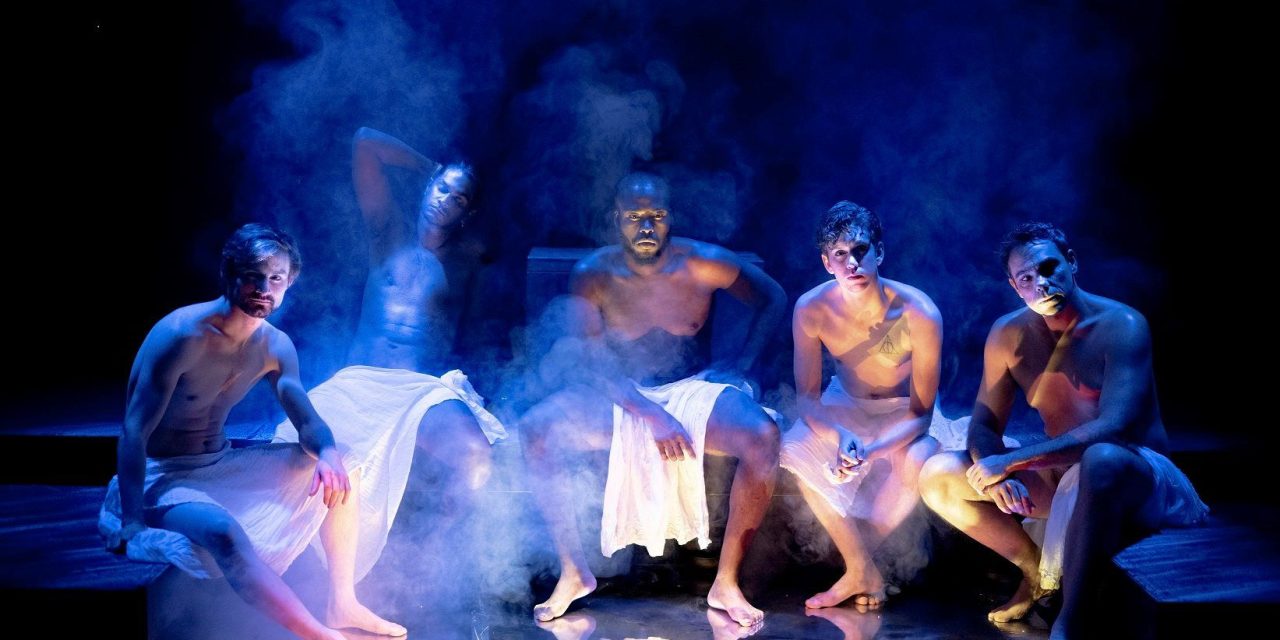
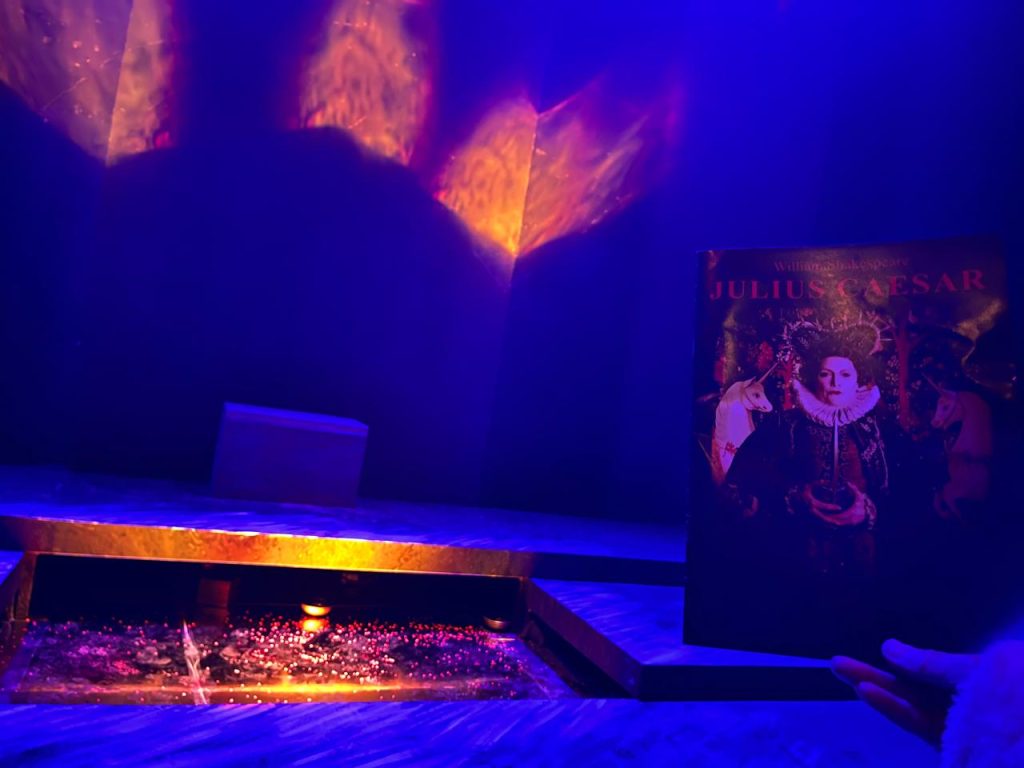
Multi-award winning Fiona Ramsay plays Julius, through the lens of Elizabeth I who was the monarch when Shakespeare wrote the play. There is blood, sweat and flesh in this staging which opens with politicians who are reclining and schmoozing in a Roman bath. As noted in the excellent programme (a keepsake, get one), the bath has not just used aesthetically in this production. The Roman bath was a space where men of all ranks gathered- politicians, merchants, ordinary peeps. I suppose it was the golf course of its day. Without their clothes, uniforms, regalia, it was flesh to flesh in the steamy bath. Remarkably, no water is used in the bath scenes as we saw afterwards, when the performance was over. Meyer explained everything is evoked through a mirrored floor, which lighting designer Faheem Bardien “then lit brilliantly with moving lights to give the reflections a beautiful sense of motion.” He added: “Combined with smoke and haze, it created a wonderfully atmospheric effect. And when the mirror was lit from a different angle, it cast striking patterns onto the angular back wall — adding another unexpected visual dimension to the scene.” It is all illusion and pure theatrical magic.
As far as Marcel Meyer can ascertain, the play has not been staged in Cape Town, since 1976. I have seen films but this was my first experience of this play on stage. I have always been flummoxed by the historical assassination of Caesar and Shakespeare’s interpretation in his play. I get that Caesar was not able to read the room and that he was not tuned in that there was trouble brewing, that there was so much disloyalty around him and how fickle people are in terms of loyalties, but so what? I could never fathom if he was a goodie or baddie. His crime, according to Marc Anthony was that he was too ambitious. Watching this production and I was torn between feeling sorry for him and for feeling contempt. Meyer replied to my sense of uneasiness that this production evokes: “Exactly. I believe the most powerful productions of Julius Caesar are the ones that leave the audience genuinely debating whether the assassination was justified. If Caesar is portrayed too overtly as a tyrant — a Hitler-like figure — it simplifies the moral dilemma. The decision to kill him should never feel easy, either for the conspirators or for the audience. Everything in the play should feel precarious, with the stakes impossibly high. The more the audience — like the people of Rome — can swing between loyalties, the more vital, urgent and intense the drama becomes.”
Julius Caesar is both a political thriller and a tragedy, reflects Meyer. “But as a tragedy, it stands out within the Shakespeare canon: it’s the only true ensemble tragedy. Unlike Hamlet or Macbeth, it doesn’t follow the arc of a single tragic hero. Instead, multiple characters — Caesar, Brutus, Cassius, and even Antony (especially when viewed through the lens of Antony and Cleopatra) — all carry the weight of tragic consequence. Even the city of Rome itself emerges as a central tragic figure, caught in the struggle between ideals and ambition, order and chaos.”
Julius tends to have a big cast, with the people of Rome, very much part of the narrative but in this production, there are only six actors and we the audience become the people. Our place is made clear, when the bright lights are switched on during the two famous speeches and we are caught in the stark glare of the lights. I felt like I was at a political rally and that cameras filming the action were pointed at us, with bright lights. I was startled, jarred, jolted when the lights came on. Meyer: “By lighting the audience during the two pivotal oration speeches, we invite them directly into the action. This choice makes those speeches feel immediate and urgent, allowing the audience to truly inhabit the role of the Roman crowd — to listen, to judge, and to decide where their allegiance lies: with Brutus or with Marc Antony.”
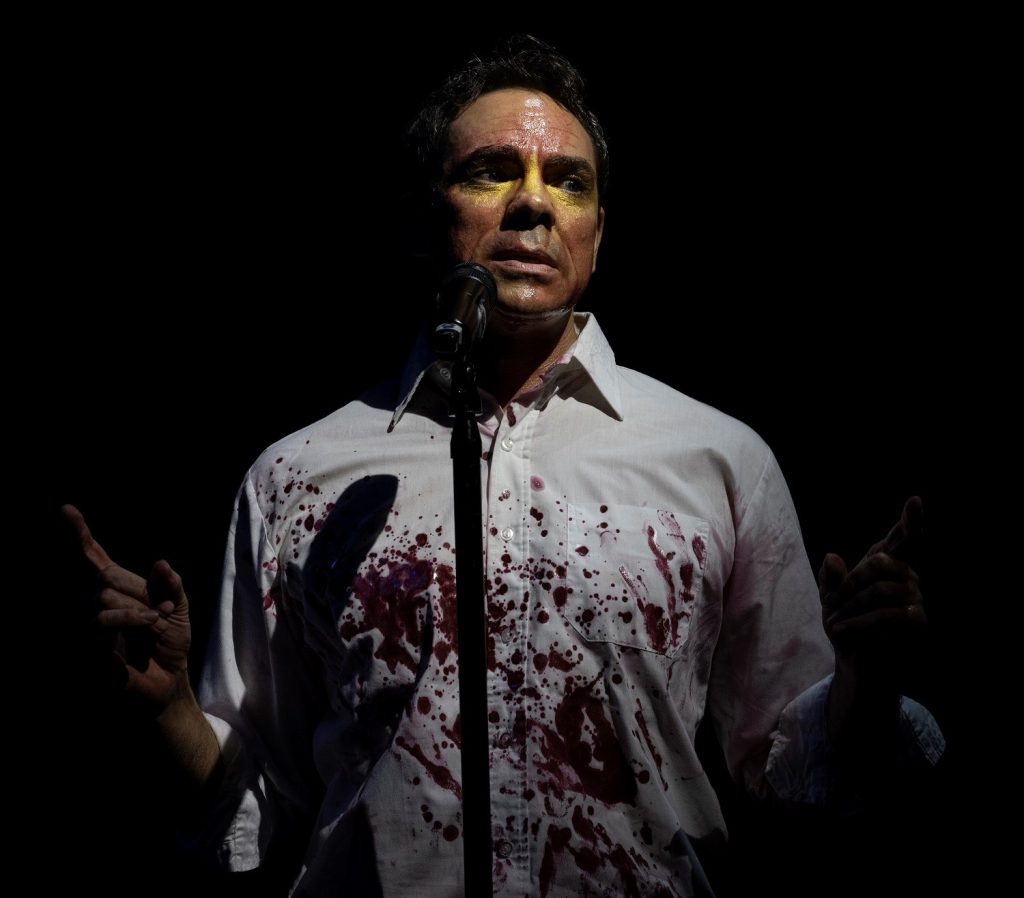
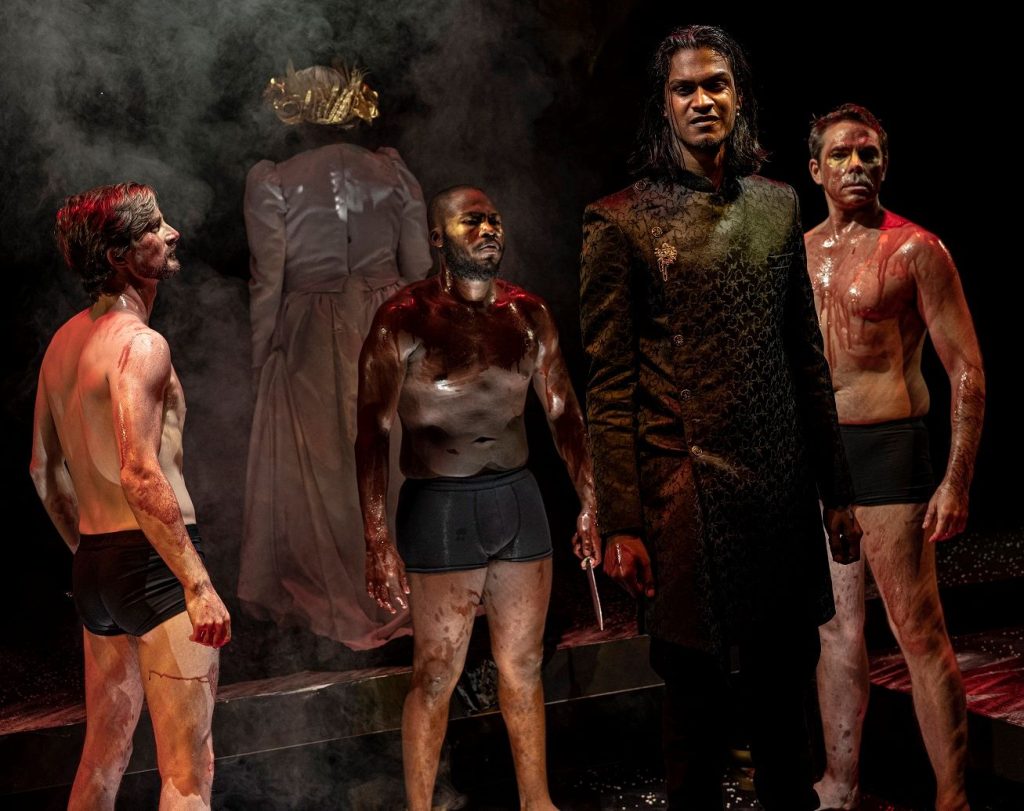
The chaos of this adaption manifests on stage as the players become progressively bloody and sweaty. Some of the characters are garbed in SPQR hoodies. SPQR – Latin -Senatus Populusque Romanus, translates as The Senate and the People of Rome. Noble words. But are they law-abiding democrats, or just a mob of thugs, easily swayed? SPQR is still an official emblem of the municipality of Rome in contemporary times. With the SPQR hoodies, I got a deep sense of foreboding of thugs in hoodies. I thought of politicians giving out t-shirts to their constituents.
The entire cast is extraordinary – with every word being heard. They don’t rush their words or swallow them. Words are measured one beat a time. Fiona Ramsay who recently won a Fleur du Cap Theatre Award, deserves to win more awards for this role which is transcendent as she channels Caesar through Elizabeth I who becomes like a statue as she hovers ghostlike on stage. Ramsay wears white contact lenses – which she ordered from abroad which make her eyes look dead – like marble – like stone. Meyer: “Yes, the milky contact lenses were intended to evoke the sense that the Ghost of Caesar appears as a walking marble effigy — reminiscent of the sculpted likeness of Elizabeth I atop her sarcophagus in Westminster Abbey.”
And how does it end- this Julius Caesar – re-imagined in 2025? If you don’t want a production spoil, skip this paragraph. I wasn’t able to process the rousing musical bricolage at the end. I need a second viewing to take it all in, so I am quoting Meyer: “The closing music of the play features a collage of voices from various world leaders — beginning with Winston Churchill, followed by Adolf Hitler, then H.F. Verwoerd -who himself was assassinated in parliament, Nelson Mandela (who was personally very fond of Julius Caesar, Julius Malema, and finally a snippet from the inaugural speech of Donald Trump. It’s a tapestry of some of history’s most revered and reviled leaders — and, depending on one’s perspective and context, each of them has been seen as both great and deeply flawed. The collage serves as a final reminder of the play’s enduring political resonance: that leadership, legacy, and power are never black and white.” Watching this play now and I feel sickened to my gut. Sadly, legacy endures and ordinary people have to deal with the mess made by politicians and others involved in wars and conflicts. I think of the haunting words from Marc Antony’s famous speech: “The evil that men do lives after them; The good is oft interred with their bones.”
This wonderfully layered and complex adaption of Julius Caesar makes for thrilling theatre – visually and conceptually. It is as I say an exhilarating production. I have mentioned the Roman bath, hoodies and contact lenses but there is so much in the design and space precludes me from going on about because this is already a long read. Suffice to say, Friends and Country People, this is epic theatre, staged with six actors, using a pared down set and ingenious lighting, costumes and stirring and charged performances.
✳ For related coverage of Abrahamse & Meyer Productions’ staging of Shakespeare’s Julius Caesar , see interview: https://thecaperobyn.co.za/interview-time-and-gender-are-fluid-mutable-in-shakespeares-julius-caesar-a-meditation-on-loyalty-governance-and-the-cost-of-civil-discord/

✳ Featured image – in the Roman bath – in Shakespeare’s Julius Caesar, staged by Abrahamse & Meyer Productions. The production premiered in Cape Town at Artscape. Photo: Fiona MacPherson. Supplied.


