| What: Rise ’76: The Story of June 16th When: May 8-30, 2026 Where: Baxter Studio, Cape Town Bookings: Webtickets Playwright-director: Tiisetso Mashifane wa Noni Cast: Alex Sono, Ben Albertyn, Botlhale Mahlangu, Zilungile Mbombo, Mfuneli Ntumbuka, Sbuja Dywili and Deon Lotz Set design: Leopold Senekal Costume design: Noluthando “Texture” Lighting design: Franky Steyn AV design: Xolelwa Nhlabatsi Sound design: Jannous Nkululeko Aukema |
Shattering.
Devastating.
Achingly poignant, lyrical, beautifully staged; within the grief, horror and loss, small tender moments, the fragility of life
I attended the opening performance in Cape Town, of Rise ’76: The Story of June 16th, written and directed by Tiisetso Mashifane wa Noni. This year, 2026 marks 50 years since the Soweto Uprisings. wa Noni writes in her programme note, “…The youth of 1976 are rightfully celebrated as heroes but on the other side, with this play, I am looking to remember 50 years later, with hindsight on our side … that the uprising is not something to celebrate in and of itself. It was a tragedy. An unnecessary massacre with devastating consequences”.
Rise ‘76 is heartbreakingly and shatteringly brilliant theatre. The cast is phenomenal: Alex Sono, Ben Albertyn, Botlhale Mahlangu, Zilungile Mbombo, Mfuneli Ntumbuka, Sbuja Dywili and Deon Lotz. Leopold Senekal’s box set is the container of rooms, where the stories are unfurled. Spaces/rooms are hinged onto each other – tethered by hinges. It all packs up into a box. Mashifane wa Noni: “The idea is that the box of memories is something that can be closed and opened. We’ve just opened the box for the 50th anniversary.” The protagonists make exits and entrances through openings and through panels with strips dangling – the type used when there are no doors. The slits swing – swooshing as each person comes and goes. Absences, presences, escaping, fleeing, arriving. What are the dangly panels made of? Mashifane wa Noni: “It is a kind of abattoir plastic”. That figures. This is the scene of a slaughter house, a massacre.
Rise ’76 needs more than one viewing to absorb and process. Mashifane wa Noni was commissioned to write the play by the Baxter and the Market Theatre. After the Cape Town run ends at the Baxter on May 20, the play transfers to the Market Theatre’s Mannie Manim, from June 5-28. Mannie Manim, the co-founder of the Market, attended the opening performance of Rise ’76. He co-founded the Market with the late Barney Simon. The Market Theatre opened its doors on June 21, 1976, with The Seagull in the “Upstairs at the Market”. Imagine, people were making and attending theatre while the massacre was happening in Soweto. The artists and audience showed up at that opening on June 21. Theatre, art, sharing stories is essential. It is winter, cold and wet in Cape Town. Please show up in cold, dry Joburg.
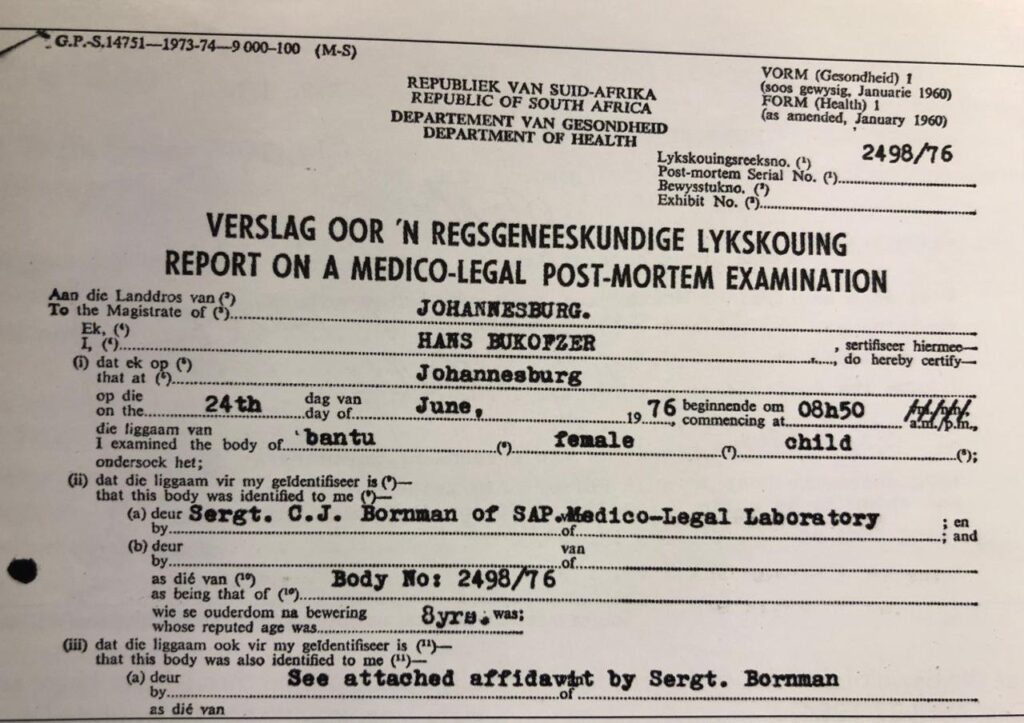
How does one “tell” the story of June 16? In constructing this play, Mashifane wa Noni sifted through testimonies from over 40 people. She spent hours going through archival material and footage, autopsy reports. Mashifane wa Noni: “There were not many autopsies to sift through. I think I went through about five, including Hector Pieterson’s autopsy report”.
Memory is fallible. We are told, from the get go, that Rise ‘76 is “historical fiction”. This disclaimer is projected onto the stage (beautiful AV design by Xolelwa Nhlabatsi). Throughout the play, are given prompts and flashes to locate us in the narratives. But, this is not a history play. It is not a docu-drama. Using historical fact and artistic licence, Mashifane wa Noni has crafted a play which goes beyond the horrific statistics of June 16. She has conjured up protagonists with names, histories, families; people who cared for them and who mourned for them.
The play is set in a fictional school of Molefe High School in Soweto. The protagonists are composites, inspired by real people. But this is a work of historical fiction and herein lies the brilliance of this two-time Fleur du Cap Award-winning theatre maker. Cantilevered on the outrage, the protest, are the stories, the memories and testimonies of those who were there, who were witnesses, who went to the hospital/morgue to look through heaps of bodies, searching for their loved ones. And the perpetrators – the police – are there – chirping, on the hunt with glee, bemoaning the death of their beloved German Shepard dogs, stoned by the protestors. That sparked some laughter by the audience, nauseating laughter.
On that note there is an unnerving evocation of an “askari” (Non-White individuals who collaborated with or participated in actions perpetrated by the apartheid state’s security forces), played by the brilliant young actor Sbuja Dywili. Mashifane wa Noni: “In varying degrees, askaris were everywhere so people would mention specific askaris in their testimonies and how they were at odds with the community. They existed in both Black and Coloured communities. So I moulded Razor (the role Sbuja plays) from what other people said about the askaris in their community. From public record there are askaris like Joe Mamasela who I did look at as well and was sort of my beacon in beginning to write Razor. Joe Mamasela was part of Vlakplaas, so he was in the Special Forces, he wasn’t an ordinary police officer like Razor.”
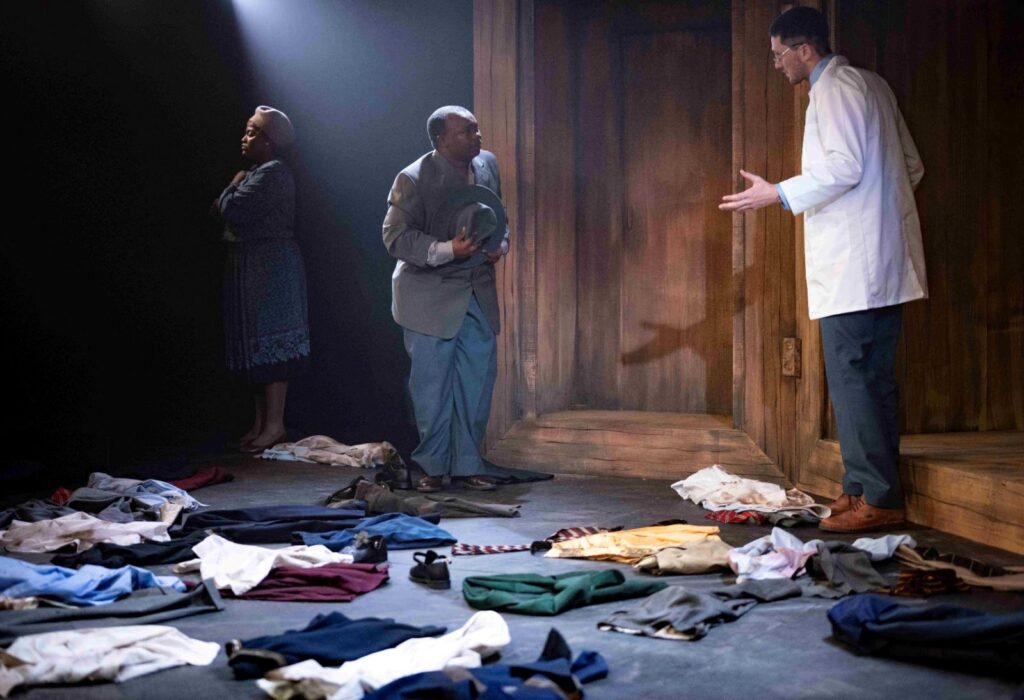
Massacre is the visual centrepiece of the 2nd half of Rise ’76. We see a graveyard of clothes which metamorphose into bodies. We see a Black nurse and a White pathologist doctor in the hospital/morgue, receiving a mother and an uncle, looking for a four year old girl, Lily. Lily was a real person. In the autopsy report, she was eight years old. Mashifane wa Noni: “We also changed her age to put her at crèche age. The real Lily was 8 but we made her 4…”
The strewn bodies on the stage, reminds me of Picasso’s huge painting Guernica (1937) which he painted in response to the Nazi bombing of the town of Guernica during the Spanish Civil War – imaging jumble of bodies, clothes, shoes, all that remained after the massacre.
In Rise ‘76, we see the tall White doctor (Ben Albertyn), stooped, ducking in the confines of the hinged set, hunched over, heaving the corpses on his back. Is it enough that he carries this burden? He also takes on the brutal role of the sniper/constable, Green Mamba. The doctor places a hanger in the space – emblematic of Lily’s life – 4 years or 8 years in “real” life. That hanger dangles, hangs there, until the end of the play, swaying, making shadows.
Archive and memory are transfigured through Mashifane wa Noni’s creativity, skill and care as a dramatist. She told me that through a brilliant creative prompt from Baxter’s Lara Foot during the rehearsal process, the clothing used on stage became puppets, humanised effigies. Foot has worked extensively with magical realism in her work and in Rise ‘76, magical realism, perhaps transformative is beautifully positioned to take us into the sorrow and love of the mother and uncle, as they discuss how to dress Lily, embodied by a yellow dress, in her favourite dresses to send her to her final resting place. The mom reminisces about what a gorgeous and easy child she was. We smile and nod our heads, listening, absorbing. Lily is no longer a statistic.
After the opening, people were talking about their “favourite” parts of the play. Some loved the sepia tinged AV in the first half and the seamless integration of movement and voice – with figures frozen, like in frames of celluloid and then shifting, moving, running, hiding. Citing favourites seems contradictory in a play about June 16 but that is what Mashifane wa Noni has accomplished with this heartbreakingly shatteringly tender work, which transfigures history into a lived experience – behind statistics.
At the end of the play, we are told that none of the perpetrators of June 16, the events on that brutal day, were prosecuted. I was gobsmacked. I asked Mashifane wa Noni if I had got this right. She answered: “Correct. There were some perpetrators who were involved with June 16 who were prosecuted for other things but not this specific event.” Fifty years on and reparation and accountability remain burning issues. Mashifane wa Noni’s use of physical movement brings in a sense of the protagonists reeling at their own experiences. They freeze. They are frozen at times, as if caught in a frame of celluloid film, waiting for the click of a shutter, capturing the next moment.
Mashifane wa Noni is 30 years old. She turns 31 in August (2026). I was dumbstruck when I saw her first play Sainthood. She was 23. No, she wasn’t born at the time of the Uprisings but via this masterful and monumental epic, she holds space for the audience in real time, in the theatre, to witness; to venture beyond statistics. We leave shattered, reeling. Within the trauma and horror, the grief, we are left with flickers, small moments that make us smile (the little dress of Lily, the story of Hector Pieterson and the bee). I hope that this box of memories of June 16 will be unpacked at other venues in South Africa and abroad.
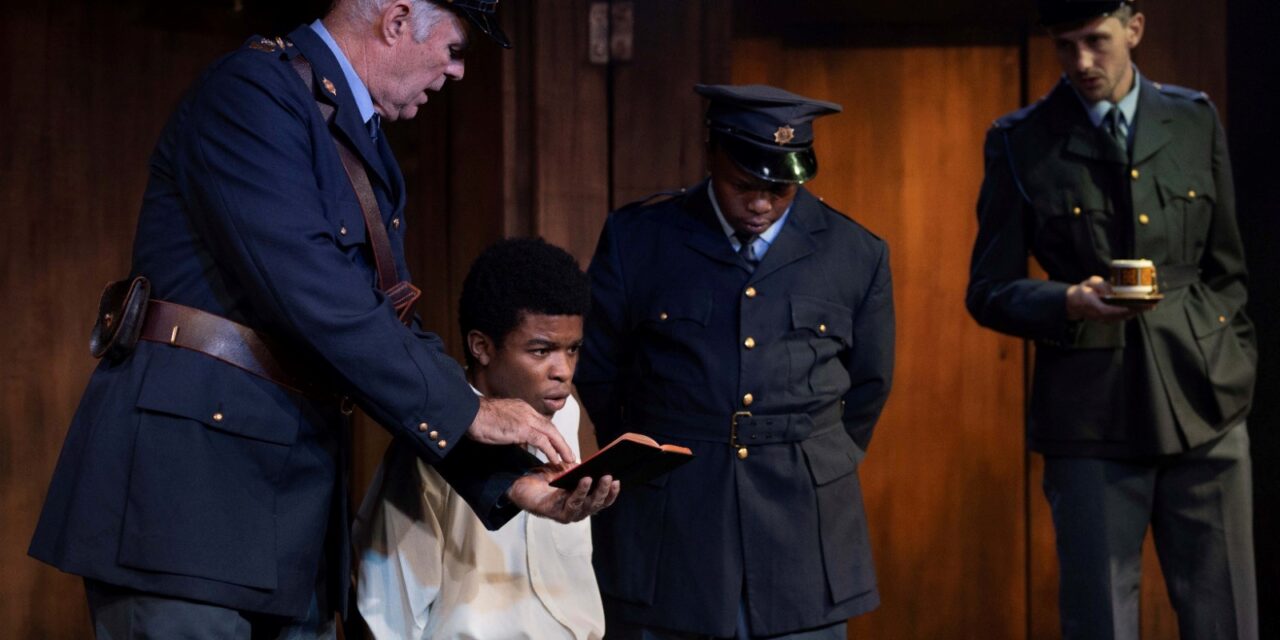
✳ Featured image: Deon Lotz, Alex Sono, Sbuja Dywili, Ben Alberty in Rise ’76: The Story of June 16th, by Tiisetso Mashifane wa Noni, Baxter, May 2026 Pic: Fiona MacPherson