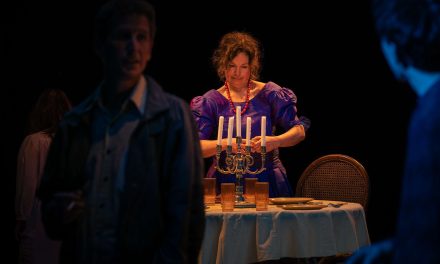
| What: Cape Ballet Africa’s The Nutcracker When: February 25 to March 1, 2026 Where: Artscape Opera House, Cape Town Orchestra: The Cape Town Philharmonic Orchestra will accompany the performance live for selected performances and the other performances will be recorded music by the CTPO Choreography and stage direction: Maina Gielgud Costume design: Marcel Meyer Set design: Michael Mitchell Age advisory: The show is recommended for all ages over five years Tickets: R290 -R790 Bookings: Webtickets Facebook: Here Instagram: Here |
Cape Ballet Africa’s acclaimed staging of Maina Gielgud’s The Nutcracker will be on in Cape Town, for seven performances only, at Arstcape, from February 25 to March 1, 2026. It is a big production – with over a 100 costumes. Marcel Meyer not only performs as Drosselmeyer but has also designed the costumes. He provides insights into the ballet, this production, his designs and the character of Drosselmeyer, who is “the catalyst and conduit for Clara’s journey, enabling her to explore courage, imagination, and wonder…”
TheCapeRobyn: This staging of the Nutcracker is by Maina Gielgud and it is a “new staging” for Cape Ballet Africa. What does that mean?
Marcel Meyer: In essence, a “new staging” means this is a completely fresh realisation of The Nutcracker. While it honours the tradition of the ballet, everything audiences see on stage is newly created for Cape Ballet Africa in 2025: the sets, the costumes, and the overall theatrical production. It is not a revival or a restaging of an existing version, but a newly imagined physical production made specifically for this company.
TCR: Has Maina Gielgud taken the 1892 staging – music by Tchaikovsky and choreography by Marius Petipa and modified it? She staged the Nutcracker in Santiago in 2024 and has presented productions for other companies. Is this the same Nutcracker but reconfigured for CBA?
MM:The Nutcracker has never had a single fixed or authoritative original version. While Marius Petipa provided Tchaikovsky with a highly detailed structural brief, much of the ballet—especially it’s most iconic passages—was choreographed by Lev Ivanov after Petipa fell ill. As a result, the work has always invited reinterpretation.
Of the three great Tchaikovsky ballets, The Nutcracker is the most flexible: its dream-like narrative and divertissement structure, particularly in Act II, allow for variation in story, design, and choreography, while Tchaikovsky’s score remains the constant.
Maina Gielgud’s 2025 staging for Cape Ballet Africa is created within this tradition. It is not a radical reinvention of the music or the story, but a thoughtful reworking of the ballet. The production draws on Petipa’s original concepts, incorporates sections of Ivanov’s choreography and integrates Gielgud’s own choreographic voice.
While related to the production she staged for Santiago Ballet in 2024, this version has been reconfigured specifically for Cape Ballet Africa, its dancers, and its theatrical context.
TCR: Can you talk about the staging of this ballet byMaina Gielgud and what that means?
MM: When Maina Gielgud comes to South Africa to stage the ballet, she works in much the same way a director would on a play or musical. Beyond creating new choreography for certain sections, she oversees the entire production in the rehearsal room—shaping pacing, character, musicality, and dramatic intention.
She works closely with the dancers to give every moment its dramatic and musical nuance, ensuring the storytelling is clear and the style is unified. In this sense, she is not simply setting steps but actively directing the ballet as a complete theatrical work, tailored to Cape Ballet Africa and the specific context in which it is being performed.
TCR: When and where is Cape Ballet Africa’s Nutcracker set? The original is set on Christmas Eve in a small town in Germany, in the 1820s. We are in 2025 in the Cape Town summer and Christmas is very different to Germany?
MM: Cape Ballet Africa’s Nutcracker is set on Christmas Eve in an affluent parlour in a non-specific Western European country. While the original story is German, we have retained the traditional character names—Stahlbaum, Clara, Fritz, Drosselmeyer—but allowed the setting to remain deliberately flexible. Given the strong German roots of the British royal family, the world of the ballet could just as easily suggest a parlour in Brighton as one in Bremen or Berlin.
We have shifted the period from Hoffmann’s 1820s to a refined late Victorian–early Edwardian era, around the turn of the twentieth century. This allows for a rich visual language while keeping the emotional world of the ballet intact.
The fantasy elements, as always, transport us beyond the domestic setting into the Kingdom of Snow and the Sugar Plum Fairy’s Kingdom of Treats, preserving the sense of wonder at the heart of the work.
TCR: Insights into the protagonists – Clara. Sugar Plum Fairy, The Nutcracker, Drosselmeyer, The Mouse King, Cavalier?
MM: After The Sleeping Beauty, The Nutcracker is one of the largest classical ballets a company can stage. Alongside the central characters—Clara, the Nutcracker Prince, Dr Drosselmeyer, the Mouse King, the Sugar Plum Fairy, and her Cavalier – the ballet features a host of fantastical figures: the Queen of Snow and her Snowflakes, the various treats of the Sugar Plum Fairy’s Kingdom, and the dancing flowers.
What makes The Nutcracker especially beloved is its extensive use of children. In this production, our young dancers not only play party guests, but also double as the Mouse King’s army and the glittering Christmas Angels.
Overall, the production includes the full company of dancers, augmented by character artists, children, and aspirant dancers, creating a rich and lively ensemble that brings the magical world of the ballet vividly to life.
TCR: What was your brief in terms of designing the costumes? Can you take us through how your designs differ from other productions and your concept for the design – and perhaps referencing other productions?
MM: My brief from Debbie Turner and Simon Bryce at Global Star Events was to create a largely “traditional” production of The Nutcracker. While I honoured those classical expectations, I also wanted this production to have its own distinctive character.
The most radical design departure was for the Sugar Plum Fairy and her Cavalier. In most traditional productions, their costumes are in pale pinks, creams, and golds. For Cape Ballet Africa, I wanted the costumes to reflect the qualities of the treats they represent. Instead of pink, the Sugar Plum Fairy and her Cavalier wear rich plum-coloured velvet overlaid with heavily beaded fabrics that shimmer like sugar. The underside of her tutu evokes a bitten plum: deep golds fading to chartreuse, adding depth, richness, and a sense of opulence.
The result is a visually striking and unique Sugar Plum, rooted in tradition but with a fresh, luxurious aesthetic, allowing the costumes to feel both familiar and completely new to audiences.
TCR: Is this your first time designing costumes for a classical ballet? You have played Drosselmeyer on very occasions so you know this ballet well. You know how it moves and lives on stage and you are bringing your “danced experience” to designing the costumes. Amazing! Insights?
MM: Yes, this is my first time designing costumes for a classical ballet, which was both exciting and deeply rewarding. Having performed Drosselmeyer previously—and performing him again in this production—gave me a unique perspective as a designer.
Spending so much time in the rehearsal room allowed me to see the dances and characters take shape first hand. This informed every design decision, ensuring that the costumes not only looked beautiful on stage but also enhanced and complemented the dancers’ movements, supporting the storytelling and the physicality of each role.
TCR: Insights as to what you have used in terms of fabrics and can you tell us about the crafting of the costumes – embroidery etc? The palette? Has the whole wardrobe been made in Cape Town? A mammoth task to dress this epic ballet?
MM: The Nutcracker is an enormous ballet to dress—over 100 costumes appear on stage in a single performance. Beyond classical ballet essentials like tights, tunics, and tutus, the wardrobe also includes period costumes for the Christmas Party, as well as highly specialised creations for fantastical characters: the Mouse King and his army, the Nutcracker, toy soldiers, and the various treats in the Kingdom of Sweets. Our team of skilled costumiers from Cape Town, Paarl, and Johannesburg worked at breakneck speed to bring hundreds of costumes, masks, wigs, and headdresses to performance-ready standard.
The fabrics are opulent and luxurious: silk brocades, velvets, beaded lace, and elaborate trims, all designed to give the audience the glittering spectacle expected of a world-class classical ballet.
For the palette, I wanted to create a visual journey. Act I, the “real world,” is in elegant Edwardian shades of ivory, cream, and black, inspired by sepia-toned realism. Colour is introduced gradually—Drosselmeyer’s magical dolls, then the Nutcracker in navy blue and red. Act II explodes into technicolor splendour: the Kingdom of Snow dazzles in whites and ice blues, and the Kingdom of Treats is rich and cohesive, with the Sugar Plum Fairy in deep plum, and the other treats in complementary reds, blues, and purples, echoing the Nutcracker Prince’s palette.
This careful use of fabrics, colour, and craft creates a visually opulent, cohesive, and magical world for the ballet.
TCR: Can you give us insights into the set design by Michael Mitchell and how the costumes and set riff off each other?
MM: Michael Mitchell has created an exquisite, fully immersive world for the ballet. The production opens with an icy exterior, setting the scene for the guests’ procession to the Christmas party. This then dissolves into the warm, sepia-toned elegance of the Stahlbaum parlour—glowing ochres, walnut, and burgundy—with the magical, growing Christmas tree as the central focus, framed by a false proscenium designed to look like the exterior of the house.
The Kingdom of Snow is a sparkling, ethereal world, framed by cascading snow borders and icicle-like set pieces, with a large frozen Christmas tree anchoring the scene. In the Kingdom of Treats, Michael has created a visually opulent realm, featuring a backdrop of glittering Christmas baubles and an intricately cut cloth suggesting gilded trellises, perfectly complementing the lavish costumes.
The sets and costumes riff off each other beautifully: the muted, elegant tones of Act I make the opulence of the Sugar Plum Fairy’s Kingdom even more striking, while textures, colours, and architectural lines in the costumes echo and enhance the shapes and patterns in Michael’s set design, creating a fully integrated, magical world on stage.
TCR: In addition to designing the costumes, you also perform as Drosselmeyer. If this ballet was being created right now, many might find him problematic – even predatory – the older man with the young Clara – plying her with gifts etc. Can you talk about playing him and how you see him – as a protagonist?
MM: I think it’s important not to impose post “Me Too” prejudices on classic tales without context. Why is it not considered problematic for Mary Poppins to take the Banks children on magical adventures only because she is a woman? Drosselmeyer is a magical, creative spirit who sees in Clara a kindred mind. She is on the cusp of womanhood in a very patriarchal society, where her desires and creative energy could easily be suppressed. His role is to nurture her imagination and guide her on a magical journey.
In the ballet, the patriarchal world of the Stahlbaum parlour transforms into the battle between the Mice and Toy Soldiers, led by the Mouse King and the Nutcracker Prince. Once Clara triumphs, Drosselmeyer then transports her to two matriarchal kingdoms: the Kingdom of Snow, led by the Snow Queen, and the Kingdom of Treats, ruled by the Sugar Plum Fairy. These worlds celebrate creativity, joy, and cultural diversity rather than battles and hierarchy.
Drosselmeyer is not a sinister figure—he is the catalyst and conduit for Clara’s journey, enabling her to explore courage, imagination, and wonder. He is a mentor and guardian of her creative spirit, guiding her through a transformative adventure that ultimately celebrates freedom, artistry, and empowerment.

✳ Featured image – The Sugar Plum Fairy – costume design by Marcel Meyer for Cape Ballet Africa/Maina Gielgud’s The Nutcracker, 2025/2026.