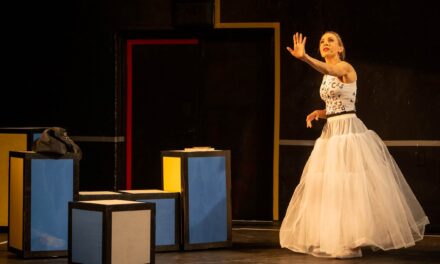
| What: Hidden/Current When: November 27-29, 2025 Where: Artscape Arena, Cape Town Writers: Fatima Dike (Cape Town), Naghmeh Samini (Tehran) and Elizabeth Heffron (Seattle) Director: Robin Lynn Smith Producer: Freehold Theatre Lab – Seattle Performances: November 27 and 28 are at 7pm, November 29 at 3pm and 7pm Duration: 90 mins, no interval Age restriction: no under 14s Tickets: R50-R120. R50 for student, seniors and group discounts (groups 10 or more) Bookings: Webtickets or Artscape-dial-a-seat 021 421-7695 Cast: Zikhona Jacobs, Sbuja Dywili, Sizwe Msutuand Chris Gxalaba (Cape Town), Emily Pike, Stefan Enriquez, Jennifer Moore and Newsha Farhani (Seattle); Soha Sanajou (Vancouver, BC) and Shayan Khoshmagham (San Francisco) Musicians/As Cast: Anne Mathews and Gino Srdjan Yevdevich Scroll down for other creatives involved with this production |
The intersection of the “grassroots and global” in the context of gender based violence is at the heart of Hidden/Current, a play, premiering in Cape Town, at the Artscape Arena from November 27-29, 2025. “There is such an undercurrent – in so many cultures, across class and ethnicity- of this oppression; and the violence perpetrated against women that is often unacknowledged- met with silence. And our surreal realm is a water world, with the fierce spirits of young women who met unjust and violent deaths, who are back to bring these stories to us. The violence and response is often hidden; the current is both the water and the fact that it is still going on – now,” reflects Robin Lynn Smith who is directing the play. She is Founding Partner and Artistic Director of the Freehold Theatre Lab from Seattle which is producing the play. This major multi-national project includes three writers, has a cast of ten actors and live music on stage. Robin Lynn Smith shares insights into the play:
TheCapeRobyn: Is this the first time that Freehold Theatre Lab is working in South Africa?
Robin Lynn Smith: We were here in July 2024, workshopping the play at Guga S’Thebe and Artscape however discussion about this project started with Fatima Dike, an artistic colleague from Langa, two years ago.
TCR: How did this major play, grappling with GBV- come about?
RLS: Fatima and I had been looking for a project to collaborate on for many years and settled on this piece after she came to Seattle for an artistic retreat that included Elizabeth Heffron, a Seattle playwright and longtime Freehold collaborator. We saw there was a vision to move forward together on a project around violence against women however we needed a third writer to meet the global nature of gender based violence. I was fortunate to be connected with Naghmeh Samini through a mutual friend, we quickly saw we were fellow travellers and artistic kin, and she joined the project.
Our dedication to this project comes, in part, from Freehold’s 20+ year partnership with the incarcerated women we work with at the Washington Correctional Center for Women – many of whom know, first-hand the harm of the gender violence plague. There is a necessity to champion women who are standing up for their full respect, human rights, and acknowledged worth every day. Through our work with these women we learned that people who have been through extended adversity have unique voices that deserve to be heard.
Fatima, Elizabeth and Naghmeh, who work extensively in their communities (home and adopted), brought stories of women exploited, sometimes brutally, in the name of the cultural traditions and State imposed law. We hope this play both investigates the underlying causes of global violence against women and serves as a catalyst to acknowledge and examine this issue, and encourage communities to take action towards establishing balance.
TCR: Why Cape Town? Why Now?
RLS: In our conversations at the retreat, Fatima brought forward that GBV is a complex and challenging issue in Cape Town and that sentiment was echoed by the other playwrights. We believe that the health of society is tied to the health of all its citizens. The global culture is out of balance because it excludes the wellbeing of women.
TCR: Insights into the process of writing the play –weaving three stories by three writers – Fatima Dike (Cape Town), Naghmeh Samini Tehran) and Elizabeth Heffron (Seattle). How were these three writers brought together?
RLS: As I mentioned, we had a gathering of artists and women who believe this is an issue that needs addressing now – again. We wanted to investigate the ‘why’: the root of gender based violence. What are the historic, cultural religious precedents? What is learned and carried forward in custom and tradition? And to look at profit, power and the commodification of women’s bodies. How are women and girls exploited by their intimate circle, their community, their culture? Working together we wanted to investigate how this violence manifests in global/individual, systemic/domestic contexts, and how policy and laws condoning the brutality grow out of family, community and custom.
TCR: Did they workshop the play from the get go, with each of them writing a story, fleshing out a protagonist?
RLS: Yes, we knew we wanted three unique stories from specific cultures. Each playwright created their story, with the intention of giving voice to those who are not seen and often not heard. We workshopped the three stories into one piece in the summer of 2024. Then we realized that we needed a larger context that acknowledges that these are only three of millions of stories across time and space.
hidden/current developed into a play that unfolds in a fluid context of the real and the surreal – an amalgam of dance, theatre, and expressionism – through live music, movement and mixed media, evoking Istanbul, Langa Township, the prison, and a water realm that surrounds these three woven stories.
TCR: Can you talk about the title: hidden/current and how it resonates in terms of Freehold’s pursuit of the “grassroots and global”?
RLS: There is such an undercurrent (in so many cultures, across class and ethnicity) of this oppression; and the violence perpetrated against women that is often unacknowledged- met with silence.
And our surreal realm is a water world, with the fierce spirits of young women who met unjust and violent deaths, who are back to bring these stories to us. The violence and response is often hidden; the current is both the water and the fact that it is still going on – now.
TCR: From page to stage – please tell us how you as director have braided the three stories, – through text performance, live music accompaniment, dance and movement? GBV is not easy territory and you are inviting us “to see the stories of three young women, to wake us up to, and incite action against the gender-based violence across cultures”. You say: “When each rooted, local story braids around the others; they’ are an undeniable testimony to the global range of this plague.” You want audiences to engage; to not look away
RLS: In our practice we have found that Story has power to open hearts, alter our perceptions of one another, engage us through imagination with those who we view as adversaries: and we can dream what genuine reconciliation might look like.
I think an essential power of sharing stories is to let us all remember that we are not alone. Our work is to take these stories and all the elements our writers, performers and designers bring to it and create a shared experience with our audiences that brings this issue back into our collective attention. We know we are a drop in a large global bucket, but my hope is our work offers a path toward healing.
TCR: Can you talk about design – set, costumes, sound and lighting?
RLS: Our designers, composer and movement director and I have worked together as a creative team through music, choreography, projections, and other design elements to manifest a layered world – real and surreal. The water realm of the Rusalka is the first circle of the world of the play and it contains the three story worlds: Istanbul, Langa, and a Women’s prison in Washington State. The design elements allow us to move from an abstract examination of violence and history of GBV into the very concrete specific world of each of the young women. Taking audiences on a journey they at times recognize and also experience for the first time.
TCR: How did you go about the casting of the 10 actors (from Cape Town, Seattle, San Francisco and Vancouver)? Did they audition and/or go through workshops?
RLS: We had the good fortune to meet and work with these wonderful actors from Cape Town in the workshop in 2024. The actors from Seattle I knew and had collaborated with before. Shayan and Soha, our San Francisco and Vancouver based actors, auditioned for their roles. All bring a collective energy for collaboration and exploration this project requires. They are amazing humans all.
TCR: What was the process in terms of gathering the creative team? Can you tell us about the composer/Musician Gino Srdjan Yevdjevich “Kultur Shock”, Musician Anne Mathews, movement director Jessica Jobaris and Scenic Designer Parmida Ziaei?
RLS: I have been lucky to work with these artists in prior productions – many of which have gone into both theatres and non-traditional sites, like prison yards. Gino and I have worked on many tours and many worlds together – from Hamlet and The Winter’s Tale, to Freehold commissioned new works across 18 years. Anne is a mighty musical force who has also toured with us before. Jessica is a Dance Theatre Choreographer, among other things, and we have collaborated many times – often it seems non verbally…kinaesthetically. Parmida is a daring and visually gifted scenic artist who is fierce in her commitment to making things truer and more resonant. We are very fortunate.
TCR: Are there plans to tour this play?
RLS: We are hopeful that we can produce it in Seattle, and are in discussion with a theatre in Istanbul. Our gratitude to Artscape, Guga S’Thebe and the many beautiful individuals from Cape Town who are making this production possible.


| Hidden/Current, Artscape Arena, Cape Town November 27-29, 2025 Creative team: Director: Robin Lynn Smith Composer/Musician: Gino Srdjan Yevdjevich “Kultur Shock” Movement Director: Jessica Jobaris Scenic Props/Designer: Parmida Ziaei Lighting Designer: Chih Hung Shao Projections Designer: Rachael Benson Costume Designer: Hannah Larson Producer: Freehold Theatre Lab – Seattle |
✳ Featured image: Zikhona Jacobs (from Cape Town) and Jennifer Moore (Seattle) in Hidden/Current, which is premiering in Cape Town, in the Artscape Arena, November 27-29, 2025. Pic: Jeffrey Abrahams. Supplied.