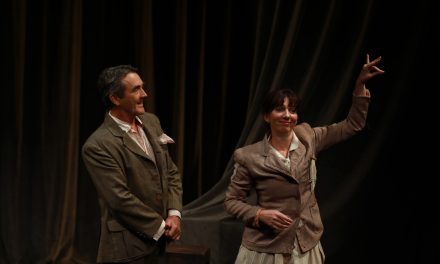
| What: ‘n Pandok se Liefde – on at Best of the Fest from the 15th Baxter Zabalaza Theatre Festival When: September 9-13, 2025 Where: The Baxter Studio Theatre, Cape Town Bookings: Webtickets online or at Pick n Pay stores Also on at Best of the Fest from the 15th Baxter Zabalaza Theatre Festival is Purpose – which will be performed from September 16-20, 2025 |
Lauren Snyders’ award winning play ‘n Pandok se Liefde is on at the Baxter from September 9-13, 2025, as part of Best of the Fest from the 15th Baxter Zabalaza Theatre Festival. Snyders is performing in the two hander, with Dealan Fredericks. Direction is by Samuel Jumat. The play is described as “a compelling drama about a married couple who have to come to terms with their wounds after a traumatic event …exploring the profound impact of a dramatic night on their relationship and identities.” Snyders: “This production asks its audience to lean in. To feel the discomfort. To sit in the ache of what is not said. It is a call to witness, not to resolve…” Intrigued? Snyders gives insights:
TheCapeRobyn: First – about you?
Lauren Snyders: I am 38 years old. I was born in Mahikeng, North West. I moved along with my family to Cape Town in 2001. I studied Psychology and Drama at UCT. I currently teach Dramatic Arts. I am a mother of a beautiful six year old boy. We are the best team, me and him and I am forever grateful to my parents who have forever held us and in seasons where I do productions they always without hesitation watch over him. He is one of the happiest people know. I am honoured to be his mother.
TCR: How did the creative team come about for this production – you, co-performer, Dealan Fredericks and director Samuel Jumat?
LS: I met Dealan Fredericks in 2016 when I produced and performed in Joanie Galant-Hulle by Dr Adam Small. He auditioned for the role of Joseph and my director, Nolan Africa and I knew immediately we wanted him in the cast. We always stayed in contact and when I was thinking on who would play this role he came to mind. I contacted him and he immediately said yes. He is also studying teaching at UNISA and currently in his 2nd year. It is something special that we all teach and connect on this level as well. Dealan and Sam both met during this process. This is our first time working on a show with Sam.
Samuel Jumat teaches at De Hoop Laerskool in Somerset. He has been teaching since 2019 and at present been at his school since 2022. He is originally from George, but did his teaching Degree at North West University. However, we met in 2017 when he applied as a writer to the DCAS Drama Festival. Here I was a facilitator and his mentor in the scriptwriting workshop. He won the festival four times and later became a facilitator for this programme as well. It is here where we connected even more and spoke on writing and what that looked like for either of us. Zabalaza works alongside DCAS as the facilitators and adjudicators of the DCAS Drama Festival. Samuel is a very talented writer and director and I always knew in my heart I would want to work with him.
TCR: Is the play inspired by elements of your own experiences, aspects of people you know or real events? The play is set in Vergenoeg, Northern Cape. Were you born there? Or is it used fictionally – as in “far enough”.
LS: There are definitely aspects from real life, I tend to always draw from my experiences when writing. I know two survivors of gang rape and their stories has always resonated in how they chose to survive and heal, in how they lived to fight another day. I was born in Mahikeng, however, my parents are both from Kimberley, Northern Cape. My dad always shared stories with us on our long drives over the weekends from Mahikeng to Kimberley when we visited our extended family and Grandparents. He spoke on a place called Vergenoeg and how this place came about. In researching, the place very much still exists and crippled by poverty as it is one of the places during Apartheid government where they moved coloured and black families during the Forced Removals. The characters are where I drew from real life experiences; their names; Hendrihetta and Robert aka Bobby, their mannerisms, their fight against poverty. I saw this in family. I wrote this to heal those parts of them that may or may not still exist.
TCR: In the play, the protagonists Hetty and Robert are living in the rain-soaked town of Vergenoeg. The play “delves into the aftermath of trauma and its profound effects on their relationship and identities, highlighting the fragility of manhood and womanhood in the face of unimaginable circumstances.” Can you give some more insight into that – without plot spoiling, obviously?
LS: The play examines the psychological and physical aftermath of a violent sexual attack, unpacking not only the loss of safety and control, but also the shattering of identity — what it means to be a man, what it means to be a woman, when those identities are stripped bare.
For Hetty, the trauma has ruptured her sense of womanhood: her body no longer feels like her own, and her mind wavers between memory and madness. For Bobby, who was present but powerless -the loss is tied to his manhood — to his inability to protect, to act, to defend. In the wake of this violence, both characters are left questioning their worth, their roles, and their humanity.
Thematically, the play navigates:
- The long shadow of trauma and its echo in daily life
- The silent and devastating erosion of manhood and womanhood
- The gendered experience of shame, guilt, and memory
- Love as both comfort and cage
- Survival in the forgotten corners of our society
- Rain as metaphor — for memory, for breakdown, for cleansing that never comes
Through lyrical bilingual text and stark, poetic imagery, ‘n Pandok se Liefde gives voice to those who are often left voiceless — to women whose pain is normalised, to men who are taught not to cry, and to the spaces “ver genoeg” — far enough from safety, far enough from justice, but never far from suffering.
This is not a play about justice or redemption.
It is a play about endurance.
About rain that keeps coming.
And love that tries to hold what cannot be held.
TCR: Is it set now – 2025?
LS: No, it is set in the late 90s, post-apartheid. However, the story is relevant to any and this era, as Coloured people still find themselves enslaved by poverty, poverty beyond our comprehension. This play delves into those truths of the lack that some people face and what that looks like for someone who works just to make ends meet, and in this case “there is no meat”. To quote from the play, “Manne wat sente tel, men who sell their souls on a potato farm to get a R50 at the end of the week. Maar werk moet jy werk, want `n man is nie `n loslappie nie”
TCR: Can you talk about the genesis of the play – your writing of the play –and how it has developed from page to stage at the Zabs and now a winner in Best of at the Zabs?
LS: I started writing this play in 2023, running the concept of toilets and their safety through my brain and researching how the very place where you find yourself needing to be relieved can be a place of discomfort and unsafe. I read a story in the newspaper about a young teenage girl who got raped and shoved into the long drop in Khayelithsa a few years ago, one evening when she walked to the toilet to relieve herself. This story sat with me for years, along with the knowledge that I knew women who were gang raped and invaded in the worst way possible. I wanted to write about love, and grapple with love as a factor in the process of healing trauma. When asked by Zabalaza to create a story, I thought I would not use this one, at the time I was only one scene in, still working on how the story would grow. Once asked I decided this story needed to come to life and started writing. The story changed over the process in placing of scenes as these got swapped around until we found the right fit. Yael Farber helped in making sense of this for me. She was my mentor in the first run during the festival.
TCR: Insights into the design and setting?
LS: ‘n Pandok se Liefde is a deeply intimate, poetic, and bilingual theatrical meditation on trauma, memory, and survival. My artistic vision for this production is rooted in emotional realism and stylistic minimalism, allowing the performances, the silences, and the space to breathe with the weight of what remains unspoken.
At the centre of this story is a woman and a man — two people broken not just by an act of violence, but by the silence and shame that followed it. This is not a play of explosive moments, but of quiet deterioration — where pain lingers in every crack of the corrugated walls, and memory drips as persistently as the rain leaking through the roof.
Tone & Aesthetic: The staging evokes the claustrophobia and fragility of the “pandok” itself — a physical space that mirrors Hetty and Bobby’s emotional entrapment. The aesthetic is simple, textured, and lived-in: rusted surfaces, faded fabrics, and muted palettes of blue, beige, and tin. Light and sound become characters — the drip of water, the rise and fall of rain, the buzz of a broken radio — crafting a sonic landscape that constantly unsettles.
TCR: Anything else to add?
LS: This production asks its audience to lean in. To feel the discomfort. To sit in the ache of what is not said. It is a call to witness, not to resolve. The shack may be small, but its walls hold the weight of a universal grief — a grief born in too many homes, silenced in too many lives.
My vision is to hold a space for that grief.
To stage the haunting.
And to let even broken voices be heard.