| What: Constellations by Nick Payne Who: Wolf Britz (designer) Director: Jay Pather Cast: Mark Elderkin and Mwenya Kabwe Constellations is on in The Baxter Studio, Cape Town, June 2-20, 2026 and at Theatre On The Square, Johannesburg, June 23 to July 11, 2026 Constellations is part of How Now Brown Cow 2026 Winter season. The other play in the season, is Prima Facie by Suzie Miller. On in the Baxter Studio, August 4-29 and the Market Theatre, September 17 to October 4 2026 Age advisory for both plays is 14 Bookings for both plays: Webtickets |
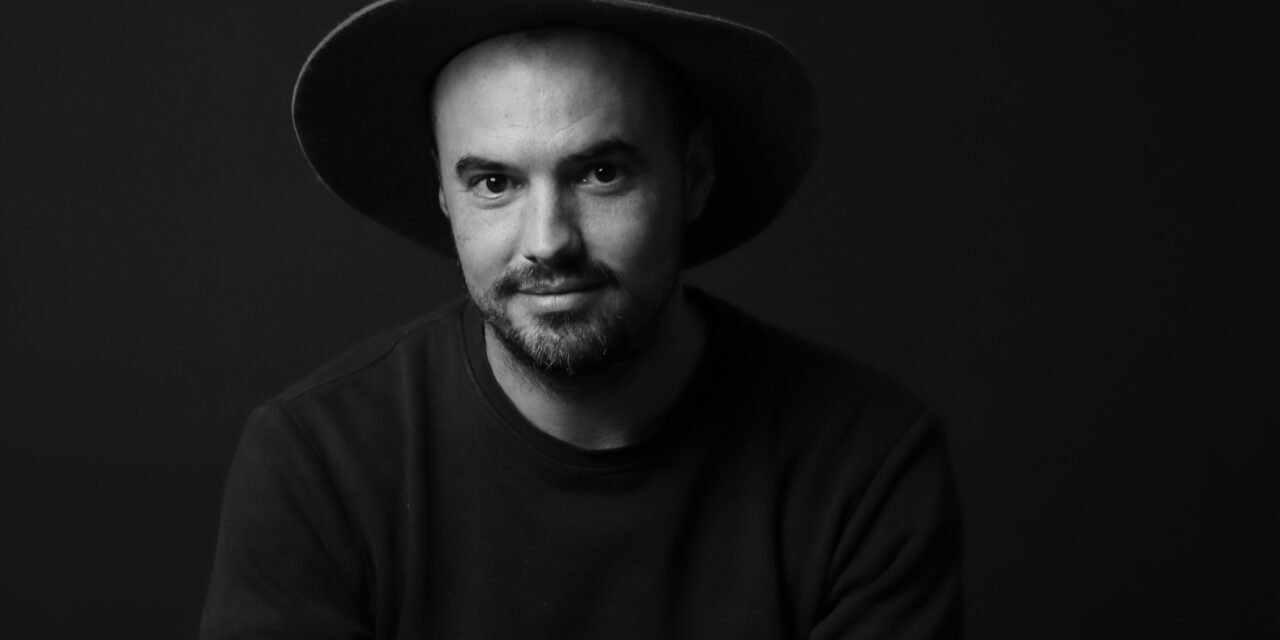
As part of its 2026 Winter Season, How Now Brown Cow is presenting Nick Payne’s play, Constellations, in Cape Town and Johannesburg. Direction is by Jay Pather. Wolf Blitz, the designer, gives insights into his design (set and lighting) for this intriguing and mercurial love story, framed against a multi verse of possibilities. “The design really is geared toward holding space for the inner workings of the characters ‘entire shared journey.”
TCR: Insights into the conceptual design arc for this production? The set and lighting?
Wolf Britz: At the onset Jay has had a very clear vision for the production and how the audience should receive it. The set and lighting design is somewhat informed by shapes and forms found within African symbolism as a departure but the relationship between Marianne and Roland being our focus, creating an emotional landscape in which the variations of their paralleled relational situations play out is the foundation for the design and organisation of the physical theatrical space. Jay has been working with long-time collaborator and editor Karen Logan in creating content for projected imagery with African cosmology as its visual language onto the set.
TCR: How is Marianne’s African diasporic ancestry imaged in your design?
WB: As mentioned, the African cosmological element is represented by the content projected at specific moments onto the set. With permission, it contains imagery of the actress’s own ancestors. The design really is geared toward holding space for the inner workings of the characters ‘entire shared journey to be at the forefront of the theatrical occurrence more than making loud advocacies for isolated arguments about ancestry. The projected content is texturally present but subtle enough to function as a layer or node within a structure of complexities related to the overall human experience.
TCR: What is Roland’s backstory in terms of ancestry and how is this imaged in your design?
WB: Framed within a certain lens the play can also be seen through the gaze of the beekeeper’s veil from Roland’s POV which is somewhat read as pragmatic in his character represented by the physical elements on stage i.e. the screen. Ancestry and history mostly pertains to Marianne as part of the ether or fleeting elements such as projected imagery and light i.e. her spiritual dimension she inhabits. For Roland having to leave behind his past life to be able to commit to the present, his love for Marianne and making a case for a future with her is where we meet him. This kind of clean slate approach opens up the space for access to opportunity and possibility as the different elements interact to tell a relational story shifting through space and stretching the notion of time.
TCR: Jay said that the actors’ own stories have filtered into this production? How is this reflected in the design?
WB: “Reflected” is the operative word here. I would say that their heritage and lived experience is an inescapable source from which they draw their performance which the design replicates and amplifies. Mwenya’s ancestors make an appearance in the form of visual representations through photographs as part of the projection.
TCR: Insights into the costumes/wardrobe by Michaeline Wessels?
WB: The wardrobe is styled to be anchored in a familiar reality for the audience to access and latch on to the characters and there within a non-descript physical space. The design has always aimed to create the support for the characters to stand out, be the focus or be accentuated against it. It follows an emotional arc which is universally relevant.
TCR: Have you been influenced by or referenced previous productions for Constellations or Sci-fi films?
WB: Other references to the play inform my own experience as a theatre goer but limited to a departure from which to make new work not seen on stage. My inspiration comes from the text and the director’s vision for the production.
Having a minimal approach to the spatial design means that we can jump from a ballroom to an astral plane at the drop of a hat with ease.
I think there are many stories about fractured parallel universes by way of fiction. We inevitably rely on our frame of reference to make sense of our existence in relation to others in order to establish and maintain connection. The film mentioned is not a source of inspiration for the design nor the works of science fiction. The immediate reality of the audience’s theatrical experience is what is important to acknowledge. The emotional and psychological exchange between the work on stage and the receiving audience should be underlined as the takeaway from a passing moment in a dark Baxter studio theatre one night in June.
TCR: How have you used design – set and lighting to configure shifts in alternate realities?
WB: Foucault in Of Other Spaces holds the theatre as an example of a space which exists both as the immediate reality where the theatrical event takes place as well as the multiple realities the stories bring to the stage simultaneously. All variations on the scenarios are equally as valid as the next alternate yet believable as a possible reality not removed or based in fantasy. By employing the theatre language as a device and by changing the space in subtle and understated ways to bring about internal drifts in an audience which would communicate a shift in space and time.