| What: Peter Pan – A Musical Fantasy by Fred Abrahamse and Marcel Meyer – based on the play by JM Barrie. Where: Canal Walk Shopping Mall in the Centre Court When: June 27 to July 19, 2026 Performance times: Three shows daily at 11am, 12:30pm and 2pm. Closed Mondays. Tickets: From R130. Family packages available Running Time: 60 minutes Recommended age: From age 2 and up Bookings: Webtickets. Webtickets: bit.ly/4dZVQTG Or buy at the box office on site – depending on availability Directors: Fred Abrahamse and Marcel Meyer Additional vocal arrangements, assistant director and musical director: Thinus Viloen Cast: Killian Blerk (Peter Pan), Rachael Saunders (Wendy Darling) and Jeremy Richard (Mr Darling and Captain Hook), Kaira Naidoo (Tinker Bell), Evan Marinakos (Pirate Smee) and ensemble – Tim Truran, Jade Tayla, Andi Colombo, Anzio September, Asanda Mngadi and Jonan Mouton. |
Peter Pan – A Musical Fantasy is on at Canal Walk Theatre, June 27 to July 19, 2026. The annual production, presented by Canal Walk is an original piece of theatre, written by Fred Abrahamse and Marcel Meyer. This Pete Pan is based on the play by JM Barrie – not his novel which came later. Abrahamse and Meyer have written the book, lyrics and music and designed the sets costumes, designed and made the puppets and – strategized how to make Peter fly in the pop-up theatre which is in a tent in the centre court of the shopping centre. It has to have a wow element but it must be safe for the actor playing Peter (Killian Blerk) and the audience. Marcel Meyer gives insights:
TheCapeRobyn: Insights into the set and scenic concept?
Marcel Meyer: For the set, we wanted to pay homage to the Edwardian Age – the Golden Age of illustration- the definitive age of illustration for children’s books. The whole scenic concept is – that everything looks like an illustration out of a book. To achieve that we want to be as authentic as possible to illustration. Rather than handing over to a scenic painter which in itself is an art form – scenic painting – we decided to actually work in the mediums that an illustrator would work with – gouache and ink and pencil and pen and watercolours. I did the various backdrops as illustrations – using the mediums that an illustrator would use. Then they were scanned in high res and then printed on fabric, gauze or on solid fabric to cover the various scenic pieces. Everything looks like it has been drawn and painted in that style of Edwardian children’s books. Colours are quite saturated. You can see the stroke in the pencil but it is not scenic painting in the way of traditional theatrical scenic painting. We wanted to make it look like an illustration for a children’s book.
TCR: Insights into costumes?
MM: In terms of costumes we have created looks for the various little subgroups of characters in the play. The children who are in the nursery getting ready for bed are in their traditional Edwardian night clothes. The parents, Mr and Mrs Darling are beautifully dressed in their Edwardian clothes. They are going out for the night and that was a nice way to take colour out of them because traditionally Edwardian men wore white tie and tails to the opera. Mr Darling is in his sophisticated whitetails look but with no colour. I decided to match Mrs Darling with him and she’s in this beautiful rich Edwardian grey velvet and ivory Georgette evening dress with a little bit of hand beading in the sleeve details which twinkle and sparkles a bit. But the parents have already sort of lost the innocence of childhood. They’re in the more grey black-and-white adult world – they have already started infusing that into the children by virtue of the Edwardian society.
Peter and Tinkerbell arrive in these incredibly detailed beautiful saturated greens, full of beading, lots of different fabric. You can’t see what it’s made out of lame, silk, lace, beading and velvets and all sorts of things. It is a collage of fabrics- so it looks like foliage. It looks like something that’s grown and is magically created rather than a garment which has been made. They are magical and enchanting.
With the little lost boys, I tried to take iconic children’s wear from the Edwardian Era – like little school uniforms or sailor suits and then slightly distress them. They’ve been hand painted in blues and greens. They look like garments the children were lost in and now I have sort of broken down and been appropriated into the Neverland environment.
And our other group is our tribe of Piccadilly warriors and they are in these beautifully ornate detailed Native American inspired costumes but wonderful bright colours. Tiger Lilly as their queen is in pinks and blacks and ivory. Her warrior Panther – has everything that’s pink basically on her costume – becomes a nice deep red on his costume.
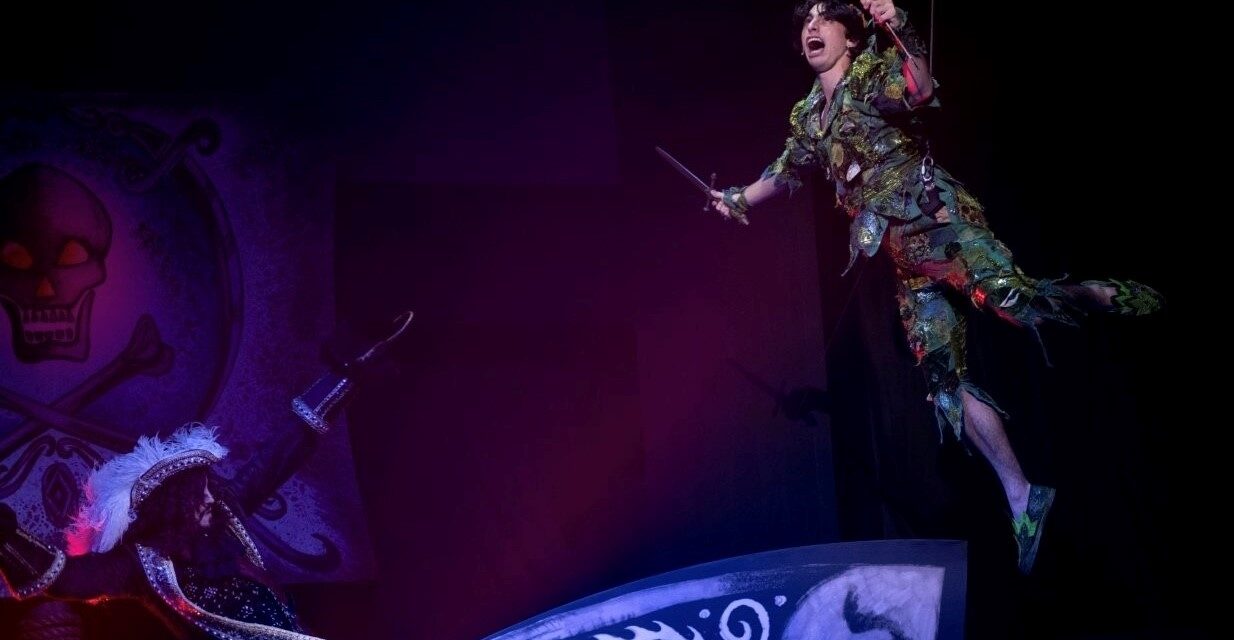
Our final group of inhabitants of Neverland are the Pirates – they are the baddies in the show so we’ve given Captain Hook incredible black costumes – jet black beading. The same as with Peter Pan – but just in shades of black –everything twinkles and sparkles. You can’t quite tell what fabric it’s made of – velvets and beaded fabric and lots of trims feathers and then likewise Smee is in smoky greys with his stripy stockings.
TCR: Tell us about the puppets?
MM: We’ve got two large animal puppets in the play- Nana at the top of the play, with an actor inside playing Nana as the big sort of Saint Bernard nanny dog. And then of course Captain Hook’s ultimate nemesis – the crocodile -which is this huge life-size puppet that Fred and I made out foam and then painted. That has an actor inside to play the crocodile – with a ticking clock inside of him that comes for Captain Hook.
TCR: And Peter flies in this production?
MM: Peter Pan flying is one of the sort of iconic magic moments in any production of Peter Pan. We have a wonderful flying Peter Pan this year. We’ve had an incredible team that have made that possible in a very challenging venue – because we are not in a theatre with a flying tower. There is rigged trussing to make sure that it’s safe for him to fly. It takes two “flying men” to get Peter up and into the air as effortlessly possible One person moves him up and down and the other moves him backwards and that’s in itself takes a certain amount of rehearsal other than the acting and the singing in the dancing -just to make it look seamless knowing when you’re taking him up and bringing him down. That is what makes Peter Pan a bit more stressful than traditional productions because you have got to allocate time for all of that and make sure that it’s safe. There is also a lot of moving scenery that’s coming in and out as he’s flying through so the logistics are – but it is very magical. He does fly up over the Darling Kids. He sprinkles them with fairy dust and at the climax of his big flying song he does a fly out over the audience. He twirls and whirls above them and then flies back to Neverland. That is one of the highlights this year. We’ve had an incredible team to make it happen. Killian Blerk is playing Peter Pan and in addition to being a wonderful actor and singer, he is a great dancer. So he’s been able to really embody the flying so beautifully – with his skills as a dancer.
TCR: Peter Pan was first written as a play by Barrie and that is what you and Fred [Abrahamse] have gone back to for his production –back to the source – the play – not the novel?
MM: I think the thing that makes our Peter Pan unique as a piece is unlike most of the shows we’ve done in the past which are generally adapted from a story of a piece of prose of Aladdin or Snow White or the Little Mermaid that are generally children’s stories. This production of Peter Pan is unique as it was originally a play. It was written as a play it started life on the West End of 1904 when Barrie wrote it as a play and then only after the success of the play, he transformed into prose and storybook for children. So there was a very strong dramatic basis to start adapting from because we could work off the original play so there’s dialogue. There are scenes. Our job in adapting it was to take the play – and obviously condense it- and then find moments where music and lyrics and songs and dance could live within what Barrie had already written so sometimes a line of dialogue by Barrie might inspire a song like the story Peter tells us how he goes to the Neverland and starts living with the fairies in Kensington Garden. That is taken directly from the dialogue of what Barrie wrote and then we transformed and shaped it into a song and set it to music. It was a wonderful journey through this man’s incredible imagination.
Ultimately I think why it has remained so popular successful is it it’s Barrie’s ode to childhood: What it means to be a child – to have that imaginative openness that we have as children – which seems to diminish the older we get – “I believe to believe in fairies, I believe to believe in magic” – all that sort of stuff that responsibility and the harsh realities of adult life seem to strip away. Barrie says – “cling to it – hold onto it”. Even though you are big you and grown- you can still rekindle or give that inner child – breathing space to live. I think that everyone needs that – to be able to escape sometimes into fantasy or just see with childlike simplicity the beauty in the world. I think that’s why the play touches people and can speak to audiences in various levels.
The way a child takes in a production of Peter Pan is very different to an adult but I think there’s meaningful content to be gained by both adults and children seeing the play. The incredible metaphor of Captain Hook and his fear of this crocodile with ticking clock – death is coming for all of us – and Barry does it in such a poetic metaphor but it’s unthreatening for a child but to an adult reading what that metaphor really means it’s quite profound that he has he has this incredible fear of death that’s coming from him and there’s no escape from it but it’s done in a way that a child thinks it’s funny and charming but for us who can read the metaphor and symbolism, it’s quite profound. So I didn’t think we needed to add layers of darkness. The darkness inherent in it but Barrie was such a master of understanding a child’s psyche that he could lay it in in a way that they could understand it but at the same time adults can get as much out of the play as a child… I think that’s why it has always remained a classic and will remain a classic for years to come.
TCR: A percentage of proceeds from this production is going to charity. That always occurs with Canal Walk Theatre productions, but with Peter Pan, it is particularly pertinent in the way it relates to Barrie and Peter Pan?
MM: Yes, when Barrie passed away, he left the rights to Peter Pan to the Children’s Hospital in London. There’s always been a charitable link to at Canal Walk Theatre. Money raised by the production has always gone to a children’s charity. This year is very special for us because all the proceeds raised by Peter Pan from programme sales and a percentage of ticket sales are going towards Reach For A Dream which is such an incredible organisation. They do such remarkable work. There is a feel good factor – buying a ticket for you or your family and especially if you buy a programme as well, all that money we raise from that goes straight to Reach for a Dream which is a wonderful initiative.
✳ Featured image: Killian Blerk as Peter Pan, flying over Captain Hook (Jeremy Richard – who also plays Mr Darling) in in Peter Pan – A Musical Fantasy by Fred Abrahamse and Marcel Meyer – based on the play by JM Barrie. Presented by Canal Walk Theatre June 27 to July 19, 2026. Pic: Fiona McPherson. This interview has been marginally edited.