| What: Constellations by Nick Payne Cast: Mark Elderkin and Mwenya Kabwe Director: Jay Pather Lighting and set design: Wolf Britz Costume design: Michaeline Wessels Constellations on in The Baxter Studio, Cape Town, June 2-20, 2026 and at Theatre On The Square, Johannesburg, June 23 to July 11, 2026 Constellations is part of How Now Brown Cow 2026 Winter season. The other play in the season, is Prima Facie by Suzie Miller. On in the Baxter Studio, August 4-29 and the Market Theatre, September 17 to October 4 2026 Age advisory for both plays is 14 Bookings for both plays: Webtickets |
Constellations, by Nick Payne, is a beautiful and tender love story, with two people orbiting around each other, dancing metaphorically around each other. Mwenya Kabwe plays Marianne, a physicist. Mark Elderkin plays Roland, a beekeeper. Direction is by Jay Pather.I was away and got to see this is exceptional production on, June 18, 2026 at the Baxter. It was the wrap up weekend of the season in Cape Town. I was so overcome and touched emotionally by this production that I have sat with it, considering how to share my joy of this beautifully immersive piece of theatre and here I am. Constellations is on in Joburg, at Theatre on the Square – until July 11 and yes, it is so good that I would say if you missed it on Cape Town, it’s worth going to Jozi to see. If you are in the UK or USA, hop on a plane to see it. Why not – travel to the West End and to Broadway to see theatre. This production is in that level of must see. We don’t tend to use a star system when reviewing theatre in South Africa. For Constellations South Africa 2026, I give a rapturous five stars – plus. Please don’t miss this exceptional production.
This review contains plot spoilers. I believe that these insights, enhance the experience of watching this production. I have seen a previous production of Constellations – i.e. live on stage. I was entranced and intrigued by the narrative and fascinated by Nick Payne’s placement of quantum physics and multiverse and the possibility of infinite choices of Marianne and Roland’s relationship. However, I found that dominated the production. Roland and Marianne meet at a BBQ and in Nick Payne’s play, multiple permutations of their relationship are played out, through repetition. The actors require prodigious memories in retailing all the versions and laying out the tantalising prospects of what ifs. The concept being that many of us are ghosted by musings of could have/should have/didn’t/can’t remember. In the production that I saw the actors were superb but I was focussed on the scenarios and marvelled at their recall of their lines. I became focussed on the ifs, the infinite possibilities of a multiverse, following the scenarios but for me, it muffled the delicacy and beauty of the story/ies.
In the How Now Brown Cow production, the story/ies of love transcends the science stuff and cerebral chit-chat and that I find wondrous. It is a complex script and cerebral stuff is obviously there, but it is scaffolding, against which the story/ies unfurl. Exquisitely calibrated by Jay Pather in the director’s seat and with magical performances by Mwenya Kabwe, as the physicist, Marianne and Mark Elderkin as the beekeeper, Roland, it’s like they have transmuted Nick Payne’s intricate and complex narrative and emanated that on stage as lived performance experience – not cerebral prompts that we should live our lives mindfully. Instead of seeing the play as a compendium of what ifs, I would suggest that it is a corpus of narrative strings. No pressure to keep track of alternate scenarios/versions of Marianne and Roland’s story – just go with the flow and enjoy.
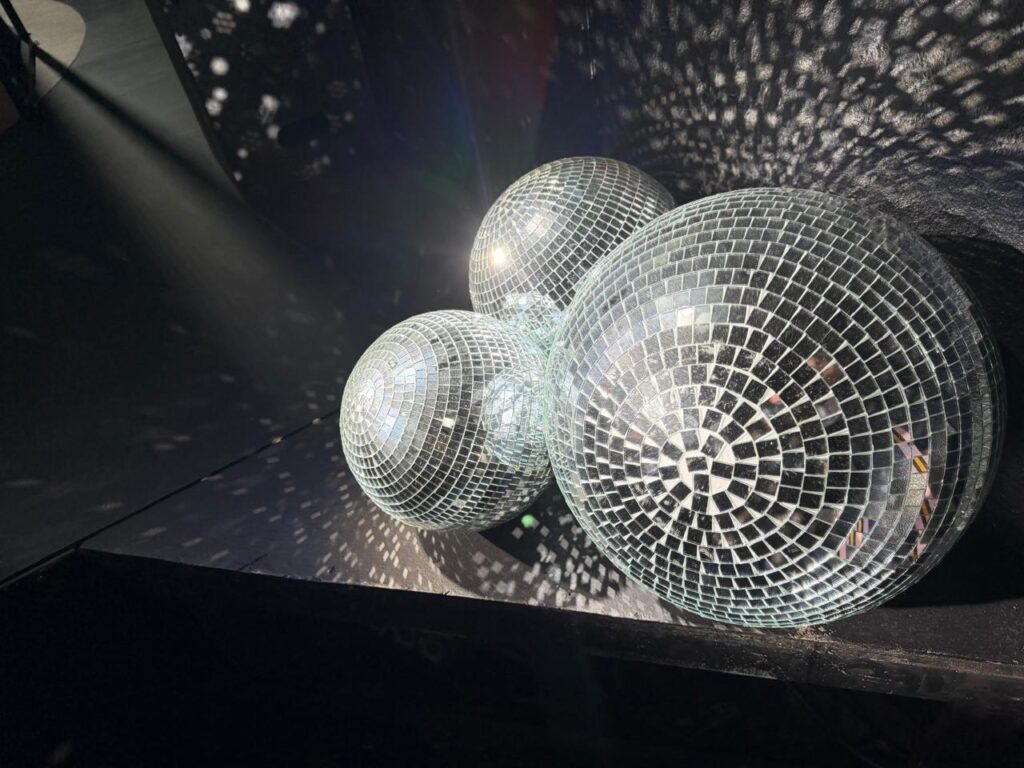
The minimalist glittering design (set and lighting) by Britz heightens the mirth and quirkiness of these protagonists as they orbit around each other. It is a very funny play and there is a deep sense of them taking the Mickey out of each other, which is absolutely joyous in this production.
In Nick Payne’s script, Marianne is the dominant Alpha character. She is the physicist with a “proper” job. Roland is a beekeeper, keeping hives in an urban setting. It is set in London, but it could set anywhere. The bring their own stories and that is a meta text – not conveyed in words but suggested subtly in images lingering like palimpsests on the screens. Wolf Britz: “Mwenya’s ancestors make an appearance in the form of visual representations through photographs as part of the projection”.https://thecaperobyn.co.za/interview-holding-space-for-inner-workings-of-the-characters-wolf-britz-designing-for-constellations/
In the opening strings, Marianne asks Roland if he makes a living from honey. When she goes on cerebral rants about scenes, a laconic Roland purrs that he founds it a turn on and very sexy. Further into the relationship – who cares where it is on their trajectory-ies – Roland gets cerebral when he talks about honeybees and marvels that they have an “unfailing clarity of purpose”. Their lives are short but they know their purpose. Marianne and Roland cannot decide what they want. We become baffled, frozen by choices. I think that is a core takeaway of this play – a call to not overthink life, relationships, the universe. There is life, hopefully love and care for others and dovetailing with that there is illness, aging and death which is there for all of us and I don’t mean that in a morbid way. It is dealt with beautifully by Nick Payne, so don’t think it’s a morbid play. I repeat – it is funny, warm, entertaining and utterly engaging.
Reading interviews with Nick Payne, it appears that the play was sparked by a documentary he saw on the multiverse. He wrote the play when his father was dying and he was meeting the woman who would become his wife (can one say that that they were courting each other?). Love and grief were intertwined. That is life: Navigating all the stuff. Some have more, rather than less but whatever. Payne said that initially, “the idea of a multiverse initially struck him as ‘terrifying and really romantic’ but through the process of writing, he realised that no matter which “universe the couple inhabit, their story always has to conclude in the same way – with death. And he asked himself – how he felt about that right now – that we all have to face death at some point – us – loved ones. [https://www.theguardian.com/stage/2012/nov/02/nick-payne-playwright-constellations]
Payne was 28 when the play was published. Remarkable writing and vision for 28. Writing Constellations allowed Payne to process his grief. In the play that is channelled viscerally through Marianne. In one of the narrative strings she can’t commit to Roland because she is dealing with the grief over her mother. Marianne: “Mum wasn’t scared of dying, she was scared of being kept alive. You know? Roland: Yes Marianne: That wasn’t what scared her. Roland I understand.” Added to that Marianne, grapples with her own medical diagnosis, agonising over life and death questions, which is heart breaking.
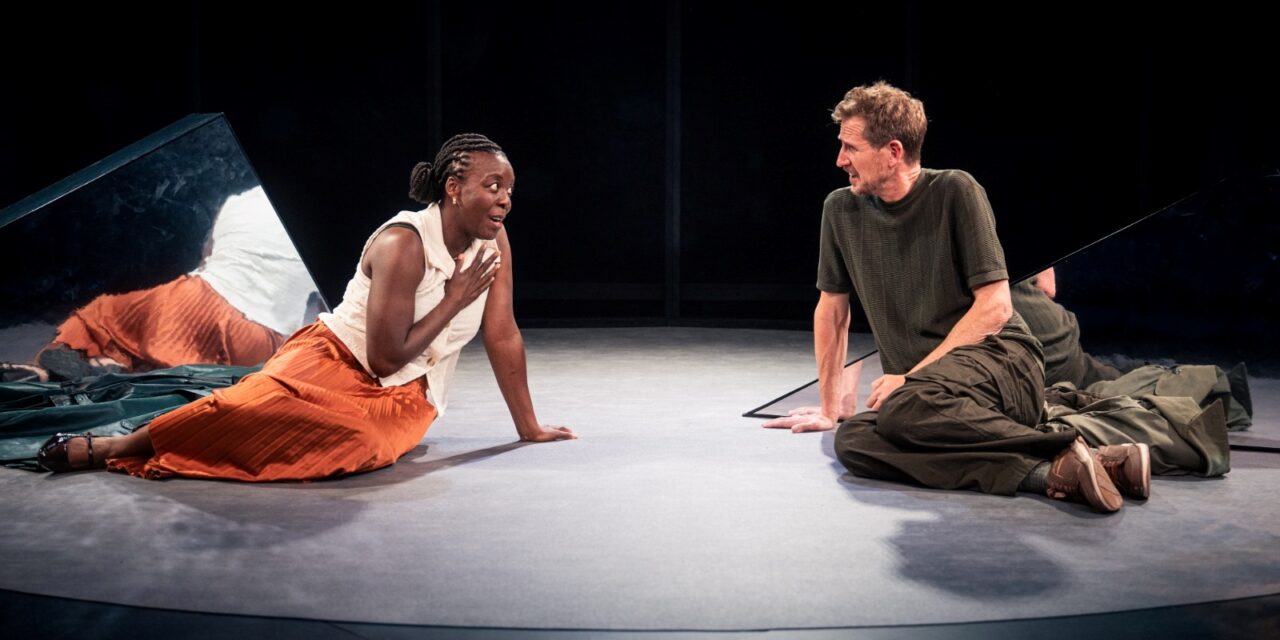
Roland who has less “words” than Marianne in Mark Elderkin’s rendering, evokes infinite tenderness, care, longing, support, love, through his sheer gentle presence and response through his body to Marianne. The incredible Kabwe uses her body as a foil for the barrage of words and as Marianne, her body cleaves to Roland as they push and pull mirrored rosta on wheels, across their multiverse of possibilities. They mirror each other. There is an embrace even when they are at odds. The push and pull attraction of these two humans is palpable across all the narrative strings. They are tethered and untethered everything always all at once. Pather with his dance and choreographic background, kind of scores their physical and verbal interactions so that the narrative strings become intertwined. Indeed, he says: “I am working with score by Philip Glass which has haunted me also for several decades when I was studying at New York University and made a dance work to the score. Its an older work but it’s the beginning of a trend of repetition of musical phrase (beginning of course with composers such as Erik Satie and picked up in the work of Michael Nyman amongst others). The minimal modality of repetition is central to the play, an enduring, unending ebb and flow of us as particles in a multi-verse, in constant repetitive motion.” https://thecaperobyn.co.za/interview-jay-pather-on-directing-constellations-by-nick-payne-in-south-africa-2026/
Wolf Britz says his design is geared to hold space “for the inner workings of the characters.” https://thecaperobyn.co.za/interview-holding-space-for-inner-workings-of-the-characters-wolf-britz-designing-for-constellations/ Britz: “Having a minimal approach to the spatial design means that we can jump from a ballroom to an astral plane at the drop of a hat with ease.” The visually pared down set, sans cutter, does that and at the same time, fun and quirky pushes through for example in the glitter balls (aka planets) made from broken pieces of mirror on polystyrene balls which look they have been made for a high end science project. There is something so tactile and playful in these balls, scattered in the space. I also find the moving of the rosta as playful as Marianne and Roland, play games with each other – science, bees and ultimately the yearning to connect and find a clarity of purpose; somehow in these complex spaces we inhabit. Jay Pather’s tender direction holds space for Marianne and Roland to step out beyond their professions and ideas. They are just two people, standing in a universe, searching for love.
Please do not miss Constellations South Arica 2026. Bravo to all for holding space for this brilliant play as beautiful, lived performance on stage.
✳ Related coverage on Constellations, South Africa 2026, produced by How Now Brown Cow Productions: https://thecaperobyn.co.za/interview-jay-pather-on-directing-constellations-by-nick-payne-in-south-africa-2026/
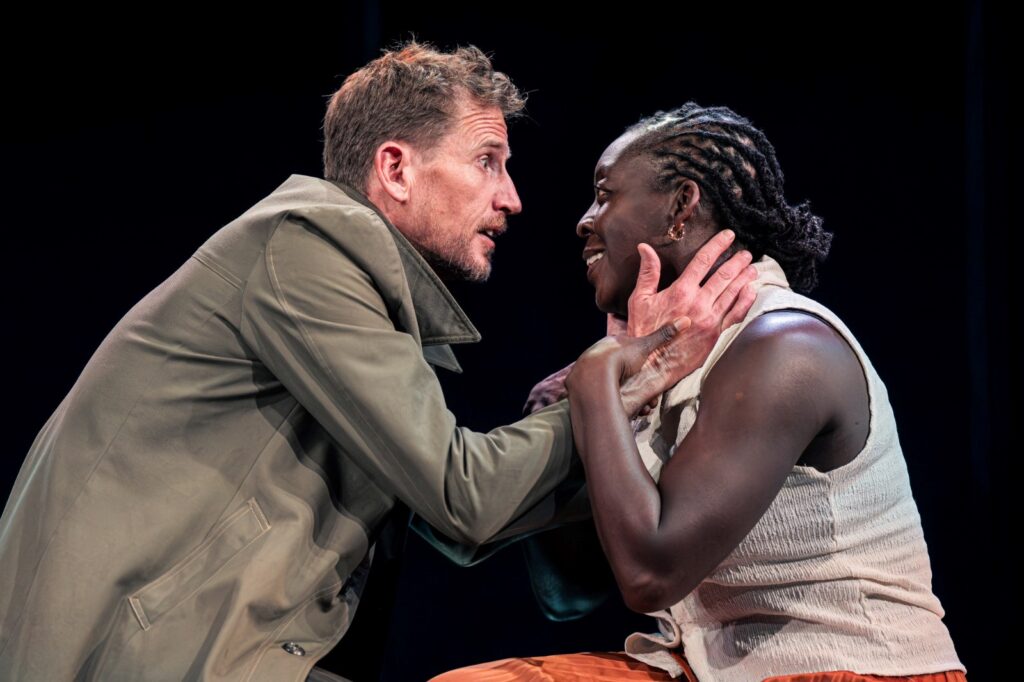
❇ Mwenya Kabwe and Mark Elderkin in Nick Payne’s Constellations, produced by How Now Brown Cow, South Africa 2026. Pics: Daniel Rutland Manners. Supplied.