
| Who: Zubayr Charles – writer of the two-hander Brasse, Tot Laat Toe August 2026 season at Baxter: August 7-15, Baxter Masambe Theatre, Cape Town Director: Carlo Daniels Cast: Anzio September and Abdullatief Davids Bookings: Webtickets |
The genesis of Zubayr Charles’ play, Brasse, Tot Laat Toe, his 5th play goes back to a short story he wrote shortly after matriculating. He developed the story for the stage, working with director Carlo Daniels, who has brought in a physical theatre approach to enhance poignant shifts in time and narrative with a magical realism, sparked by the two protagonists, played by Anzio September and Abdullatief Davids. Unlike his previous plays, Brasse, Tot Laat Toe, is foregrounded by a conversation rather than a plot and delves deep into friendship, belonging, identity, love in all its guises, aging and how we deal with moving on – or not:
TheCapeRobyn: How would you translate Brasse Tot Laat Toe – for those not up on Kaaps – who might miss nuances?
Zubayr Charles: During my high school years, in the late 2000s and early 2010s, “Tot Laat Toe” was a common phrase of endearment between friends. So, to translate the title “Brasse, Tot Laat Toe” means “friends forever and always”. At school, it was also subconscious rite-of-passage or an unwritten rule where we would write the names of our friends and under it “tot laat toe”. The phrase was also used romantically between two people: if you liked someone or dated them, you would write your names and under it “tot laat toe”.
Originally, the title was a pun on the friendship and platonic love between our two main characters, but because a lot of the play deals with death, Carlo’s interpretation of it is: “Friends to the kabr (to the grave)”. So as we have been sifting through the script, the play has been redeveloping and the title has been constantly interpreted in different ways, which is quite interesting.
TCR: Did a particular incident spark this play?
ZC: Many of my plays stem from short stories that I have written many, many years ago. I used to be suffer severely from insomnia, and in my late teens and early 20s, I would just randomly think of stories that would keep me up at night. One of them was this idea of two misfits at school becoming friends in detention. Without spoiling too much, as the friends get older, and due to severe betrayal, they grow apart. Years later, in their mid-30s, they reconnect.
As I’ve been building traction as a theatre maker, I decided I wanted to revisit that short story. Because this bra’s a psycho, Please, don’t call me moffie, and The Battered Housewives’ Club deals with severe and emotionally intensive subject matter, I realised that I just wanted to tell a simple story and move away from storytelling that is so “in-your-face”.
I then reworked the short story into a play, and approached Carlo Daniels. I asked him if he could sift through the story and find something interesting to comment on. Thereafter he highlighted sections and key elements for me to rework in the writing.
I’ve often heard that a “real writer” is able to master the art of having characters converse around a table. I wanted the story for this play to be driven by conversation rather than plot.
TCR: Is the play set when the men are in their 30s? And it looks back to their younger selves?
ZC: I will explain this play in a linear sense – in relation to parallel narratives. So Junaid and Luqman became friends – after meeting while serving detention at school – on recurring Saturdays. The play is also inspired by The Breakfast Club, the famous John Hughes film.
Luqman, follows a general bully and bad boy archetype, whereas Junaid is more of the goody two-shoes and nerd. Both are misfits. Both develop an unlikely friendship. And as the friendship develops, there’s a severe betrayal that happens within the play. Thereafter, as the narrative shifts to fifteen years later. Junaid comes to visit Luqman after the death of Luqmaan’s wife on the evening of her “forty nights”.
In Cape Malay, the “forty nights” is an important night of commemoration where the family and loved ones honour the deceased through acts and prayer, remembrance of God and the recital of the Quran. Because this is a play, with a lot of the drama and conflict. Luqmaan’s grieving process is disrupted. And as explained before, the play jumps between present and past.
TCR: What made you write the play in Kaaps? Your other plays have included Kaaps words but have been primarily in English? Why Kaaps for this play?
ZC: As somebody who has been studying language and teaching English for over nine years, I must mention that Afrikaans is not my home language. It is the language of my mother and father. Of course, their type of Afrikaans is mixed with Kaaps, Cape Muslim vernacular and Arabic. And although they spoke to us in Afrikaans, we responded in English. My siblings and I also attended schools where the medium of instruction was in English. And although my Afrikaans has improved severely over the years, as I am teaching and engaging so much with English on a daily basis, the language does not come as naturally as it used to.
For the play, I wanted to challenge myself as a writer beyond the plot. Number one: I followed the writing conventions of standard Afrikaans in terms of sentence structure, yet I followed the spelling of words from the newly released Kaaps dictionary by Professor Quentin Williams. I’ve also incorporated many Islamic phrases, Arabic, Cape Muslim vernacular, and various Cape Town slang words with English words mixed. Language wise, the script has had an interesting development.
I am aware that the play might not be accessible to the general public or those who have been following my career within theatre, however, that is the beauty in representation. It is important for Cape Malay culture and language to find its place on mainstream theatre in Cape Town.
I am hyper aware that the play may not be as commercially popular as our other plays. However, I believe it is important to represent my history – as a Cape Malay man – on stage – alongside Cape Town’s culture, slang and Kaaps.
Stories rooted in Cape Malay and broader coloured communities rarely find space in mainstream theatre, which makes presenting this work at the Baxter Theatre especially significant for us all. I could’ve written this story in English, but language shouldn’t be boxed. Theatre and storytelling shouldn’t be boxed.
TCR: Can you talk about Carlo Daniels as director? You have directed your other plays. This time, not only do you have a director but it is a director who is known for his physical theatre approach?
ZC: I approached Carlo Daniels to direct the show for several reasons. First and foremost, Afrikaans is not my first language, so I needed someone who could interpret my words from a different linguistic perspective. I have also often been encouraged to collaborate with other directors to strengthen my own understanding of staging, direction and storytelling. I recognise that writing is my greatest strength, whilst directing remains a craft in which I still have many tools to acquire. Most importantly, I did not want this play to feel like a repetition of something I had created before. I have long admired Carlo and everything he has taught me since he mentored me during the 2023 Zabalaza Theatre Festival.
As a coloured man living in Cape Town, he also brings his own cultural background and lived experience to the material, allowing him to interpret the story in ways that differ from my own. I knew that he could elevate the text by incorporating physical theatre into the storytelling. Although the play possesses a rich, nuanced and highly specific spoken language, Carlo has developed an equally powerful physical language through which the actors’ bodies tell the story. Carlo often reminds me that the play is deep and intense, and it has been fascinating to watch him interpret my words.
I feel deeply honoured to work with such an immensely talented, multifaceted and multidisciplinary artist. Every rehearsal leaves me feeling chuffed because I get to witness his mind at work and see his artistic signature emerge within my writing. There is a particular privilege in surrendering your work to another director, especially when you can admit that you would never have staged the play in the same way or followed the same creative route. Carlo has made the production abstract and metaphysical.
At times, one might even describe it as absurdist theatre, alongside its strong elements of physical theatre. More significantly, however, Carlo identified an element of magical realism within the writing. I do not want to reveal too much about his interpretation before audiences experience the production, but magical realism was certainly not something I had consciously intended when I wrote the play. When Carlo used that term to describe the work, it completely blew my mind. I had never imagined that I possessed the ability to write something that could be understood through that tradition. It has been an extraordinary honour to work this closely with Carlo once again. I will forever remain indebted to him for the care, imagination and artistry with which he has brought my words to life.
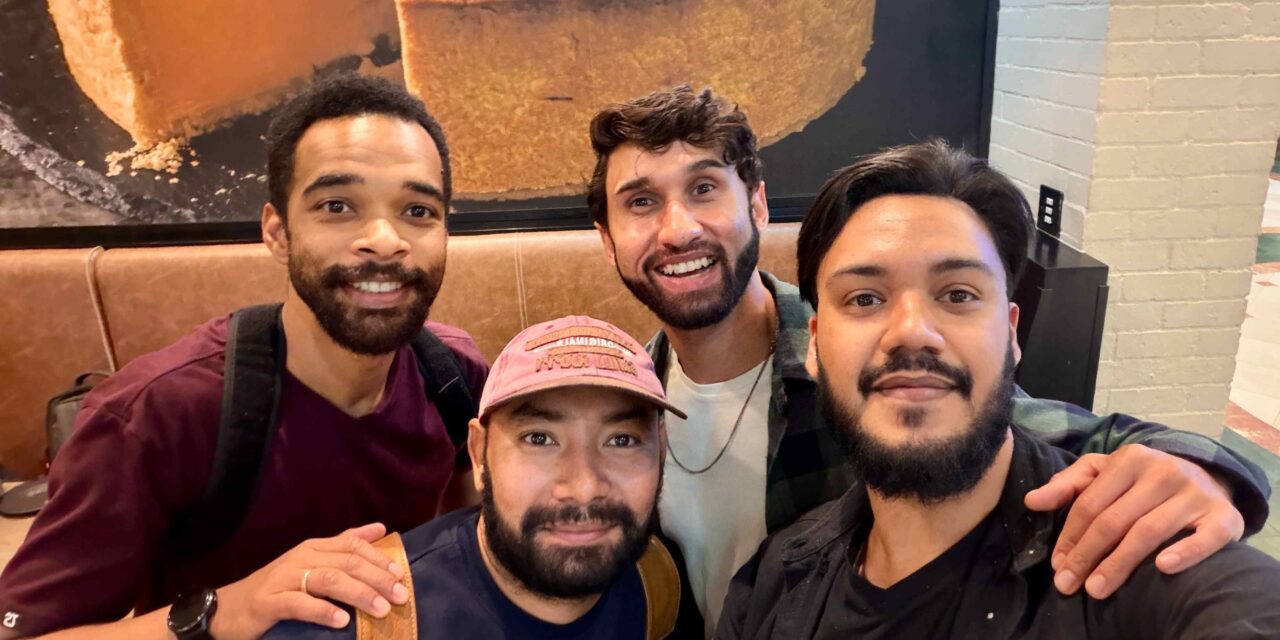
❇ Featured image: Team Brasse, Tot Laat Toe: Front from left – Abdullatief Davids (actor), Zubayr Charles (writer); back from left – Carlo Daniels (director) and Anzio September (actor). The play is on August 7-15, 2026, Baxter Masambe Theatre, Cape Town. Pic: Supplied.


