
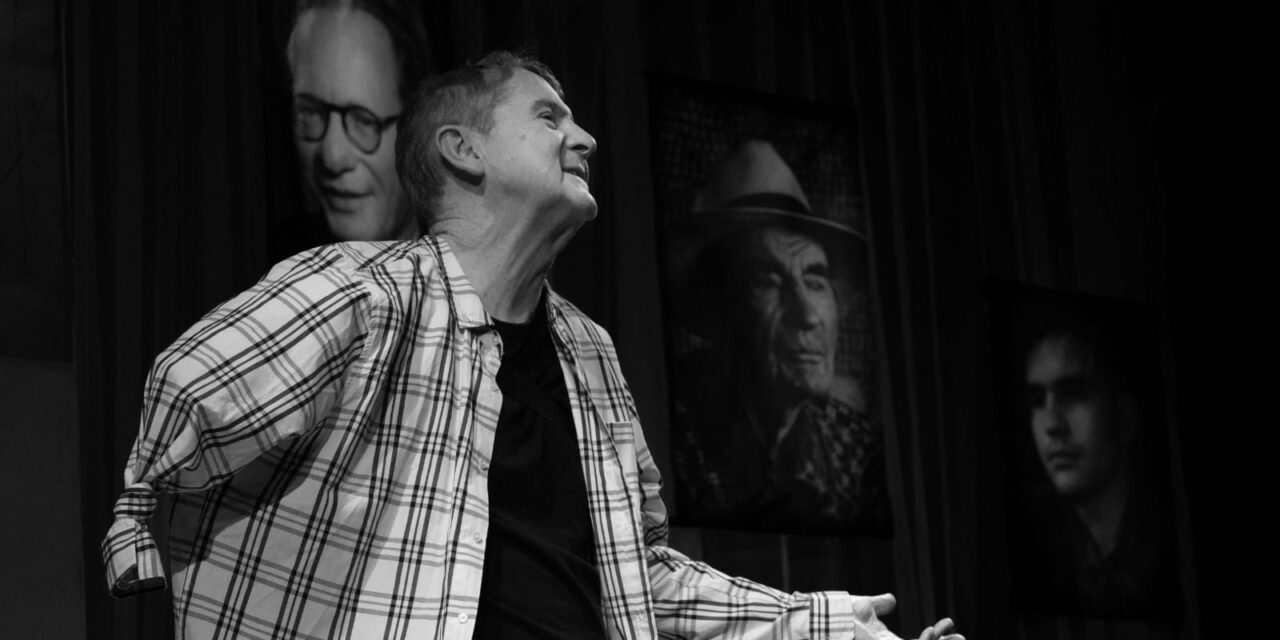
| What: Albie Sachs: Father, Son and Soft Vengeance When: October 13-31, 2026 Where: Baxter Studio, Cape Town Writer: Gail Louw Performer: Graham Hopkins Director: Fiona Ramsay Lighting design: Oliver Hauser Sound design: Dean Pitman Short arm: James Dee Set design: Fiona Ramsay and Graham Hopkins |
Albie Sachs: Father, Son and Soft Vengeance, written by Gail Louw, performed by Graham Hopkins and directed by Fiona Ramsay is on in Baxter Studio, Cape Town, October 13-31, 2026. The production is presented by Troupe Theatre Company and the Baxter Theatre, in association with Daphne Kuhn. The play was previously on in Johannesburg at Daphne Kuhn’s Theatre on the Square. The Baxter season marks its debut in Cape Town.
It was a privilege to be at the Baxter, last night, October 14, at the opening. After the rapturous ovation for Graham Hopkins, Albie Sachs went on to the stage and spoke about the emotions that he felt watching and that he felt that the struggles were so well captured. Albie thanked the team for its care and dedication, in bringing his story to the stage. He then invited his son Oliver to speak. Oliver told the audience that in the early stages of the play script, he was represented as a generic eight year old. He felt that it was important to share “a piece of his story”. His observations and reflections are a key part of this beautiful and intensely moving play. Oliver is present, through his voice (a voice over). Watch here as father and son hold space for each other, in a very special gathering on the stage: https://www.facebook.com/share/v/1CRCnvBapc/ and https://www.instagram.com/reel/DefZR-etk1m/ Judge Albie is holding space for his son and Oliver is holding space for his dad.
Oliver’s curiosity and spiritedness becomes a protagonist in this play which surprised me – in a good way. It starts off as a memory play. We see Albie waking up, dazed, after the bomb blast in Maputo, in 1988. He was 53. Physically, he was left without an arm – his writing arm – and with impaired vision. He was grateful to be alive. He was upbeat but emotionally it was a tough journey. He craved physical touch, physical connection. He faced his rehabilitation with humour and an upbeat sense of purpose and triumphed in learning how to tie his shoelaces with one hand. He was determined to lead a full life he led after the car – which he embraced with a fierce “soft vengeance”. He was not powered by hate and the wish to murder and maim. He did not seek physical retribution. He found love, with his second wife, Vanessa September (an extraordinary woman in her own right) and Oliver cemented their union.
As Albie shares his story, his famous dad, Solly Sachs (the union organizer) is looking over his shoulder – figuratively and literally. There are two portraits of the enigmatic but elusive and absent dad in the installation set, dangling in the space. The portraits of Solly are accompanied by portraits of Albie – before the bomb blast attack and after –with his iconic Panama hat and bright shirt. Oliver bookends the sequence of portraits – young Oliver age eight is on the left – starting the cycle. Oliver – now – on the cusp of twenty closes the circle, In the centre is Leonardo da Vinci’s Vitruvian Man (1490) – overlapping figure of a naked man in a circle and a square.
So the play, starts off as a memoir on stage, Albie sharing his story and then it segues into Oliver’s journey, looking over his dad’s shoulder. We hear about Oliver’s struggles – overlapping in a sense with the struggles of his dad and the struggles for a Democratic Society – overlapping images and narratives.
Albie is brave. Oliver, on the cusp of turning 20, is brave in being present in this narrative – with his voice; his words, sharing a piece of his self. Graham Hopkins is extraordinary as Albie – bringing the twinkle, sassiness and naughtiness of the man to the stage. It is not something one can get from Google. It is a lived experience on stage, Albie channelled by Graham Hopkins.
There is a wonderful sense of the prosaic, the everyday struggles of parenting and relationships, which Gail Louw as writer has nailed in bringing this story to the stage. It is intensely personal and intimate. The great icon, the living legend Judge Albie Sachs is there in front of us, auditing the trauma, loss and grief after the bomb and how he chose to be present in life – after – professionally and personally. On the home front, there was his anxiety of being an old dad – not being present in his son’s life – elusive like his dad, Solly. The text, drawn from Albie’s own writings by Louw has been finely calibrated, tempered with Albie’s humour and wry sense of self. We get a sense of the excitement, thrill and joy that Albie felt as being a key player in the Struggle for a Democratic South Africa and the joy that his family unit (Vanessa and Oliver) have brought him.
Last night, October 14, 2026, Judge Albie stood on the Baxter stage, age 91 (born January 30, 1935), inviting us along to experience part of his journey – not as a luminary and former judge on the Constitutional Court but as a man who has led a full and present life and who continues to inspire the Nation.
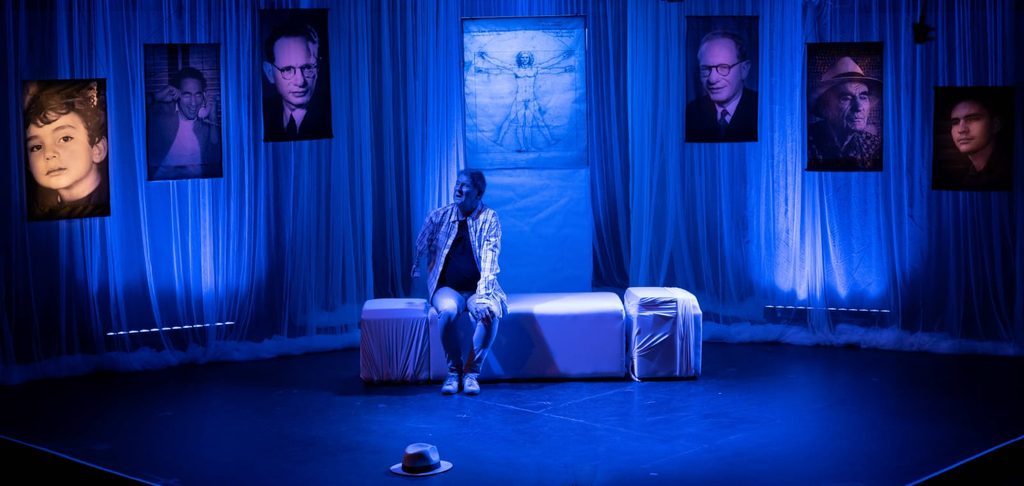
✳ Albie Sachs: Father, Son and Soft Vengeance by Gail Louw, October 13-31, 2026, Baxter Studio, Cape Town, starring Graham Hopkins and directed by Fiona Ramsay. Photo: Fiona Ramsay. Supplied.


