Zubayr Charles’ play Brasse, Tot Laat Toe, starring Anzio September and Abdullatief Davids and directed by Carlo Daniels was on in the Baxter Masambe, August 7-15, 2026. It was the first “official” run, after its acclaimed debut at the 2026 Suidoosterfees. It was the first time that Carlo Daniels was directing a play by Zubayr Charles. Daniels brought on board his physical theatre approach and was involved in conceptualising the design – which involved stripping away the walls and curtains in the Masambe – creating an installation type set. He gives insights into the play, his creative process and this production:
TheCapeRobyn: What interested you about this play – set in a particular milieu now – in Cape Town? You say: “The play is also a slice of Muslim culture and Cape Town culture that we don’t often see represented on stage.” Please expand on that?
Carlo Daniels: This play has a very specific tone. One can also hear with clarity that the writer is someone who grew up with Islam and in Cape Town. I really love that about the play. It has a very specific setting and tone and I wanted to lean more into that and at the same time learn more about such households (as we have in our play) and how culturally things are dealt with. So it is an attempt to bring the Afrikaaps language to stage and a closer look at the people who speak the language.
TCR: Did both you and Zubayr work on taking the play from page to stage? And specifically – how did the ideas around magical realism come about?
CD: The play deals with quite complex themes such as loss, grieving, friendship, death, inheritance etc. And yes it jumps to the past and present, so for me, as a director, it was about how do we find a way to follow the events in the life of the characters and through playing on the floor exploring the creative possibilities. We managed to find a way that is interesting to us and not linear but clear. Then, there is another element to it that is more sensitive such as the rituals and prayers and the respect we would like to show: these are things bigger than us as artists and we recognise there is a strong spiritual element that comes with it. Zubayr is the writer of the play in total. I directed and he was always open for me to change the structure where I feel it’s needed and move things around.
TCR: Insights into the process?
CD: I like to start my process with movement first before we work on dialogue. I know sometimes actors don’t expect it and only understand after day one or week one: this is how the story will be told and we will not only be “talking” I am interested in the meaning, the story, acting, movement, sound, silence, all in all to find the best way to tell the story using what tools we have. In this case we didn’t have a big budget but we had our bodies for starters, a space and a script.
TCR: Can you talk about language and how physical theatre is used in this production to convey meaning, when chunks are lost in translation, for people not familiar with Afrikaaps argot?
AD: I find sometimes there are things that words cannot explain, feelings, thoughts, dreams etc. My best way of expressing myself is to move. To trust one’s movement – that does come with hard work – but it’s something I really value and I feel that is something that can bring healing and a feeling of freedom. I would love for the actors to attempt with me to bring this to our work and in this way have communication with our audience, beyond words. To captivate the audience, to make them search for meaning in the movement and to trust their own findings.
TCR: How did this directing gig come about?
AD: I met Zubayr when I was mentoring participants of the Zabalaza Festival and he was one writer-directors I mentored, and so I was familiar with his writing style. He was always open to try different things and ways, just to explore to find the best result, so that is something I always like in terms of collaborating cause often when I work there is a lot of exploration. So now it’s about two years after that Zabalaza Festival that he contacted me to ask if I would be interested in directing this play and I like working with young people, writers, actors etc. Sometimes it’s a workshop, or teaching, mentoring, that kind of stuff. I had a gap for it so I jumped on board.
TCR: Thoughts about your transition from acting back into directing? You have a Fleur du Cap Award for directing but your focus for the past two years has been as an actor in the Baxter’s Fire Burning Company.
CD: I love directing, I know I am first a performer but above all a theatre-maker. So I always act, sometimes write, sometimes direct and I am really passionate about them all. For me it all boils down to making theatre, so it is a big shift to jump from acting to directing. There are huge responsibilities as a director: different rhythms, different ways of expression and also working with lots of people and making sure that things are in order. So, sometimes it brings more restless nights then performing itself, but I love it all and nothing is really easier than the other it’s all hard work and if it comes together it’s most rewarding.
TCR: Can you talk about the framing used in this production – the frames hanging in the space and the use of framing – in terms of using the wall by Junaid (Anzio September) literally grounding himself along the wall and for the most part staying off stage?
CD: The frames come out of the fact that the play is set in the family house. Luqmaan now being alone in the house that was once filled with his loved ones and now it kind of all feels empty physically but still filled with the memories of what was. And so in trying to create a world that can capture that I felt the frames might be a way of achieving that. The use of frames was also on a practical level something we could find and won’t cost lots of money. I really wanted to use the space (Masambe Theatre) and Junaid (played by Anzio) also has his own relationship with the house. It is the place he grew up in but also abandoned when he was old enough, he regrets that part and now that he is back in the house, clings to the walls and with his gaze, reaching into the frames.
TCR: It is a very interesting use of space in the Masambe – stripping out sidewalls and increasing stage size? Comment
CD: I like to explore the spaces I work in. Each space has a gift and the Masambe came with many. In our story there is a sense of emptiness at the same time a place full of reflection and a sense of grappling with the absurdities of life. I felt it appropriate to remove all curtains of the Masambe and see what is underneath it was not easy and I had to wait a day or two to get it done but, when the curtains was removed it felt right and empty enough and then we added more objects in the space and they were empty too: frames, empty cup and a muslah / salaah mat (prayer mat)
TCR: How did the conceptualisation of the design come about?
CD: So landing on the design, the story itself, always guides one best and the more one thinks about the story there are such gems, I am not saying it is a great design or anything like that, I am sure someone who specialises in design will have some notes for me, but it felt like something in the right direction one is often pushed to make something that uses more creativity than money. I am grateful how the Baxter Theatre helped us. They opened props and costumes to us and we found our whole set basically in the props room and reused them.

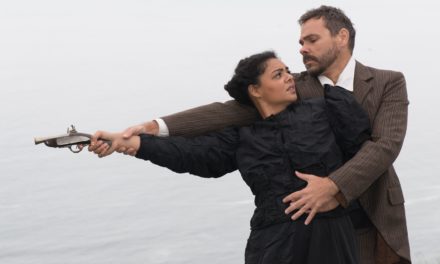
✳ Brasse, Tot Laat Toe, by Zubayr Charles, directed by Carlo Daniels, Baxter Masambe Theatre, Cape Town, August 7-15, 2026. Carlo Daniels in rehearsal with actors Anzio September and Abdullatief Davids. Photos by Brick Mbekwa. Supplied.