| What: Working Title, Live Art Weekend at Masambe Presents – The Soil Remembers When: October 1-3, 2026 (Thursday – Saturday) Venue: Masambe Theatre, Baxter Theatre Centre, Cape Town Time: 7pm. The programme is about 90 minutes. Bookings: Webtickets Direct booking link: https://baxter.uct.ac.za/events/live-art-masambe-soil-remembers Tickets: R120 full price, R100 students /seniors/group booking Curator: Carin Bester Featured artists: Live Art Kopano Mashike: Before the City, I Was Home Laphakade Myataza, Lutho Magubu & Kwakhanya Mboniswa: SANKOFA Siphesihle Nkantini: The line is dead (Calling the soil) Page Dina: Naturalised Video Art Nashilongweshipwe Mushaandja, Justina Andreas and Bupe Chiwala: KINA Note: There will be a short Q & A session with the artists after the performances on Thursday October 1. Some of the performances will be taking place outside. Take something warm in case it is a chilly night Age restriction: No under 12s |
How is “our history and identity” shaped by nature? How does the land continue to carry that history “long after people have moved on”? Carin Bester has curated Live Art Weekend, around the thematic prompt of The Soil Remembers, Baxter Masambe, October 1-3, 2026 (Thursday – Saturday). The theme was sparked by a performance work that she presented at KKNK in 2025, Die Grond Onthou. Bester and the artists provide insights into the programme and the performance pieces:
TheCapeRobyn: Carin Bester, can you walk us through the programme– The Soil Remembers -from inside to outside spaces – and the order of pieces?
Carin Bester: At this stage, I do not yet know the final order of the programme or exactly which spaces each work will occupy. We only finalise that during the technical move in sessions with each artist in the two days before the Live Art Weekend. The artists already have ideas about where they would like to work, but Live Art is very responsive to space, and those ideas can shift once the artist is physically in the venue.
That is one of the things I value about Live Art. The space is not simply a container for the work. It can influence the rhythm, scale and meaning of a piece, and sometimes the work changes because of what the artist encounters there. Unlike more traditional theatre structures, Live Art is often less fixed and allows for adjustment, response and discovery during the process.
TCR: Was the theme, prompted by José Cardoso’s 2023, with the same name?
CB: The theme came from a performance work I presented at KKNK in 2025, Die Grond Onthou. It forms part of an ongoing interest in how our history and identity are shaped by nature, and how the land continues to carry that history long after people have moved on. Through researching the work, I became increasingly aware of how many artists are engaging with related ideas around land, ancestry and identity. I wanted to extend that conversation by looking at how other artists respond to these questions through their own practices.
TCR: Can you talk further about inherited memory as the theme, at Live Art Weekend? As you say, regarding the theme: Belonging is not only where we live, but what lives in us.
CB: For me, inherited memory is about the idea that memory does not only sit in the mind. It can live in the body, in family lineage and in the places we come from. A few years ago, I stepped off a plane in Bloemfontein and had an immediate physical sense of recognition. I cannot fully explain it, but there was a feeling within my body, a knowing that I came from that soil. My body seemed to know where it was before I had consciously thought about it.
I think where we come from shapes us in ways that are both physical and emotional. Our bodies respond differently to certain landscapes, and there are places where we feel more settled, more connected, at home. Some of that may come from our own memories, but I believe some of it is carried from generations before us.
This links closely to ideas I have explored in Die Grond Onthou and Komvandaan. Land is not only a backdrop to our lives. It holds history, and we carry parts of that history with us. There is often a longing to return to a place where nature speaks to us on a deeper level, where there is a sense of recognition and belonging.
That becomes complicated because belonging to land is never only personal. It’s political. Man-made borders, displacement and forced removal have shaped people’s relationship with land in South Africa and across the world. So the theme also sits within that tension between the place the body recognises as home and whether we are able, or even permitted, to return to it.
TCR: This is the 7th Live Art Weekend? What is in store for next year?
CB: This is indeed the 7th Live Art Weekend, but the first one for 2026. Earlier this year, Working Title presented a five day Live Art Workshop facilitated by Carin Bester and Qondiswa James, with Oupa Sibeko as guest facilitator. The final day included an open showcase and panel discussion.
For 2027, we hope to present both another workshop and a Live Art Weekend, while also exploring ways of taking Working Title’s Live Art offerings into different areas. We also curate Live Art for Suidoosterfees, and next year will mark the fourth year that Live Art Curation by Working Title forms part of the festival programme. We hope to extend this presence to more festivals. In October, Haar Pad Huis toe, first presented at this year’s Suidoosterfees, will also be performed at Woordfees in Stellenbosch.
TCR: Kopano Mashike, please tell us about Before the City, I Was Home? As a socially engaged artist, you are the founder of City Of Shacks, “a socially engaged arts project centred on the stories, creativity and lived realities of people living in informal settlements”. As part of your journey, you began by studying journalism. What can we expect from your piece at Live Art?
Kopano Mashike: Before the City, I Was Home is not separate from City of Shacks; it is a new installation/ offering, from the project. City of Shacks has always been about stories of home, displacement, survival and the lived realities of people navigating the city. This piece allows me to explore those questions through my own body and experience. It’s quite a confessional piece for me. Moving from Johannesburg to Cape Town in 2024, as an artist to follow a dream that nobody else can really see is, honestly, a little crazy. I know some of the things I’ve had to do to survive and stay in this city, but I also know that my story isn’t unique. There are so many young women who have had to negotiate their bodies, their safety and their dignity just to survive.
I am, as a result, very interested in the way the body can almost become a ticket to safety, something you have to use or give up in exchange for somewhere to sleep, protection, money or simply the opportunity to keep going. There’s a kind of silent abuse in that, because when survival is involved, people don’t always recognise it as abuse. And the question we so often ask is, “But why don’t they just go back home?” And in return the work really asks what if you don’t have a home to go back to?
I started out as a journalism student and although I dropped out, I don’t think I ever stopped being interested in people’s stories. I just found different ways of telling them through performance, film and socially engaged art. This is also my first time really exploring live art, so as a performer I definitely feel a little out of my element. But I also come to it as a curator, and that helps me understand it differently. So our audiences can expect a ritual. There is a cleansing that becomes a way for me to return home to myself to reclaim my body and perhaps remember who I was before survival required me to become something else. And underneath all of that is this idea that the soil remembers. Even when we leave places, and lose homes, even when our bodies carry things we don’t always have words for, the ground remembers that we were here. It’s intimate, physical and very personal. It’s also my first live art work, so I’m excited and a little terrified to see what happens when I place that story in front of an audience.
TCR: Laphakade Myataza, Lutho Magubu and Kwakhanya Mboniswa, can you tell us about Sanofka which will be performed at Live Art Weekend? Is it referencing the Sanofka bird – which looks back, although it is body faces forward?
Laphakade Myataza, Lutho Magubu and Kwakhanya Mboniswa: Yes the name is referencing to the Sankofa bird. Which is usually associated with the proverb in Akan language (Ghana) “Se wo were fi na wosankofa a yenkyi,” which translates as: “It is not wrong to go back for that which you have forgotten.”
The piece is centred around presenting a token of acknowledgement to the amount of baggage that the young people, as a collective, carry in South Africa; through the melodies of the body being displayed for the audience. The piece is an invitation for those that will be present to ask themselves, as they are watching: To what degree, can we as young people extend our care for who we are? How do we have to evolve – around the world – with all its demands?
We aim to create a piece that speaks to us as the living beings with just a glance at the body and its connection to all the other departments within the living being.
TCR: Page Lotze, insights please into Page Dina: Naturalised?
Page Lotze: In Naturalised, a solo live performance, Page Dina attempts to plant themselves – to take root – while a voiceover recites the NEMBA (National Environmental Management: Biodiversity Act) classifications that sort living things into native, naturalised, and invasive. Exploring their own mixed heritage, the piece asks what it means to belong to this land, and stages the tension of reaching for a rootedness.
Page Lotze: “I grew up in suburbia in Johannesburg, far from the Cape Malay lineage that ties my family to this land – roots with a deep history here, which colonial and apartheid systems worked to sever and dilute.
This piece explores the memory a body holds and the memory soil holds, and what happens where those two archives meet. My disconnection to the land is personal, but it isn’t only mine: these are systems that cut so many of us off from older ways of belonging to land, replacing that knowledge with settler ideas of ownership, privatisation and separation. So the piece asks what it might mean to be in connection again – to root myself in a place I come from but was raised apart from.“
TCR: Siphesihle Nkantini, what inspired The line is Dead which will be performed at Live Art Weekend?
Siphesihle Nkantini: The Line is Dead is haunted by the direct words of Mama Winnie Madikizela-Mandela in The Trials of Winnie Mandela: “I quarrelled with him. I said to him, ‘What are you negotiating? What are you compromising? We have suffered too much, we have given away too much.’ We had negotiated enough… We had the enemy on its knees, but we went to CODESA and gave away the land, gave away our wealth, and accepted a desk in an office.”
The piece is born from the lingering echo of that warning the hauntology of a liberation deferred. It channels the visceral tension between the compromise made behind closed doors and the physical, unyielding reality of a dispossessed land. The spark of the work lies in the tragic exchange described by Mama Winnie: trading the actual earth beneath our feet for a chair and a desk in a bureaucratic office. Why This, Why Now? We are living in a moment where the promises of institutional reform have worn thin. Decades into a neo-colonial era, the structures built to resolve historical debt continue to delay it with polite, systemic inertia. We are constantly told to trust the process, sign the forms, and wait for the motion to be passed all while the physical landscape remains unchanged.
Our current generation is shifting from asking – to reclaiming. There is an urgent cultural need to stop bargaining within frameworks designed to exhaust us, and instead re-examine where true authority and memory reside.
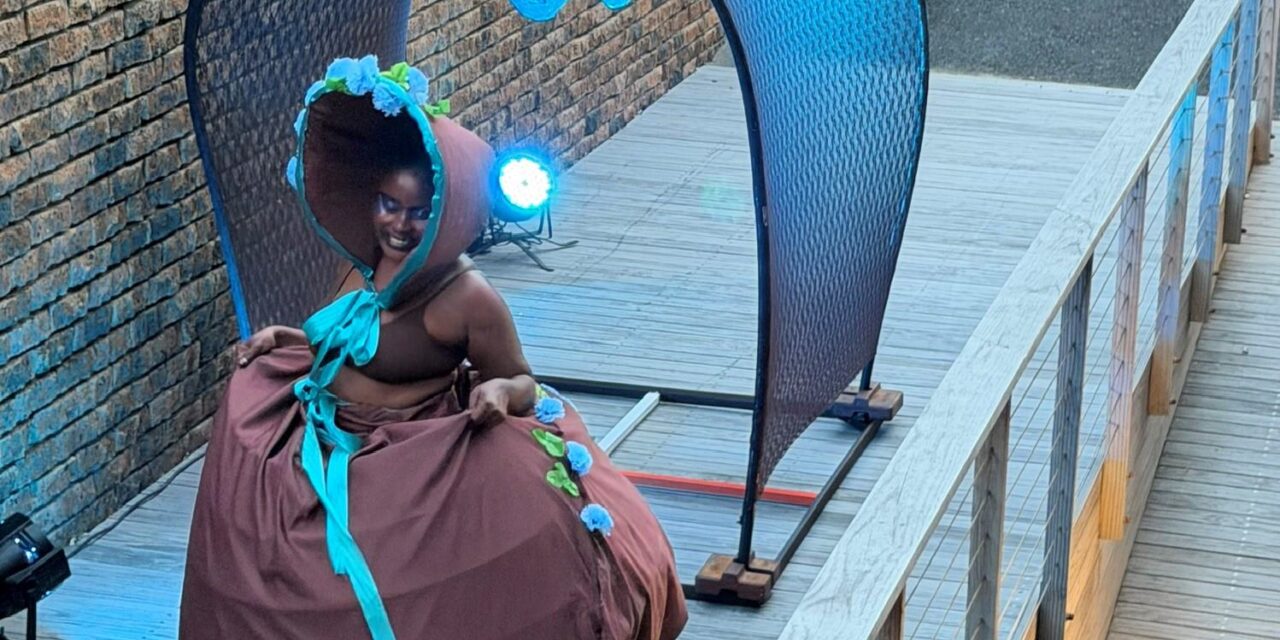
✳ Featured image: Vroulikheid – performed at Working Title’s Live Art Weekend Soft Rebellion, Baxter Masambe, December 2025. Pic: Robyn Cohen/TheCapeRobyn.