| What: Pieces of Me Written and performed by: Bo Petersen Accompanist: Chris Petersen Musical director: Royston Stoffels When and where: February, 21-28, 2026 at the Avalon Theatre, District Six Homecoming Centre, Cape Town Feb-March 2026: performances in schools and community spaces across the Western Cape Tickets: Quicket Direct booking link: https://www.quicket.co.za/events/357907-pieces-of-me/#/ SA Producer: Yvette Hardie, ASSITEJ SA Info: For enquiries regarding the Western Cape run, contact Yvette Hardie on director@assitej.org.za, or sign up for performances here: https://forms.gle/CcZCi7KJWRkwLk4N6 |
When South African born, theatre maker Bo Petersen was 19, she found out that her father had “passed” as “white” in Apartheid South Africa. Classified as “coloured”, under the draconian legislated racism, he made his choice in order to survive, so that he could with the love of his life, the mother of Bo Petersen. It was at the height of Apartheid, in 1974 and she in turn had to keep the family secrets under wraps – in order to survive and keep her family safe. The process of picking up, retrieving the pieces, took years. “Innocent questions of origins were landmines”, she recalls. After almost four decades of excavating, she decided to develop her lived experience of getting to know the “other family”, into a performative experience; into a play. That resulted in Pieces of Me. The play in its embryonic phase, was first performed in 2022 in Oslo. Subsequent seasons followed in South Africa and in Europe – in mainstream and public theatres and in spaces in private homes. Now, in 2026, she has brought her story home, to the Western Cape, for a tour which includes performing at The Avalon Theatre in District Six and at schools and community spaces. The performances include talkback sessions, inviting audiences to engage with “secrets and identity”, survival in Apartheid times, reflecting back to our own stories of survival:
TheCapeRobyn: Can we look at the journey of Pieces of Me as a theatre piece?
Bo Petersen: I did a reading of it in Oslo, Norway in November 2022. It was only three monologues at that stage. Those three are still in the play but I edited and rearranged and new ones were added.
The wonderful Caroline Calburn of Theatre Arts in Cape Town, gave me the opportunity to perform there for two nights in January 2023. This was the kernel of what you see today. After Theatre Arts, I performed Pieces of Me in South Bend in the USA, in 2023 and 2024.
TCR: When did you go and live in the USA? You have continued to work in South Africa, so “leaving” is not the correct word?
BP: I live in South Bend Indiana on a glorious river, the St Joseph. We left in 2017 for the USA. We left physically but not spiritually. South Africa will always be home. It’s really only because of Pieces of Me and the wonderful assistance of Yvette Hardie/Assitej, who is producing, that I’ve been able to return. I have performed Pieces of Me in Oslo, Stockholm, Uppsala, and Reykjavik. In the USA, in NYC, Boston, Santa Fe, San Diego, Madison, Bloomington, Albuquerque and Los Alamos.
TCR: Can you talk about the current tour – 2026 to the Western Cape – and the staging in a theatre at the Homecoming Centre and at schools and community venues? Is this the first schools tour that you have done? From the get-go, you envisaged getting the story out to young people in South Africa – to ignite conversations about the “hidden”, the “erased” and the “uknown” stuff.
BP: This SA schools tour is our first schools’ tour. The schools’ tour is close to my heart as I began my career doing that in 1977. I was a member of the Pact Playwork Company headed by the inspirational Robin Malan. It was an educational theatre company. In that year I experienced the power of bringing theatre to young people all over the then ‘Transvaal’.
Young people who have seen Pieces of Me have been so positive with their responses. These ranged from not fully understanding beforehand the devastating effects Apartheid had had and still have on their parents and grandparents, to understanding South African history in a different way, igniting an interest in going back to their families to hopefully “break the silence” by asking questions not asked before. They encouraged me to go to schools. This was my motivation to bring Pieces of Me to the youth in South Africa, to schools.
TCR: Talking of erased- it must be very poignant to be performing in a space which is shrouded physically with palimpsests of the past –District Six and which resonates personally?
BP: Yes, we will be in the Avalon Theatre. This means a lot to me. When the Homecoming Centre took over the Fugard Theatre, it re-named the theatres after movie houses that existed in District 6. My Aunty Sarah, who we meet in my play, lived in District 6 with her family and she worked at the ticket office of The Star movie house. The big theatre at The Homecoming Centre, has been given that name – The Star.
My father studied at Zonnebloem, in the vicinity of what is now The Homecoming Centre. When he was growing in Riversdale, there were no High Schools for people of colour. It is an important part of my father’s history that he never shared with us.
I performed “Pieces of Me” at The Homecoming Centre once before, on July 20, 2024. July 20 was my father’s birthday so it was very special. From the first chords of music that my cousin Christopher played on his keyboards, there was a deep murmur of knowing. The talkback, which happens after each performance, was profound, moving and very painful as members spoke of their own painful stories.
TCR: You found out about your dad’s “passing” as white, when you were 19. That was 1974 – slap bang with Apardheid on the boil. Two years before the Soweto Uprisings. You could not exactly share in those days?
BP: Yes, my discovery happened at the height of Apartheid. We were in the belly of the beast of Apartheid and so I had to, in some way, “pass” myself so as to protect my father because he was so vulnerable, in danger. We all were.
In terms of writing and reflecting about what I had learned, I wrote a poem, after I found out my father’s secret in 1974.
Yes, it was a long process – excavating and discovering my “other” family. I met my “other family” 10 years later – after learning about my dad. So, it was a gradual process of recovering and discovering “pieces of me” – not only in terms of information but more importantly in terms of “lived” experience. In a sense I was being “coloured in” and I mean that in terms of being filled in, but also in relation to the Apartheid context of racial classification. For instance, I spent time with Christopher’s parents in Glenhaven and our Aunty Sarah in Kensington. I met cousins, 2nd cousins, aunties and uncles, friends and pupils of my father.
Initially, I shared my father’s secret with only my very closest friends. They said I should write about my father’s story. Instinctively, I felt I couldn’t write HIS story because it was his to tell…which he never did, sadly. Not even to my mom. They were very in love and were married for 62 years but he carried his secret to his grave.
Over the years, I did write and reflect on what I was learning about my father, but it was for my eyes only.
The prompt, trigger that shifted my story from a private space, to a public space, in theatre, was when we were on my husband’s sabbatical in Oslo, Norway, in 2022. I was invited to the South African Embassy for Heritage Day. The Ambassador stood at the entrance to greet the guests. I stopped in my tracks because she looked so much like my Aunty Sarah and my cousin Shirley. THAT was the pivotal moment. That was when I knew viscerally that I needed to claim MY heritage…BUT what was that? What did it look like? Who could I claim to be?
I was 67 years old, when I had that pivotal moment at the embassy. As we do this interview, in February 2026, I am 70. But to get back to the gestation stage, three years ago, after sitting with it for so long; inside, for almost five decades, I faced putting out my story; sharing it. I knew that the only way I could make sense of the complexities of my life, is to perform. I knew that I couldn’t tell or “narrate” my father’s story. I needed to tell MY story and that entailed the process of uncovering my father’s story, which I inherited so it became my story.
This is key to my narrative, that it is about my experiences, unearthing “pieces of me” and the key moments of my journey which I thought would be important to consider – for myself and for those watching.
After the visit to the embassy, I went back to our flat and started to map it all out. I knew that three of my monologues would form the backbone – but of what? A play? A book? Who would be interested in my story? Should I just read it to a therapist? Should I just share it with family and friends?
I had not considered myself as a writer, although I wrote and performed in a play at The Market in Joburg, in the 80s. It was called Going Dark. I performed opposite Claire Stopford. It was about a famous actress who is taken hostage by another woman, whose husband died in detention because he wasn’t given his inhaler. He suffered from asthma. He was involved in the struggle but had kept his wife in the dark about the level of his involvement. After his death she learned many truths about him. Clearly he was living a double life, but kept it secret because of his love for her. The less she knew, the safer it was for her. Oh my gosh – so many parallels with Pieces of Me. I haven’t thought about Going Dark, in ages.
Going back to Pieces of Me, in a sense, I think there was a realisation that as an actor, as a theatre maker, I was extending my “lived experience” into a “performative experience”, into a play, into a theatre piece. The process of “writing” the play, echoed the process of discovery, which was not linear. I realized that I wasn’t simply archiving what I had experienced. It wasn’t simply about constructing a memoir on stage, a biography. I wanted to get across something a lot deeper. I wanted to tease out layers – to explore uncomfortable aspects and at the same time celebrate and play tribute to my father – who I loved so much and who gave us so much. It wasn’t just about revealing family secrets, but about sharing through performance and evoking some of the complexities of my story. My father sat with it all his life. I sat with it for so long and all of that became key to transmuting my material for the stage and sharing it with audiences – hopefully all over the world. That is what I hoped for and that has happened in the last three years – which has been amazing.
TCR: It is a survivor’s story – your father and what he did to survive the race legislation in Apartheid, in order to live his life with the love of his life, your mom. You in turn, needed to survive in Apartheid SA in the 1970s, to keep your family safe. It is difficult for us to conceive that in 2025 in SA, but that’s how it was. And, in conjunction, with survival, there were those who facilitated the secrets – such as your dad’s mom – your grandmother?
BP: My father’s entire family and the community kept his secret and those of his three sisters. My grandmother, the matriarch, was ambitious for her children and wanted the best for them, wanted them to have every opportunity she never had. She gave my father her blessing but at such a cost. I am filled with rage and pain often when I think about how Apartheid forced people to make choices no one should ever be asked to make.
TCR: Did you conceive of the talkback sessions from the start – that it would be important to offer a session after the performances, for people to sit with you; sit with what they had seen and reflect on the particular historical context of your story – Apartheid – and racism elsewhere?
BP: The talkback happened organically from the start. A friend told me it would never work. That I would be left with only a few audience members. This has never happened. The talkbacks are like Act 2. They are an essential and integral part of the play. Racism is everywhere. From the Sami in Norway to African Americans in the US.
TCR: Have audiences responded to the play in terms of other “stuff” in their lives – the first time they found out that they were adopted for example? I am thinking of the Toni Morrison quote – very triggering: “No one ever talks about the moment you found out that you were white. Or the moment you found out you were black. That’s a profound revelation. The minute you find that out, something happens. You have to renegotiate everything.”
BP: Very much so. The first time I did it at Theatre Arts, a gay friend of mine said he related to the story completely…as a gay man living in South Africa, when being gay was illegal and the consequences were dire if caught: Jail sentences, shaming, losing your job. Gender has also come up quite often…not being able to be your true self, being made to feel ashamed of your true self and so hiding it. In other countries, where indigenous people have been forced to assimilate, the story resonated strongly with them. Because, I guess, in essence the play is about secrets and identity. People forced by society, by religion, by governments to hide their authentic selves. Facing punishment if they dared to.
TCR: Has the piece shifted/developed – dramatically – since it was first staged? I love the flash cards – rather than AV. Are the flash cards still being used to map out your story?
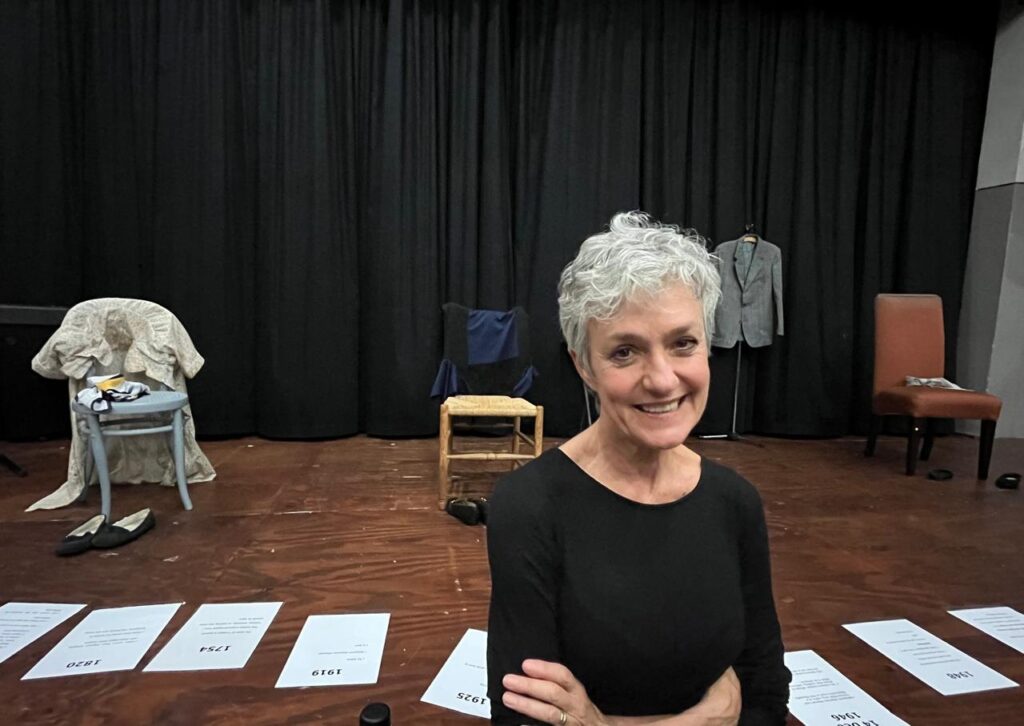
BP: It hasn’t shifted dramatically. Sentences have been refined. A few details added to assist with clarity of meaning and context. Yes, the cards are still an important part of the play. This was a development after my performance at Theatre Arts in 2023. I needed a way to put our complex and terrible history into some context. I was not sure that these cards would work. I didn’t suddenly want to launch into a history lesson. However, so many people have responded so positively to them in ways I had never intended them to and quite honestly was surprised. They are often seen as being symbolic, having a deep meaning. One person said it felt like I was laying gravestones on the events of my history. That was not my intention, but it touched me.
I am basically funding the play myself and that has informed the staging. For most of the time, I am a one-person band. From the inception, my aim was to be able to travel with it, as easily as possible. I wanted to take my suitcase, which belonged to my parents, with all my props and costumes. It was important that I could travel on my own and move into any space, set up and perform.
To do that, to go on the road, I needed to keep the production technically as simple and transportable as possible. Hence the use of flash cards, no slides. Some people have said they wished I had used slides. I used slides in the Oslo production. I think the slides worked well but I was in a theatre that was producing me. There were funds. They had the staff and equipment.
TCR: And the context of the performance feeds into the play? Can you talk about the intimacy of performing in other peoples’ rooms in the USA?
BP: Yes, I have been doing a lot of “living room” or “voorkamer theatre” in the USA. I perform the play in people’s homes; in their lounges. It has been very successful. People love being so close to the performer. It is very intimate. It requires you to be as truthful as possible and to move away from theatrics. I love it. The play lends itself to this kind of intimate storytelling mode.
TCR: How has Pieces of Me been shaped with your cousin Christopher who accompanies you on stage, on piano? Can you share about his input and contribution in terms of the music?
BP: I can’t believe I never thought of including Christopher in the first place. I had always imagined a pianist (my father played the piano) a shadowy figure, somewhere on the stage, adding substance, mystery and texture. When we were invited to perform at the Baxter in 2024 and knowing I would be in a formal theatre space, that I had some funding, I thought now is my chance.
My pre-show music before Chris came on board was a compilation of my father’s favourite songs and then mine from the 70 and 80s. I phoned Christopher who knows the Cape Town music scene and performers for suggestions. Chris isn’t a professional musician but has played in bands and was a founder member of the impressive Jazz Yard Academy in Bonteheuwel. He has taught many young people who have gone on to become respected musicians, here and internationally. He was a role model and a brilliant teacher. As I was chatting to him, asking him for suggestions for a pianist, it suddenly hit me on the head! It obviously should be, had to be Chris. This is his story – as it is mine. My grandmother that I play, is also HIS grandmother; the Aunties HIS Aunties. He was initially terrified but being the brave and generous person he is, he said “yes”. His being with me onstage makes a very strong statement about the absurdity of the vicious and cruel Apartheid laws that tore our family apart.
We have spent a lot of time chatting about our very different life experiences because of the decision my father made. I was afforded all the advantages and privileges but lost any understanding of belonging and connection. I was always the outsider. I had no sense of belonging. Chris is deeply connected to his roots and always has had family around him.
We – my side of the family – lived an isolated and very removed life – always on the outskirts of any community. My parents had virtually no close friends, no social life to speak of. It was too dangerous. Innocent questions of origins were landmines. Chris and his family lived surrounded by family and friends, living a rich social life.
The music choices were predominantly mine because I knew the music my father loved but the preshow music and religious music Chris chose. He grew up in a religious home and with his community. I did not.
TCR: Can you talk about some of the music; the poignant soundtrack and soundscape that is referenced in Pieces of Me?
BP: Yes, my father expressed his longing and his pain through his music. He sang and played on the piano and guitar – such as Oh Danny Boy, Red Sails in the Sunset, Suikerbossie, Al le die Berge nog so Blou, Galway Bay, Daar kom die Alibama, Januarie, Februarie, Abide with me. They were songs of my youth. The hymns that we use in Pieces of Me were suggestions made by Chris. My family were atheists. My Ouma would not have approved.
BP: How has your daughter, Rebekah responded to your story?
TCR: We had her when I was relatively old, 44 years. She was lucky to know my parents. They were quite old when she was born, but they lived to a ripe old age. She knew my story from the beginning. She has accompanied me to many performances in the USA as my sound person. When Chris is not with me, we have a recording of his music. I’ve never really asked Rebekah how she feels specifically. She always gives me a very all-embracing, long-lasting hug afterwards. It gives me sustenance. The performance is emotionally and physically demanding.
TCR: Touring to schools and communities was always key to Pieces of Me, on stage?
BP: Yes, it was very much part of my vision for Pieces of Me. That goes back to my wonderful experiences with PACT Playwork, when we took plays to far flung towns. I love the sense of being a troubadour and taking to the road with theatre, taking it literally “to the people”.
My very first exposure to professional theatre was through PACT Playwork. I had never been to a theatre before and then the company toured to my school in Carletonville in the late 60s, where I grew up. That was a profound moment – exposing me to theatre and then I knew about that from the other side – being involved as an actor – taking plays on tour. I wanted to do the same with Pieces of Me– reaching schools and communities –out of the mainstream- reaching those who perhaps cannot access a theatre. And going back to what I mentioned earlier – that is why I wanted the production to fit into a suitcase, to facilitate touring light.
TCR: Plans to tour the piece further – to schools and young people? In SA, to Europe, in the USA?
BP: I am trying to organize living rooms to perform in, in the UK. I have quite a few friends there who have offered theirs. I just have to organize it and try to raise funds for my air ticket.
I’ve had an invitation to perform in Uppsala again. I performed at a school there.
I would love to take it to The Netherlands since the Dutch are responsible for the beginning of our difficult and cruel colonial history.
TCR: Anything else to add about the current tour and Yvette Hardie’s/Assitej SA’s role as producer in touring the piece – in getting it to a wider audience?
BP: Yvette/Assitej SA is the producer everyone wishes for and dreams about. She is seamlessly efficient, innovative, unflappable, kind, gracious and generous. I could go on and on. Without her offer to produce Pieces of Me after my 1st performance at Theatre Arts, none of the above would have happened in South Africa. I am honoured to be affiliated with such a woman and such a wonderful organization.
| Performance history of Pieces of Me Oslo-Norway-2023 Stockholm and Uppsala-Sweden-2023 Reykjavik-Iceland- 2025 USA NYC-different venues including living rooms 2023, 2024, 2025 Boston-Massachusetts- 2023 Dublin-New Hampshire -2023 South Bend- Indiana (where Bo Petersen lives) 2023 & 2024 Bloomington-Indiana- 2023 & 2024 Madison-Wisconsin- 2025 Los Alamos- New Mexico- 2025 Santa Fe- New Mexico- 2025 Albuquerque-New Mexico- 2025 San Diego- California – 2024 Johnson City- Tennessee- 2025 Durham- North Carolina-2024 |
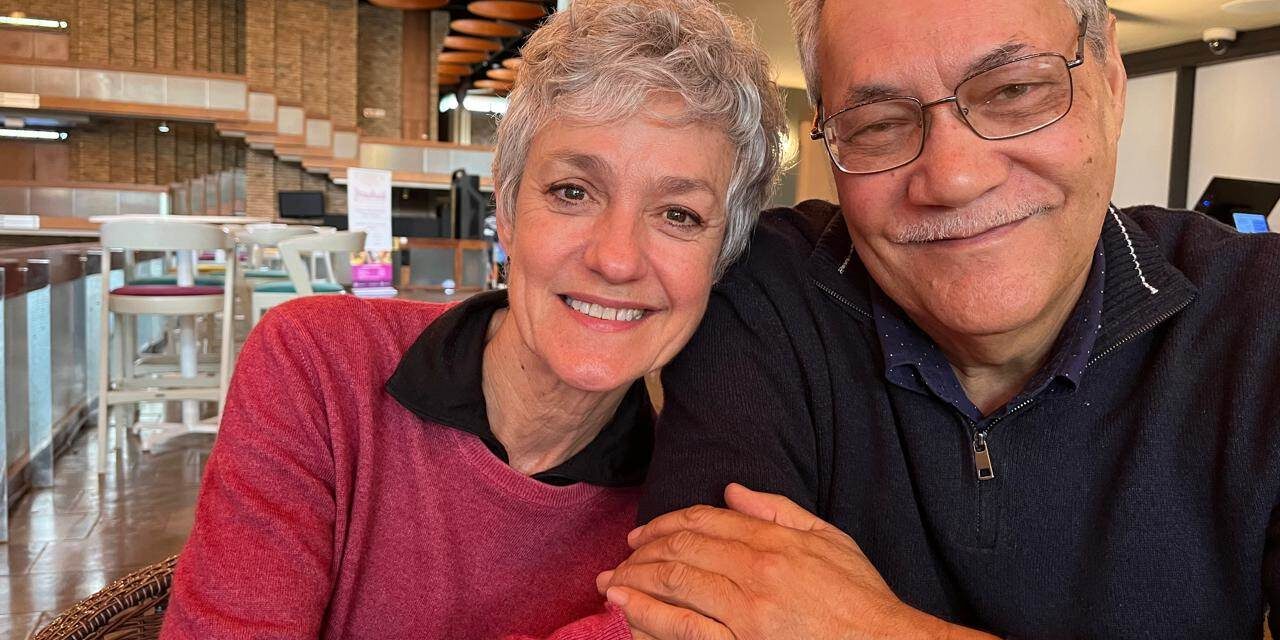
✳ Featured image: Bo Petersen and Chris Petersen, June 2024, at the Baxter Theatre, Cape Town. They were about to embark on a tour to FynArts in Hermanus and Pic: Robyn Cohen/TheCapeRobyn.