
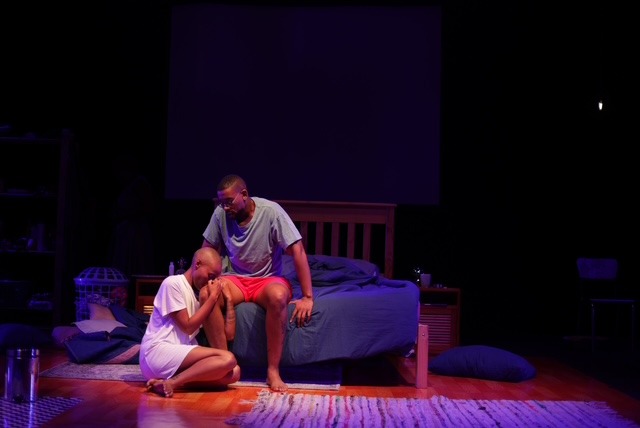
| What: Amaxelegu Writer/director: Qondiswa James Dramaturge: Greg Homann Cast: Qondiswa James, Luxolo Ndabeni and Peggy Mongoato Where and when: Magnet Theatre: March 18-21, 2026. Corner Lower Main & St Michael’s Roads in Observatory, Cape Town Azande Theatre: March 22, 2026. Makhaza, 4 Sivivane Cres, T3-V5,Khayelitsha, Cape Town Bookings: Webtickets Set and costume designer: Lungiswa Joe Sound designer: Jannous Nkululeko Aukema Lighting designer: David Themba Stewart AV designers: Abigail Meekel and Claire Meekel Movement Director: Ernest ‘Ginger’ Baleni Intimacy Coordinator: Tshego Khutsoane Performed in English with isiXhosa Age Advisory: 16 (SNL) |
Amaxelegu (roughly translated from isiXhosa as Messy People), written and directed by Qondiswa James, is funny, entertaining, sexy, perceptive; a delicious and wry take on contemporary dating and relationships in post democratic South Africa. It is date-night must-see. The three hander is performed by James, Peggy Mongoato and Luxolo Ndabeni.
Dramaturgy is by Greg Homann, who is artistic director of The Market Theatre in Johannesburg. The production is being staged in association with The Market and was incubated out of the Market’s Play Development Programme which was launched in 2025, under the guidance of Homann, to focus “on unearthing and developing fresh, urgent, or compelling stories”. Amaxelegu is all of that – urgent, rousing and arousing. The production is a synthesis of brilliant script, masterfully staged (design – lighting, set, costumes, movement) with physically charged, visceral performance.
It is a play “about love in the time of non-monogamy” with a bunch of young 30 somethings who are dating, maybe looking for a happily ever after, beyond hook-ups. On the fringes of the canoodling, cleaning up after them is Mama Priscilla, the maid, char, “domestic” as is the lingo in South Africa. Brilliantly played by Peggy Mongoato, she is there at times physically and at other times emotionally, cleaning up, enabling Thabisa (James) and Azola (Ndabeni) in their pursuit of whatever they are seeking which becomes a bane of contention.
Commitment? Uhhm it’s complicated, no matter if there is full disclosure of your ethics and positions. From the get-go, as they hook-up on Bumble, Thabisa is in full disclosure mode as polyamorous. The sultry and sexy Azola goes with the flow. I am not going to plot spoil what happens. That is one thread of this intricately conceptualised play. Of course we want to know how it ends. It is exciting and thrilling. Watch and see.
Bundled with the plotting thread, there is a rousing and burning interrogation as to how the “pair navigate the day-to-day transactions of class, politics and gender as they move between various private and domestic contexts as young, upwardly mobile-middle-class Black South Africans.” I am using James’ words here.
The couple are traversing the sex stuff, free love et al but core to their story is who they are and what they are right now, in Cape Town, and that is cleaved with their recent past. They meet on the dating app Bumble and doing social geography, soon realise that they met during the “Movements” – the Student Movements – the Fallist Movements – Rhodes Must Fall and Fees Must Fall – 2015-2016. The sassy Thabisa is charmed with Azola and his “curation” of his texts and hashtags. Love that! She is feisty and fabulous.
The elephant in the room – is the person cleaning up after them. Thabisa is particularly conflicted about that. She who demonstrated, who agitated for change, carried the placards, is now blithely benefitting from someone’s labour from the system she fought against, within the intimacy of her home. How do the pursuit of freedom and love intersect, she ponders. There is a sense of self-deprecation as Thabisa blithely audits her younger self in the Movements, facing up to as she is now. She admits that it was exciting; that there were elements of “art” to some of the way the protests unfurled. The sexy Azola is nonplussed. He has always been poor.
James is 32, so yes, that was her milieu. In Amaxelegu, a decade after the Movements, she unpacks a lot of the messiness in our midst, which is a legacy of Apartheid and the attempt by students in the Movements to try and level the playing fields. Flipping forward from 2015/2016 to 2026, is Amaxelegu, a rom-com, comedy-drama, modern relationship story, tethered on the back of a big mess.
James has brilliantly transcended “issue play” with the creation of two urbanites who are calibrating themselves, before our eyes, with oodles of mirth and yummy very quotable asides. A mother and grandmother chirp in (very funny, hilarious). A pack of others who part of the polyamorous landscape, chip in, via texts on the screen. I cannot think of another contemporary playwright who has nailed the lingo and zeitgeist so vividly of contemporary dating in South Africa – specifically through the gaze of Black thirty-somethings who are living in spaces which are still dominated by white people of privilege – totally removed from township life – that is for sure.
The narrative unfurls in a mix of isiXhosa and English. There are pings from texts on a screen. Some people at the performance that I attended, said that they would have liked surtitles so that could access the isiXhosa. For me, in this particular play, the blocking of language, is emblematic of the armature (carcass?) of Apartheid South Africa, which persists now. In this play, physical performance conveys volumes – beyond words – with Azola and Thembisa and the domestic helper, relegated on the fringes, for most of the time. Spatially complex, the intricacies are amplified by the lighting design by Themba Stewart and sound design Jannous Nkululeko Aukema, which heightens the liminal absence/presence of Mama Priscilla. The bed becomes stage, battle ground, safe-space. Brilliant physical direction by Ernest ‘Ginger’ Baleni.
The way Priscilla trudges through space, clutching on to the straps on the bus, is pure physical theatre. Priscilla occupies spaces which are radically different to the spaces that Thembisa and Azande are so comfortable in and occupy. Priscilla on the bus, her body lurching from side to side, as a kind of dance of balance is testament to not only the movement direction by Baleni but to James’ eye as director. Priscila is hovering; essentially invisible but critical to balancing the pyramid of relationships. She is witness and voyeur. We are also voyeurs. She is the base of the triangle and the mechanics of the relationships are transmogrified through movement of the bodies.
In terms of fun, may I just gasp at the nifty hack that Thembisa does with the duvet. Watch and learn if you go for a date night, of how to upskill your domestic craft as choreography: Dance of the duvet? May I also say that I love how the messy bedroom aesthetic has been “curated”, as Thembisa might say, by set and costume designer Lungiswa Joe.
Yes, the play is romantic and sexy and erotic but it is also subversive and radical in its conceptual arc, which is a lens that James operates from in her art. Her tag on Instagram is (Black Girl Radical). She has spoken extensively about “radical softness as a weapon for liberation”. Radical Softness is a hard-hitting leitmotif in the play, bandied around by Thabisa, but there so much fun, glee and utter enjoyment in the way James pulls it all together. The protagonists are seductive and compelling as they thrust through their positions, dicing with issues of ethics, freedom, complicity, fear. And yet beyond the issues, it is a tender and achingly intimate play. Azola muses, that inevitably “there is always hurt”. Love that. Love this play. Go and see it.
✳ Qondiswa James and Luxolo Ndabeni in Amaxelegu, written and direcected by Qondiswa James, with dranaturgy by Greg Homann. The cast also features Peggy Mongoato. Pic: Hlalanathi Radebe.


