| What: David Nixon’s adaptation of Bram Stoker’s Dracula Where and when: Artscape, March13–29, 2026 Age Advisory: No Under 12s Bookings: Webtickets Company: Cape Town City Ballet Choreography, stage direction, set and costume design: David Nixon Castle design: Christopher Dudgeon Lighting design: Faheem Bardien Music: Alfred Schnittke, Arvo Pärt, Sergei Rachmaninoff and Michael Daugherty |
David Nixon’s Dracula for Cape Town City Ballet, adapted from Bram Stoker’s Dracula (1897) is on in Cape Town, at Artscape, March 13–29, 2026. This is exhilarating ballet-theatre – sensual, alluring and horrifying, darkly beautiful, Kafkaesque nightmare which through alchemy of ballet, becomes an alluring, erotic fantasy, a twisted and manic love story of possession and obsession. I was dazzled by the performances by the principals and the entire company. Even if you don’t “like” ballet, get to Dracula. It is definitely worth jetting into Cape Town for this mesmerising and thrilling production, seared with physicality, athleticism, grace, heightened by a theatrical intensity at all times.
David Nixon is a genius. The choreography, stage direction, set and costume design is all his. The castle design is by Cape Town’s Christopher Dudgeon and lighting by Cape Town’s Faheem Bardien. The Artscape stage has been configured brilliantly by Nixon. The full volume of the stage is used. Trap doors become coffins and cages; lifts heighten the supernatural, magical and fantasy elements. Christopher Dudgeon’s castle is obstacle course, watch tower, dungeon, lair, hiding space, coffin. Dracula climbs the walls of the castle – like Superman/Spiderman. The black walls of the set – the castle, spaces in London – heighten the blackness of Dracula’s world – exquisitely lit by Faheem Bardien. Minimalist opulence, aesthetically pared down, without clichés one might expect from vampires and horror.
Traditionally in classical ballet, male dancers tend to be there as props for the female dancers. In Nixon’s Dracula, the male dancers are very much characters in their own right – physically and emotionally. There is stunning coupling work, with pas de deux between Lucy and Dracula, Mina and Dracula and threesomes and foursomes.
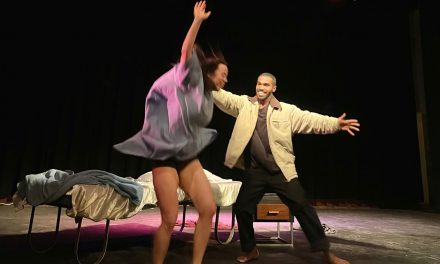
We attended Saturday March 14. The cast included special guest artist, Jerome Barnes as Dracula, Sasha Barnes as Mina and Isabella Blair as Lucy. No relation between the two Barnes dancers. Jerome Barnes, a freelance dance, was formerly a principal dancer with Scottish Ballet. He is 28 and it is his first time performing as Dracula. Sasha’s dad sat behind us on Saturday night. He told us that she is 19. The chemistry between Sasha’s Mina and Jerome’s Dracula is electrifying and utterly believable. They make us believe in them as individuals, beyond tropes of vampire and the possessed, predator and victim.
In Stoker’s original tale, Mina is repulsed by Dracula. In Nixon’s ballet, she becomes enchanted with him. As Nixon writes in the programme notes of the story: “Dracula who should feed upon Mina; cannot; Mina who should be repulsed by Dracula, is drawn to him.” Mina is grieving for her bestie, Lucy and she is, attracted to him.”
It is advisable to become familiar with Dracula, the original and David Nixon’s adaption because Dracula – the ballet – is non-verbal theatre. Without an outline of the story, one is likely to miss nuances in the story. Google Nixon’s ballet plot, if you don’t want to buy the programme
Nixon was commissioned to create a horror inspired ballet in 1999, 26 years ago. It was a marketing thing to draw in audiences who wouldn’t usually go to the ballet. I have never been bitten by the bug of horror and vampires and went into a deep dive about Stoker’s novel which was published in England, 1897. What led to Dracula, the novel? Stoker, was Irish, living in England. He was very much ensconced in the world of theatre. He was the business manager for an actor and was manager of London’s Lyceum Theatre. It looks like it was theatrical and dramatic life, mixing with creative people, intense, exciting, skirting what was deemed morally “acceptable” in Victorian England.
The trigger to write Dracula was apparently tied into Stoker’s fascination with Eastern European vampire folklore. It has been widely speculated that Stoker’s Dracula, was emblematic of the anxiety in England in 1897, on the edge of the 19th century. There was an influx of foreigners into England, technology was changing, usurping humans and it has been suggested that Dracula is emblematic of xenophobia – the fear of the exotic and “foreign” outsider (Dracula was from Transylvania), coming to take over, a hostile takeover, sucking the blood out of everyone.
In terms of further context in relation to what might have fed into Stoker’s frames of reference, it is interesting to consider that Dracula was published, two years, after the Oscar Wilde libel trial which subsequently led to him (Wilde) being convicted and jailed for “gross indecency” (homosexuality). Stoker was an acquaintance of Oscar Wilde and although married to a woman, it has been suggested that he was a closeted gay or bisexual and/or had fantasies of being with men, sexually. Dracula gave him full reign to radically explore and shape shift through expressions of sexuality.
With the idea of an anxious Victorian England becoming fascinated with Dracula, I was curious about Dracula in 2026 – as a ballet. We are all very anxious. The world is an anxious place. Like the Victorians, we are being overwhelmed with changes in technology – with the onslaught of AI – disintermediating us further. Imagine all those bots and ChatGPT thing-a-majigs as Draculas, sucking up everything.
Nixon reflects in his programme note that, Dracula is about our vulnerability. The women are prey to the men in their lives. They all want to be loved, touched. However, Nixon’s Dracula is not riding on the horror schlock which has inspired so many movies and famously the Rocky Horror Picture Show. Yes, Dracula wears a cape but he is stripped of fancy clothes, bare chested, flesh bared, susceptible, exposed. Dracula, Mina, Lucy and the Brides of Dracula wear prosthetic fangs. Sure, they are channelling “vampire” and sex. Think of fangs – drawing blood – biting and consuming – seducing, alluring but within this, they project very human complexities.
Dance is a potent genre to transmute the story of Dracula and Nixon has created a noir piece of ballet-theatre which posits Dracula, less of a malevolent force and more of a release agent, who shakes up the social order in uptight society, unleashing deepest darkest desires and fantasies. The power of this Dracula, for me is that Dracula transcends monster/predator, as Mina embraces him. Seduction, desire, love all become intertwined. It is hypnotic to watch how the protagonists loop, literally around each other, throwing, slapping, pushing, pulling. They are flayed and embraced at the same time and this twisted duality underpins the choreography, which is underscored by the dissonant and jittery music, particularly the Alfred Schnittke interludes.
The twisted duality starts in the opening scenes, where we see Jonathan the lawyer in Dracula’s study in his castle, being flayed and drained as the two do a dance on the desk. It is a scene of brilliant neo-classical ballet – where the bodies are the primary medium – on the podium like desk. This is intensely Kafkaesque. What the heck has Jonathan the straitlaced lawyer been sucked into? But, he is turned on, despite his fears. There is extraordinary choreography throughout– the duality of figures fusing, climaxing and becoming one – Dracula and Jonathan, Jonathan and Dracula’s Brides, Dracula and Lucy, Dracula and Mina. A pas des Deux on steroids in the bedroom. Shades out of a porn hub Pool Party transverse the scene with Jonathan and Dracula’s brides, with us as voyeurs, looking on. We are fixated, consuming this piece of art.
To reiterate what I suggested, at the start of this review, Nixon’s Dracula becomes an alluring, erotic fantasy, a twisted and manic love story of possession and obsession. It goes beyond good versus bad/evil. There is often no accounting for behaviour and in a sense in this production, Dracula is submitting to the universe of desire and passion, through dance. Stokers’ original title for Dracula was The Un-Dead and David Nixon’s ballet, harnesses the delicious liminality of the story: Being alive and dead, desiring and being repelled, obsession which may defy logic, rationality and reason. Let all your pre-conceptions go and submit to the sheer beauty of story, dance and music. I loved this production; I am possessed by it. For footage of curtain call and more pics, see https://www.facebook.com/share/v/1EPd5vyFwu/ and https://vt.tiktok.com/ZSuQ2uDYq/

✳ David Nixon’s Dracula for Cape Town City Ballet, March 2026. In the photo – Sasha Barnes as Mina and Jerome Barnes as Dracula. Pic: Brenda Veldtman. Supplied.