| Who: Barend Van Der Westhuizen who is performing in and musical director of A Gentleman’s Guide to Love and Murder Where: The Masque and Milnerton Playhouse Dates and booking links: The Masque in Muizenberg, May 22 to June 6, 2026. Book at Quicket Milnerton Playhouse, June 19 to July 5, 2026. Bookings https://milnertonplayers.co.za/product/gentlemens-guide-to-love-and-murder/ Director: Kyla Thorburn Musical director: Barend Van Der Westhuizen Cast: The cast of 11, includes, Regina Malan, Barend Van Der Westhuizen, Lara Basson, Nick Plummer and Melissa Sanderson Age restriction: No under 13s |
The hit comedy-musical A Gentleman’s Guide to Love and Murder nabbed four Tony Awards in 2014. And here we are in 2026, Cape Town, about to be treated to a production of Love and Murder (yeah, love and murder go together in this romp) at two venues: The Masque in Muizenberg, May 22 to June 6, and at the Milnerton Playhouse, June 19 to July 5. As far as can be ascertained, this is the first major mainstream production of the musical in Cape Town and South Africa, so this is a coup for the producers. It is a big production – with a cast of 11. Multi-talented cross-over theatre maker Barend Van Der Westhuizen is playing the “gentleman”, Monty Navarro who is on a mission to collect on a windfall inheritance. Van Der Westhuizen who is also the musical director, gives insights:
TheCapeRobyn: How did this production come about? Have you seen this play staged before – ie live? As far as can be ascertained, this is the first mainstream production in Cape Town?
Barend Van Der Westhuizen: Kyla Thorburn, the director of this production and I met up about two years ago. We have been collaborating since our 2018 production of Nunsense and have worked together on various productions and concerts since then. During that meeting, we each shared our “bucket list” of musicals we would love to stage, and A Gentleman’s Guide to Love and Murder appeared on both our lists.
We were both familiar with the musical through the 2014 Tony Awards performance, which was widely shared on platforms like Facebook, YouTube, and Instagram. However, neither of us has seen the show performed live, nor have I encountered it as part of a concert or revue.
As far as we have been able to determine, this is the first mainstream production of the musical in Cape Town, and possibly the first in South Africa. We were very fortunate to secure the rights, and we are grateful that The Masque and Milnerton Players placed their trust in us to bring this production to life.
TCR: Can you give us insights into the character you play, Monty Navarro? He is described as a charming “everyman” who “turns into a daring, witty serial murderer under the guise of an Edwardian gentleman.” There isn’t a 2026 equivalent for “gentleman” – certainly in South Africa?
BvdW: I’m excited about playing Monty Navarro because he is such a wonderfully layered character who requires a fine balance between charming innocence and cold-blooded, witty manipulation. It is less about playing a realistic criminal and more about embodying an “everyman” navigating a ridiculously uptight world, while somehow making the audience root for a murderer.
Monty is relatable because he is an outsider who has been denied his rightful status, which makes his murderous ascent feel justified to him — and hopefully to the audience as well. One of the quirks of the character is that Monty himself often seems surprised by his own daring, and the audience cannot help but chuckle at the fact that he is actually successful in some of his outrageous murder attempts.
The Edwardian “gentleman” archetype — uptight, rigid, and obsessed with bloodline and social standing — has largely disappeared. In 2026, there is not really a direct equivalent, especially in a modern South African context where we do not have the same rigid British social culture. However, that contrast is exactly what makes the piece so entertaining. The exaggerated “uptight Britishness” becomes the perfect backdrop for farce and dark comedy.
For me, Monty represents a witty, charming, and dangerous individual who uses politeness and sophistication to mask his ambitions. What also makes the role especially enjoyable is that Monty frequently breaks the fourth wall and speaks directly to the audience, effectively making them accomplices in his schemes.
TCR: Insights please into the music? In addition to playing Monty, you are also musical director. Are you using backtracks? The play has a substantial book, so it must be a challenge to balance the sound – with spoken dialogue and sung dialogue – so that we can hear the dialogue/lyrics at all times?
BvdW: The music of A Gentleman’s Guide to Love and Murder is witty, sophisticated, and written in a wonderfully “old-fashioned” style. It draws heavily from British Savoy operas and music hall traditions, featuring high-energy patter songs and jaunty melodies. At the same time, composer Steven Lutvak incorporates beautiful soaring melodies reminiscent of the early Rodgers & Hammerstein Golden Age musicals and Viennese operetta waltzes. These musical styles help create the formal sound world that perfectly suits the Edwardian setting.
That being said, the score is vocally demanding and requires strong legitimate musical theatre and operatic technique from the cast. We are using backing tracks, which introduces another skill set that the singers need to master. I am ecstatic to work with some wonderful singers with solid vocal foundations and they truly do justice to the score.
Balancing the sound is always a challenge in a production like this, especially because the show contains substantial spoken dialogue alongside sung dialogue and intricate lyrics. Clarity is absolutely essential. Fortunately, we are very lucky to have a dedicated sound operator whose sole focus is balancing the microphones, rather than also having to manage sound effects and playback simultaneously.
TCR: How is that factored in to the music and the way the ensemble sings?
BvdW: As mentioned earlier, the musical incorporates elements of the “penny dreadful” tradition by drawing on musical styles that mirror 19th-century melodrama, British music hall entertainment, and operetta. The score cleverly transforms violent and dark events into light-hearted comic spectacle, making it surprisingly easy for the audience to enjoy — and even support — Monty’s actions.
The ensemble plays a particularly important role in achieving this tone. Beyond portraying servants, relatives, and passers-by, they also function like a Greek chorus, guiding the audience through the story and helping to establish the mood and setting of each act. Their musical contributions beautifully introduce the acts, while their singing and heightened theatricality reinforce the exaggerated world of the production.
At the same time, we specifically tried to avoid the tendency to overly “ham up” the acting and singing. Instead, we aimed to keep the performances more grounded and natural, allowing the sharp comedic writing and absurd situations to speak for themselves. We found that the humour lands even better when it is played with sincerity rather than exaggerated caricature.
TCR: Insights into the design – set and costumes?
BvdW: The focus of the set design — conceptualised by Kyla Thorburn and designed by York Froon — was to adopt more of a vignette approach in order to maintain an intimate atmosphere. The rapid transitions between scenes make the production quite a workout for the backstage crew, but by utilising this approach, together with clever lighting design, we hope to keep the audience fully engaged throughout the storytelling process.
Visually, the set evokes the early 20th-century world of 1907 to 1909, with a distinctly Downton Abbey-inspired aesthetic.
The same philosophy informed the costume design. For the D’Ysquith characters in particular, the costumes are used to immediately establish the eccentric personality traits of each family member — from extravagant feathered outfits for some of the ladies to the stiff, formal hunting attire of the Earl.
TCR: Let’s talk about you. Where did you grow up? Did you study music at school and where was that?
BvdW: I grew up on a farm just outside the small Namaqualand/West Coast town of Vredendal. I was very fortunate that both my primary school and high school had vibrant music programmes with wonderful teachers who truly went above and beyond to make music come alive for their students.
TCR: You have a Masters of Music degree (cum laude). Your thesis is titled “The singer as cross-over artist”. And that is what you do – from the Mikado to Love and Murder? Can you tell us about your journey as “a cross-over” artist?
BvdW: I studied music, specialising in voice, at Stellenbosch University under the tutelage of the late South African baritone André Howard and Magdalena Oosthuizen. Dr Oosthuizen, in particular, really opened up the technical aspects of singing for me and guided me through both my Master’s degree and my UPLM in voice.
Up until that point in my career, my focus had mainly been classical voice. However, my home was always filled with a wide variety of music — from my father’s love of Paul Simon and Elvis Presley to my mother’s love of Andrew Lloyd Webber musicals. Of all the genres, musical theatre ultimately remained closest to my heart.
After years of performing oratorio — including 32 productions of Messiah — as well as lieder concerts and opera ranging from Mozart to Verdi and winning the singing category of the national ATKV Musiq competition twice, I made my musical theatre debut as Freddy Eynsford-Hill in My Fair Lady, in 2016, also under the direction of Kyla Thorburn. From there, I continued balancing both the classical and musical theatre worlds.
TCR: You teach at Tygerberg High and head up the Tygerberg Mafia Boys Choir (what’s with the name – Mafia?)?
BvdW: On the teaching side, I joined Tygerberg High School as a music teacher in 2007 and now serve as deputy head. Up until 2020, I directed all the school’s revue stage productions and always tried to include as many learners and staff members as possible.
In 2015, I founded the boys’ choir, The Tygerberg Mafia. The name actually came from that very first group of boys who connected deeply with my belief that music and theatre should be inclusive and have a place for everyone. They jokingly said, “Once you are in, you never get out,” which, unfortunately, is also true of the Mafia — you only leave with cement shoes at the bottom of the ocean! And so, the name “Tygerberg Mafia” was born. The choir went on to become national category winners at the ATKV Applous for three consecutive years.
TCR: Love and Murder looks utterly delicious, hilarious and entertaining. Sounds a bit like Sondheim’s Sweeney Todd but not as dark?
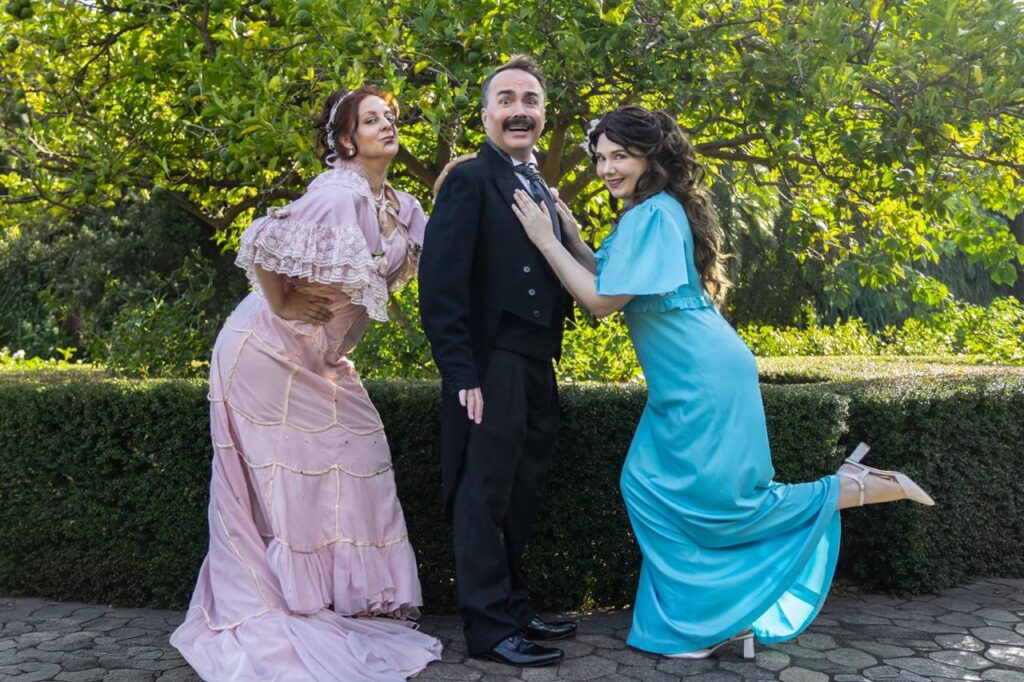
BvdW: Nick Plummer takes on the guises of all the D’Ysquith family members which is a tour de force in itself, with Regina Malan, Lara Basson, Clarenda van der Walt and Melissa Sanderson taking on the female leads of ‘Gentleman’.
One reviewer for talkingbroadway.com has described it as follows: “A Gentleman’s Guide to Love & Murder is the best Sondheim show not written by Sondheim. All the elements are here: the not-your-typical storyline for a musical; the anything-for-a-rhyme lyrics; the songs that go by so fast that you can’t catch all the words. And one lovely ballad.”
You can describe it as a brighter, more farcical version of Sweeney Todd, with similarities of a high body count, witty lyrics, a brilliant score, and sardonic themes regarding class and poverty. But instead of the gritty, gothic terror of Sweeney, Gentleman’s Guide is a light hearted farce. The murders are not gory; they are creative and theatrical, with the violence being played for laughs.
Hopefully we will be able to bring more “new” musicals to Cape Town that will find wonderful supportive audiences to entice us to look and “fight” for more.
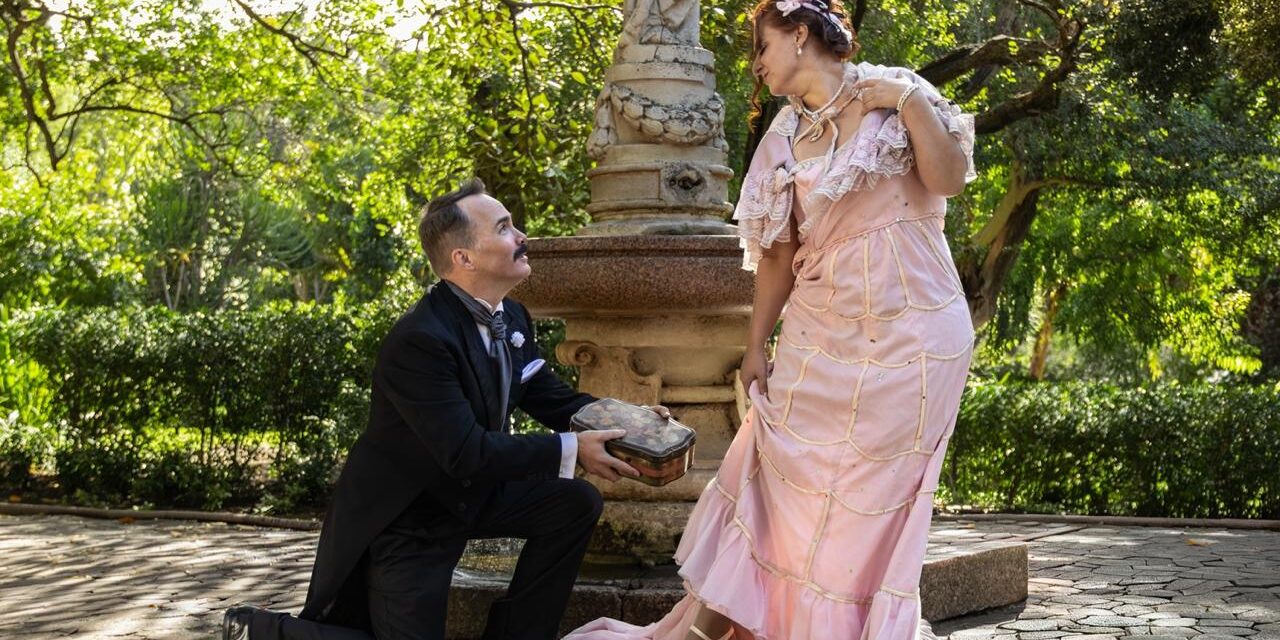
✳ Featured image: From left – Barend Van Der Westhuizen and Regina Malan. They are performing in A Gentleman’s Guide to Love and Murder, Cape Town, Masque and Milnerton 2026. Photo: Sara Hassall. Supplied.