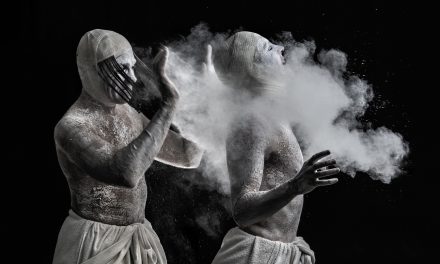
| What: Constellations by Nick Payne Director: Jay Pather Cast: Mark Elderkin and Mwenya Kabwe Design: Wolf Britz Constellations is on in The Baxter Studio, Cape Town, June 2-20, 2026 and at Theatre On The Square, Johannesburg, June 23 to July 11, 2026 Constellations is part of How Now Brown Cow 2026 Winter season. The other play in the season, is Prima Facie by Suzie Miller. On in the Baxter Studio, August 4-29 and the Market Theatre, September 17 to October 4 2026 Age advisory for both plays is 14 Bookings for both plays: Webtickets |
“It’s fiercely a contemporary play, in these times of AI, multiverse, and so many approaches to intimate relationships,” muses Jay Pather about Constellations, the play by British playwright Nick Payne, which he is directing for How Now Brown Cow for its 2026 Winter Season, in Johannesburg and Cape Town. It is a relationship story with an intriguing non-linear narrative. Mwenya Kabwe plays Marianne, a quantum physicist, deep diving into string theory and the multiverse. Mark Elderkin plays Roland, a beekeeper. From their first meeting at a BBQ (or did that actually happen?), the audience becomes immersed in a multiverse of realities/possibilities. While the text and setting is as Payne envisaged it, in this production, South Africa 2026, it is layered with an African Cosmology. Pather gives insights:
TheCapeRobyn: Is this production set in South Africa or in the UK?Nick Payne located the play in England, with cultural references. For instance, in Marianne and Roland meet at a barbecue in England. In your production, do they meet at a braai?
Jay Pather: The play is set as the writer intended. We had no rights over changing text, which meant that the locale etc had to remain as is. However one of the two characters, Marianne Auberle in this version is a Diasporic African with ancestry from Southern and Central Africa. The production draws as much as it does from Theories of Relativity, Quantum Physics and String Theory as it does then from African Cosmology. Here there is parallel reference to multiple universe especially between String Theory and broadly African cosmology, and in our reference Dogon Creation Philosophies. The text does remain the same though, with video references and the actors’ own history coming from the African continent.
TCR: Is Quantum physics foregrounded in this production or is it more about relationships and the fact that no matter how open we are to possibilities, there is so much we can’t control?
JP: I am focusing on the central tenet in the play that addresses how we make choices and where we land with them. These follow us to choices in our relationships, our passions and our excesses, and ultimately our health, death and choices about dying. As much as we are exploring intimate relationship, I am foregrounding the science that informs the outcome. So while it is potentially a moving work, the science is fascinating and holds these intimate life choices in a very contemporary way.
TCR: Insights into the design by Wolf Britz?
JP: I had a conversation with Wolf a few months ago and was from then wanting to develop an intimate way of doing this work. Also the use of some video projections but hoping to keep it all minimimal. These were the prompts and Wolf did his usual magic!
TCR: Are are you using dance, phsyical theatre – non-verbal theatre –– to go beyond words? And voice and music?
JP: There is no dance or physical theatre as such. I started my career decades ago as a theatre director and moved into choreography and since then I draw from several disciplines. So if we are loking any dance influences, one could talk about the movement in the shifting scenarios of one moment in these charaters’ lives as a choreography of sorts. However I am deeply interested in the psychology, the internal worlds of these characters that give this choreography a vital pulse. This combination of internal and external worlds is what I am most interested in, and above all allowing the text to be the impulse, the beginning and end. I am working with score by Philip Glass which has haunted me also for several decades when I was studying at New York University and made a dance work to the score. Its an older work but it’s the beginning of a trend of repetition of musical phrase (beginning of course with composers such as Erik Satie and picked up in the work of Michael Nyman amongst others). The minimal modality of repetition is central to the play, an enduring, unending ebb and flow of us as particles in a multi-verse, in constant repetitive motion.
TCR: Can you expand onhow, as you put it, the play evokes a “human frailty through compelling text, sometimes hilarious, sometimes heart wrenching that builds steadily with the inevitability of ancient ritual and Greek drama.” The inevitability of death and dying, illness, happiness, sorrow, tragedy?
JP: The strength of the play is how it disarmingly captures our pedestrian lives, our little wants and deceipts, our vulnerabilities and defences. The humour lies in this disarming quality. However underneath this is an ineviatble tragedy of sorts, though Marianne does not see it as such. So there is a tension between a fun filled intimate romance that promises to last for ever after, that is sobered up with a healthy dose of reality and a philosophy hed by Marianne of multiple realities that keep it from being overly sentimental or just dark, and ultimately, re-assuring.
TCR: Anything else to add about the play, this production, a new production being staged in South Africa, 2026?
JP: It’s fiercely a contemporary play, in these times of AI, multiverse, and so many approaches to intimate relationships. It is above all fun to watch but something that will endure after you leave the theatre, whether it’s in conversation with someone or with yourself.
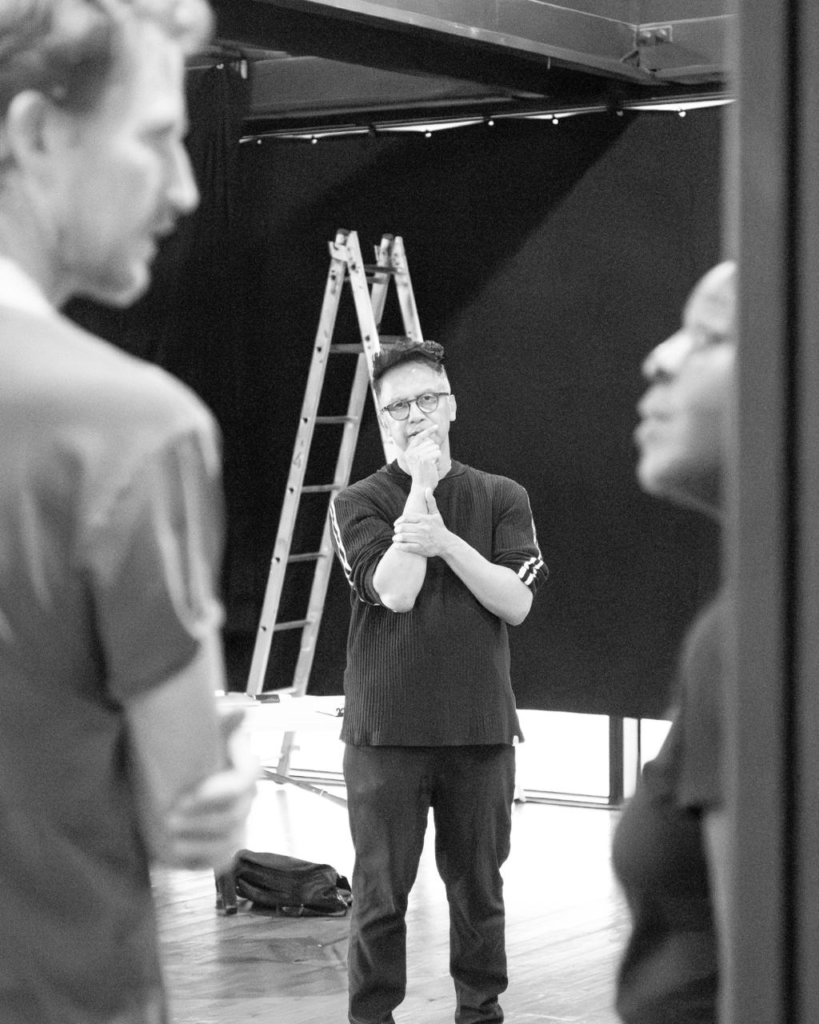
❇ Featured image – Jay Pather, who is directing Constellations, the play by British playwright Nick Payne, for How Now Brown Cow for its 2026 Winter Season, in Johannesburg and Cape Town.